Synopsis
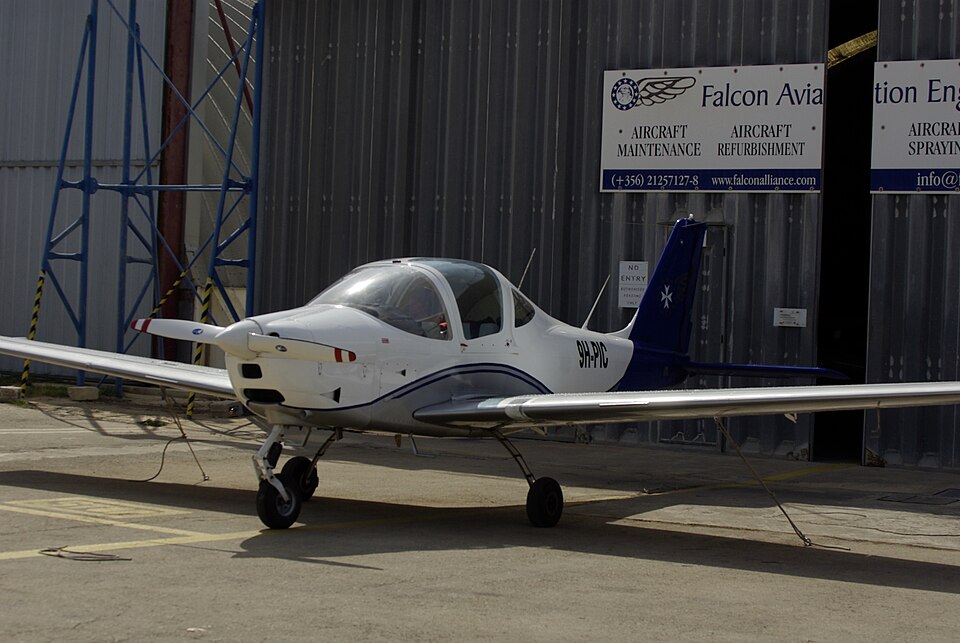
A Tecnam P2002 JF Sierra, registration 9H-PIC, operated by European Pilot Academy, was landing on runway 23 at Malta International Airport on the morning of 1 February 2020 under clear visual conditions. During the flare, the aircraft stalled, resulting in a hard landing on the nosewheel. The propeller and right wing struck the ground, causing the engine to seize and damaging the propeller and wing tip. The aircraft veered left, and heavy braking was applied. The aircraft came to rest on the grass adjacent to the runway. One occupant sustained slight injuries.
Aircraft and Operator Information
The aircraft was a 2004 Tecnam P2002 JF Sierra, a single-engine airplane with tricycle landing gear and two seats. It was registered as 9H-PIC and owned by European Pilot Academy. A portable personal locator beacon was on board; no fixed ELT was installed.
Meteorological and Airport Conditions
At the time of the accident, conditions at the site were visual clear, with daylight. Wind was from 280 degrees at 4 knots. The runway used was RWY 23, which is asphalt, dry, 2377 m long and 45 m wide.
Damage and Injuries
The aircraft sustained significant damage: the right wing-tip was damaged with a buckled leading edge, the propeller was damaged, the nosewheel collapsed, and the engine and gearbox were damaged. One occupant reported slight injuries.
Investigation and Findings
The Malta Bureau of Air Accidents investigated the accident. Three hypotheses were examined: wake turbulence from a larger aircraft, a nosewheel dive due to hard braking, and improper landing technique leading to a stall. The first was considered unlikely given the wind direction relative to the runway. The second was discarded as the propeller strike could not have resulted solely from hard braking because the aircraft would have needed to be airborne and suffer a sudden nosedive. The investigation determined that the propeller ground clearance is 320 mm, and with deflated tire and compressed shock absorber it is 102 mm, but no tire deflation occurred. The third hypothesis was assessed: a stall during the flare, where the aircraft had insufficient altitude to recover. The investigation concluded that the probable cause of the accident was a slow-speed stall.
Probable Cause
The Bureau of Air Accidents (Malta) determined the probable cause of this accident as a slow-speed stall.