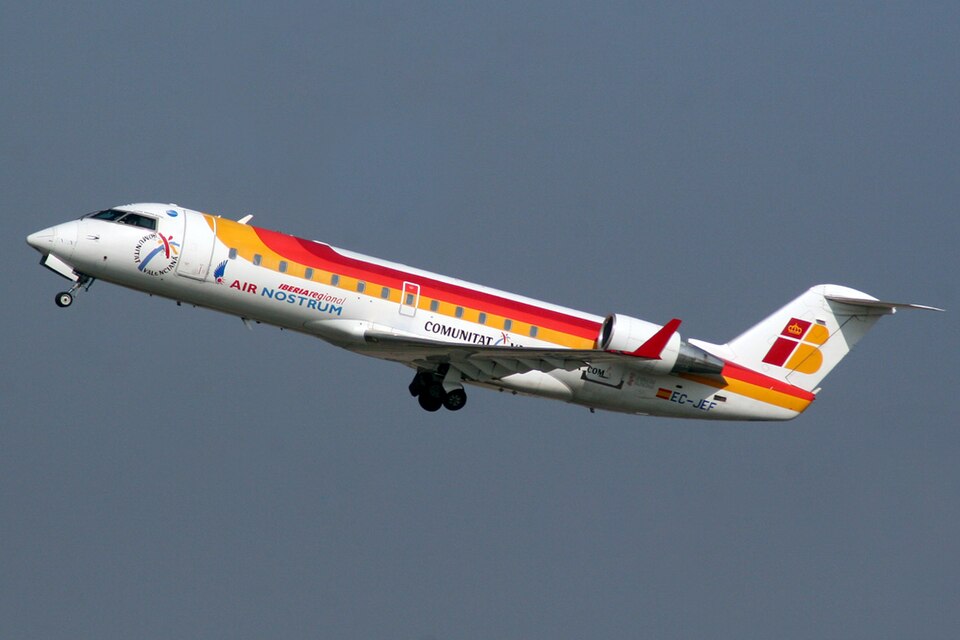
On August 1, 2008, a Bombardier CRJ 705, C-FNJZ operated by Air Canada Jazz was involved in an aviation accident near Winnipeg, Manitoba, 180 nm SE, CA. This summary draws on records from the Transportation Safety Board of Canada (TSB); 8 related events involving the same aircraft type or operator are linked below.
On 31 July 2008, an Air Canada Jazz CRJ 705 experienced an uncommanded descent of 4,600 feet after a gradual airspeed decay at FL 380. The crew recovered the aircraft, and it landed safely in Winnipeg.
Incident Overview and Flight Details On 31 July 2008, Air Canada Jazz flight JZA 8491, a Bombardier CL-600-2D15 (CRJ 705) with registration C-FNJZ and serial number 15046, departed Toronto, Ontario, at 2315 EDT for Winnipeg, Manitoba. The aircraft carried 75 passengers and 4 crew members. After passing Thunder Bay, Ontario, the flight climbed to flight level 380 (FL 380). Following the level-off, the captain reduced engine power. Approximately 17 minutes later, the crew heard a rumbling sound, and the aircraft began an uncommanded descent. The crew re-established control, and the aircraft levelled off after losing about 4,600 feet. During the recovery, the engines experienced an uncommanded power reduction but recovered without crew intervention. One passenger sustained minor injuries. The flight landed in Winnipeg at 0052 CDT on 1 August 2008 without further incident. ## Meteorological and Operational Context Forecast conditions for FL 380 included winds from 280 degrees true at 75 knots and a temperature of -51°C. The aircraft encountered smooth atmospheric conditions and predominantly clear skies at both FL 360 and FL 380. A significant meteorological information (SIGMET) report issued at 2346 CDT on 31 July 2008 indicated a line of thunderstorms near Dryden, Ontario, topped at FL 330, approximately 30 miles north of the intended route. Air traffic control provided a small route deviation to avoid these storms, which the crew observed on the cockpit weather radar and visually. ## Crew Actions and Speed Decay The captain, acting as pilot flying, used 86 per cent engine fan speed (N1) to maintain Mach 0.77 at FL 360 until Thunder Bay. After climbing to FL 380 at climb thrust, the autopilot was used for the level-off. The aircraft lacked an auto-thrust feature, requiring the pilot to manually set thrust for the desired cruise speed. After levelling, the thrust was left at climb thrust to accelerate to Mach 0.77. The programmed speed was exceeded, and the pilot reduced thrust to approximately 86 per cent N1 to allow a slow deceleration. The intention was to monitor the speed and adjust power when Mach 0.77 was attained. The aircraft flight planning and cruise control manual indicated that the thrust required to maintain Mach 0.77 under the actual conditions at FL 380 was approximately 87.3 per cent N1. The aircraft manufacturer assessed the selected power setting as below that required to maintain minimum drag speed. About two minutes after the power was set, an airspeed of Mach 0.77 was reached and stabilized, as confirmed by the crew and the airspeed trend line indicator. However, the power setting was not readjusted. For the next 17 minutes, the crew engaged in various activities, including reprogramming the flight management system (FMS) for the weather deviation and the Winnipeg approach, and receiving cabin crew visits. The cockpit voice recorder (CVR) was overwritten after landing, preventing a rigorous establishment of the sequence and extent of these activities. ## Data Recorder Findings and Recovery According to the digital flight data recorder (DFDR), approximately two minutes after levelling off, a stable airspeed of Mach 0.77 (243 knots indicated airspeed) was maintained for several seconds before beginning to decrease. Over about 17 minutes, the airspeed decreased to 180 KIAS as the angle of attack gradually increased while the autopilot attempted to maintain altitude. Engine N1 and fuel flows decreased by about one per cent and 200 pounds per hour, respectively. The DFDR showed that the power levers were not adjusted during this timeframe. The aircraft did not have an early speed decay audio or visual warning other than low-speed visual cues on the airspeed indicator. The gradual decrease in airspeed and engine indications was not observed by the crew. At approximately 0010, a rumbling sound was heard, and a vibration was felt throughout the aircraft. The crew initially believed an engine anomaly was occurring but found no indication of engine abnormality on the display. The autopilot disengaged, and the stick shaker activated. The captain took control and advanced the power levers within two seconds. The stall light illuminated, and the warbler tone associated with the stall protection system (SPS) sounded. The stick pusher activated and re-activated four times over about 32 seconds as the captain attempted to recover with minimum altitude loss. Control was re-established, and the aircraft levelled off after an altitude loss of approximately 4,600 feet. ## Engine Response and System Performance Analysis of the DFDR and full authority digital engine control (FADEC) memory indicated that when the power levers were advanced in response to the stick shaker and pusher activation, the General Electric CF-34-8C5 engines responded but then spooled down to 49 per cent N1 before recovering without crew input. The crew did not observe this rundown during the event. The SPS performed as designed, automatically activating the engine igniters as soon as the angle of attack exceeded the auto-ignition firing angle, which occurred just prior to stick shaker activation. DFDR data showed both engine fuel flows dropped significantly eight seconds after the stick pusher activated in response to the high angle of attack and resultant lack of airflow. The right engine FADEC registered an indication that FADEC parameters for engine flameout had been reached 19 seconds after stick shaker activation, while the left engine FADEC did not. The SPS had already energized the igniters of both engines in the stall condition to prevent flameout. Thirty-four seconds after the uncommanded power reduction, both engines responded to the power lever positions set by the pilot flying. ## Crew Qualifications and Fatigue Factors Both crew members were licensed and qualified in accordance with existing regulations. The captain had about 8,000 hours of total flying time, with approximately 2,000 hours on the CRJ series. The first officer had approximately 13,000 hours of total flying time, with about 1,600 hours on the CRJ series. During the 15-day period prior to the incident flight, the captain worked a series of irregular shifts, with start times ranging from 1715 to 2145 and finishing times from 0700 to 2315. The captain experienced some difficulty maintaining a regular sleep pattern. On the day of the occurrence, 30 July 2008, the captain woke at 1215 after sleeping for about nine hours and reported for duty at 1730. At the time of the occurrence, he had been on duty for about eight hours, and his work schedule conformed to flight duty time limitations established in subsection 700.16(1) of the Canadian Aviation Regulations. The first officer worked during the day from 24 to 26 July and slept from about 2300 to 0800. He did not work from 27 to 30 July and slept during the night. He awoke at approximately 0800 on 31 July and remained awake throughout that day, reporting for duty at 1730. At the time of the occurrence, he had been on duty for about eight hours. Irregular sleep patterns are known to result in circadian rhythm disturbances that can lead to fatigue, with the risk increased when coupled with variable sleep patterns and sleep deprivation. ## Contributing Factors and System Design Forgetting to adequately monitor for the appropriate moment to perform an action is a common phenomenon, more prevalent when a distraction occurs in the middle of a monitoring task and no overt cues, such as alarms, are in place to remind pilots to return to the task. A review of radar tapes indicated that wake turbulence from other traffic in the vicinity of JZA 8491 would not have affected the flight. For an aircraft similarly configured, the CRJ 705 SPS provides a minimum five per cent margin between stall warning and stall identification. Stall warning is provided by the stick shaker, considered clear and distinctive. Stall identification is considered to be by means of the stick pusher. Certification testing reports indicated that, in the configuration of the aircraft during the occurrence, light airframe buffet was present at low altitudes just before pusher activation, but was present earlier at higher altitudes and, in some cases, prior to stick shaker activation. The manufacturer does not consider airframe vibration or buffeting to provide either stall warning or stall identification on the CRJ 705. Although buffeting is characteristic of the stalling behaviour of the aircraft, it is not considered significant in terms of SPS design or operation. The manufacturer does not provide information regarding the vibration or buffeting characteristic in either the airplane flight manual (AFM) or the flight crew operating manual (FCOM). The Air Canada Jazz aircraft operating manual (AOM), based on information extracted from the AFM and FCOM, also does not provide information regarding the vibration or buffeting characteristic. The AOM, Volume 2, indicates that, in the event of a stall warning at high altitude, it may be necessary to reduce pitch angle slightly to achieve a suitable acceleration. It also notes that if a full stall occurs, the nose must be lowered and some altitude lost for recovery. The AOM, Volume 1, indicates that the SPS will activate the stick pusher before the angle of attack reaches the threshold.