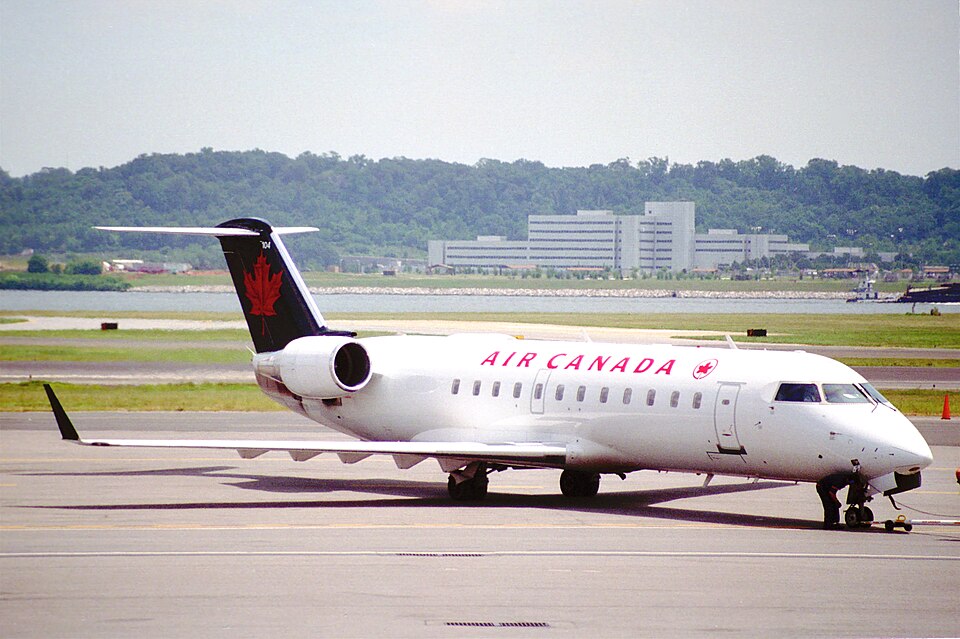
Accident
Air Canada Jazz Flight 8911, carrying 3 crew members and 37 passengers, was operating from Moncton, New Brunswick, to Toronto/Lester B. Pearson International Airport, Ontario. At 1235 eastern daylight time, the aircraft landed on Runway 06R. The wind was a 90-degree crosswind from the left, gusting from 13 to 23 knots.
Landing Sequence
The aircraft first contacted the runway in a left-wing-down sideslip. The left main landing gear struck the runway first, subjecting the aircraft to a sharp lateral side load before it bounced. After becoming airborne again, the flight and ground spoilers deployed, and the aircraft landed hard. Both main landing gear trunnion fittings failed, causing the landing gear to collapse. The aircraft remained upright, supported by the landing gear struts and wheels. It slid down the runway and exited via a taxiway, where passengers deplaned. No fire occurred.
Injuries
The crew sustained no injuries. Some passengers reported minor injuries resulting from the hard landing.
Probable Cause
The investigation identified several findings as to causes and contributing factors: 1. On final approach, the captain diverted his attention from monitoring the flight, leaving most of the decision making and control of the aircraft to the first officer, who was significantly less experienced on the aircraft type. As a result, the first officer was not fully supervised during the late stages of the approach. 2. The first officer did not adhere to the Air Canada Jazz standard operating procedures (SOPs) in the handling of the autopilot and thrust levers on short final, which left the aircraft highly susceptible to a bounce, and without the bounce protection normally provided by the ground lift dump (GLD) system. 3. Neither the aircraft operating manual nor the training that both pilots had received mentioned the importance of conducting a balked or rejected landing when the aircraft bounces. Given the low-energy state of the aircraft at the time of the bounce, the first officer attempted to salvage the landing. 4. When the thrust levers were reduced to idle after the bounce, the GLD system activated. The resultant sink rate after the GLD system deployed was beyond the certification standard for the landing gear and resulted in the landing gear trunnion fitting failures. 5. There was insufficient quality control at the landing gear overhaul facility, which allowed non-airworthy equipment to enter into service. The condition of the shock struts would have contributed to the bounce.