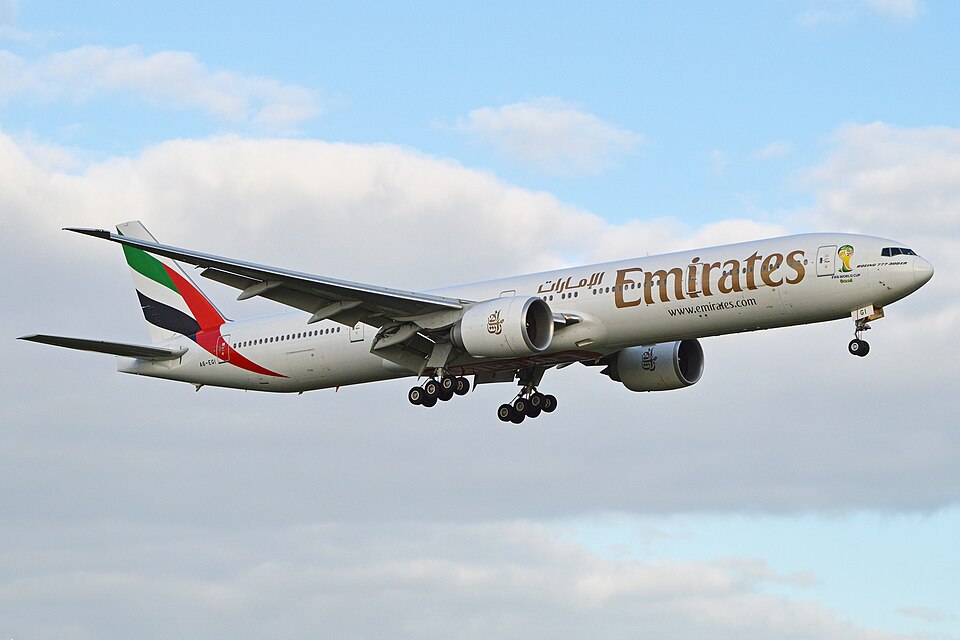
On May 31, 2023, an Airbus 380 (registration A6-EGI) operated by Emirates Airline was involved in an aviation accident near Over Colombo Oceanic Control Area, LK. Investigators recorded the probable cause as: The controller granted a climb request to UAE 359 to FL360, the same level as the preceding aircraft UAE 5CL, deviating from minimum vertical separation standards, due to unintended instruction, failure to use the flight progress stripe board, and procedural… This summary draws on records from the Aircraft Accident and Incident Investigation of the Civil Aviation Authority of Sri Lanka (AAII).
Sourcesthe Aircraft Accident and Incident Investigation of the Civil Aviation Authority of Sri Lanka (AAII)Primary reportUpdated 2026-06-29Data APIEditorial standards
Sri Lanka's CAA investigated a 2023 separation breakdown between Emirates flights UAE 359 and UAE 5CL over the Colombo Oceanic Control Area, attributing it to controller errors and procedural lapses.
Incident Overview and Investigation Scope The Civil Aviation Authority of Sri Lanka (CAASL) released a final report on April 10, 2024, detailing an incident involving a separation breakdown between two Emirates Airline flights. The event occurred on May 31, 2023, over the Colombo Oceanic Control Area. The investigation was initiated after the involved air traffic controller (ATCO) filed a mandatory occurrence report. The CAASL notified the General Civil Aviation Authority of the United Arab Emirates, the state of registry and operator, as part of the process. ## Flight Details and Sequence of Events The incident involved Emirates flight EK413, operating under the callsign UAE 5CL, and Emirates flight UAE 359. UAE 5CL was an Airbus A380 with registration A6-EVG, en route from Sydney, Australia, to Dubai International Airport. UAE 359 was a Boeing 77W with registration A6-EGI, en route from Jakarta, Indonesia, to Dubai International Airport. Both aircraft were flying on Air Route L896 through the Colombo Flight Information Region (FIR). UAE 5CL entered the FIR at 2000 UTC at Flight Level 360 (FL360) via the NISOK reporting point. UAE 359 entered at 2003 UTC at FL340 via the same point. At 2021 UTC, UAE 359 requested a climb to FL360 via Controller Pilot Datalink Communication (CPDLC). The ATCO granted the request, causing the aircraft to climb to the same flight level as the preceding aircraft, UAE 5CL. This action resulted in a breach of minimum standard vertical separation for Instrument Flight Rules (IFR) traffic in controlled airspace. ## Contributing Factors and Analysis The report identified several factors contributing to the incident. The controller provided an unintended instruction to UAE 359 while momentarily unaware of the action. Additionally, an un-cleared CPDLC message queue and the failure to update or use the flight progress stripe board for decision-making were noted. The controller had also worked more than 200 hours per month, which the report stated was a non-compliance with prescriptive limitations under SLCAIS 096. Further analysis highlighted a lack of supervision and issues with the reporting of the incident. The report also examined a broader population of worked flight progress stripes beyond the incident's duration. It noted that controller changeovers were taking place amidst peak traffic scenarios or during the immediate preceding time period. Finally, the report found that the published means of communication for the transfer of control and coordination within the center were not followed.
Probable cause
The controller granted a climb request to UAE 359 to FL360, the same level as the preceding aircraft UAE 5CL, deviating from minimum vertical separation standards, due to unintended instruction, failure to use the flight progress stripe board, and procedural lapses.
An X-AIR HAWK ultralight crashed in Chonburi, Thailand, killing the pilot and injuring a passenger. The accident was caused by deteriorated wing fabric and…
A Challenger II Special ultralight aircraft (U-B23) landed off-runway at Pai Airport, Mae Hong Son, on September 17, 2024, due to a gust of wind. No injuries…
The Polish aviation safety authority is investigating a serious incident involving an AT-3R100 aircraft that occurred on September 2, 2024. The investigation…
A SZD-48-3 glider suffered damage when its left wing struck a ground obstacle during a low final approach at EPWK on June 20, 2025. The pilot was uninjured.
A 39-year-old skydiver died after a hard landing near Leszno on May 1, 2026. The PKBWL preliminary report indicates the fatal impact resulted from a late,…
A student pilot crashed an SZD-50-3 Puchacz glider into the airfield fence during a solo training flight on June 6, 2026. The pilot was uninjured, but the…