Accident Overview
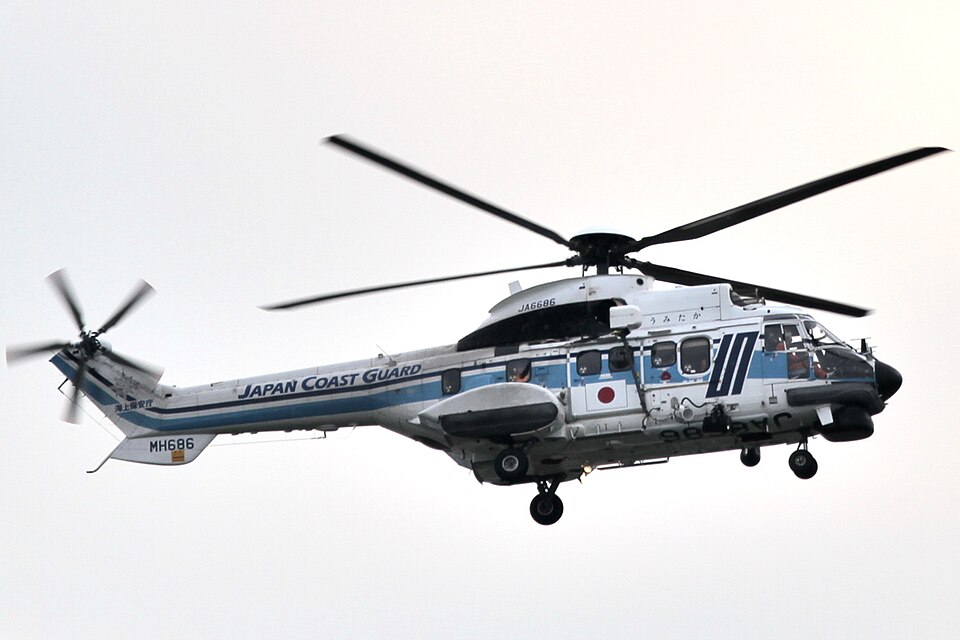
On April 12, 2024, an Aerospatiale AS332L1 helicopter, registration JA6686, operated by Shin Nihon Helicopter Co., Ltd., was conducting cargo transport operations at a transmission tower construction site in Aoi-Ward, Shizuoka City, Shizuoka Prefecture, Japan. At approximately 10:01 Japan Standard Time, the helicopter approached a loading/unloading site above an RMC hopper tank at an altitude of about 50 ft (15 m) above a stage. The rotor downwash caused a white steel formwork panel, weighing 139.77 kg and measuring 6.50 m long, to lift off from a stack of four panels. The panel struck the leg of a ground worker who had taken cover next to the panels, resulting in a serious injury (contusion and laceration of the left lower leg requiring hospitalization for more than 48 hours). No other personnel were injured, and the aircraft sustained no damage.
Flight and Operational Details
The helicopter, with a pilot and an onboard mechanic, had completed 13 transport runs of ready-mixed concrete earlier that morning. After refueling, it approached the site from the west-southwest, following the same approach path used previously: aligning with the hopper tank and reducing ground speed to below 15 kt from about 20 m ahead. The pilot and mechanic were not immediately aware of the injury and continued operations until 12:58.
According to statements from the injured worker (Worker A) and a nearby worker (Worker B), the downwash felt stronger during this approach. The four stacked white panels began vibrating, and the topmost panel lifted off, flipping over its wider southern edge and striking Worker A's knees. Worker B later placed weights on the panels and secured the remaining panels with iron wires.
Meteorological Conditions
The Shizuoka Local Meteorological Observatory, approximately 5.4 km south-southwest of the accident site, reported at 10:00: wind east-northeast at 3.4 m/s, visibility 20 km, cloudy, temperature 17.4°C, dew point 8.0°C, atmospheric pressure 1020.8 hPa. The pilot reported light wind from the west-northwest and visibility of 10 km or more.
Additional Information
The formwork panels were steel column segments used for transmission tower foundations. The white panels that lifted off were 6.50 m long, tapered from 1.08 m wide at the bottom to 0.52 m at the top, and weighed 139.77 kg each. The workers had received group safety training on downwash dangers but did not anticipate a heavy object like a formwork panel could lift off.
The helicopter was equipped with an integrated recorder, but GPS data was not properly recorded due to low-altitude flight. The helicopter's weight and center of gravity at the time were within allowable limits.