Overview
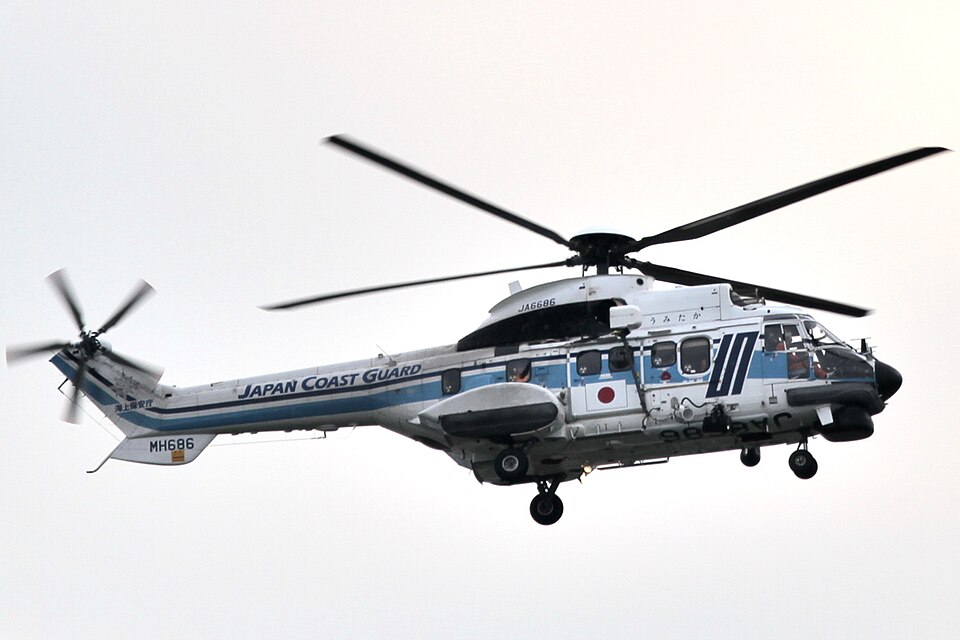
On July 2, 2025, at approximately 12:21 Japan Standard Time, an Aerospatiale AS332L1 helicopter (registration JA6686) operated by Shin Nihon Helicopter Co., Ltd. experienced an unintentional release of cargo lashing material during an underslung load operation. The helicopter was flying at about 150 meters above ground over Hamamatsu City, Shizuoka Prefecture. The three occupants—a captain and two mechanics—were uninjured.
Flight Details
The flight originated from a loading site near a steel tower in Haruno Town, Tenryu Ward, Hamamatsu City, en route to the Haruno Operation Site. The helicopter carried an underslung external cargo totaling approximately 800 kg, consisting of Cargo A and Cargo B. Cargo A comprised about 50 steel pipes of various lengths (approximately 2.5 to 4.2 meters) bundled together. To prevent shifting, both ends of Cargo A were covered with ton packs (large flexible bags), nets, and binding wire as lashing material.
At about 12:21, while flying at approximately 500 feet above ground and an airspeed of about 40 knots, the captain observed via a cargo mirror that one of the cargo lashing materials attached to Cargo A was flying off and falling. The captain informed the two mechanics. The mechanic (instructor) then opened the left cabin door and confirmed that one end of the lashing material was missing; the remaining end was flapping and at risk of falling. The captain slowed the helicopter to near-hover and continued to the operation site, landing at approximately 12:23. After landing, the captain cancelled further transport operations. Inspection revealed that approximately 4 kg of lashing material—a ton pack, a net, and binding wire—had fallen from Cargo A into a mountain forest.
Investigation Findings
The Japan Transport Safety Board (JTSB) analyzed the incident based on crew statements and evidence. The JTSB concluded that the lashing material fell unintentionally because the bag-shaped ton pack was subjected to wind pressure during forward flight. Wind pressure increases with the square of airspeed; the helicopter's airspeed of about 40 knots generated sufficient force on the ton pack.
Regarding packing procedures, the company's Safety Text prescribed three steps: (a) cover both ends of long cargo with ton packs, (b) tie the ton packs together to prevent wind-induced separation, and (c) wind the cargo sling around the ton packs using the Adamaki (one-round-turn slinging) method. However, according to the site supervisor of the construction company (Company A) responsible for packing, procedures (b) and (c) were not performed. Procedure (b) was postponed due to insufficient rope and was not completed. Procedure (c) was omitted; instead, the sling wire was wound directly around Cargo A, with nets and binding wire used to secure the ton packs. The JTSB determined that these omissions likely prevented the ton pack from being secured against wind pressure.
Additionally, the JTSB noted that safety education records indicated that two of the eight workers from Company A involved in cargo packing had not been confirmed as having received the required safety education for helicopter transport operations, as outlined in the company's Safety Text.
Conclusions
The JTSB concluded that the cargo lashing material fell unintentionally because the bag-shaped ton pack was subjected to wind pressure, and that the prescribed packing procedures (tying the ton packs together and winding the sling around them) had not been performed, which most likely prevented the ton pack from being secured against wind pressure.