History of the Flight
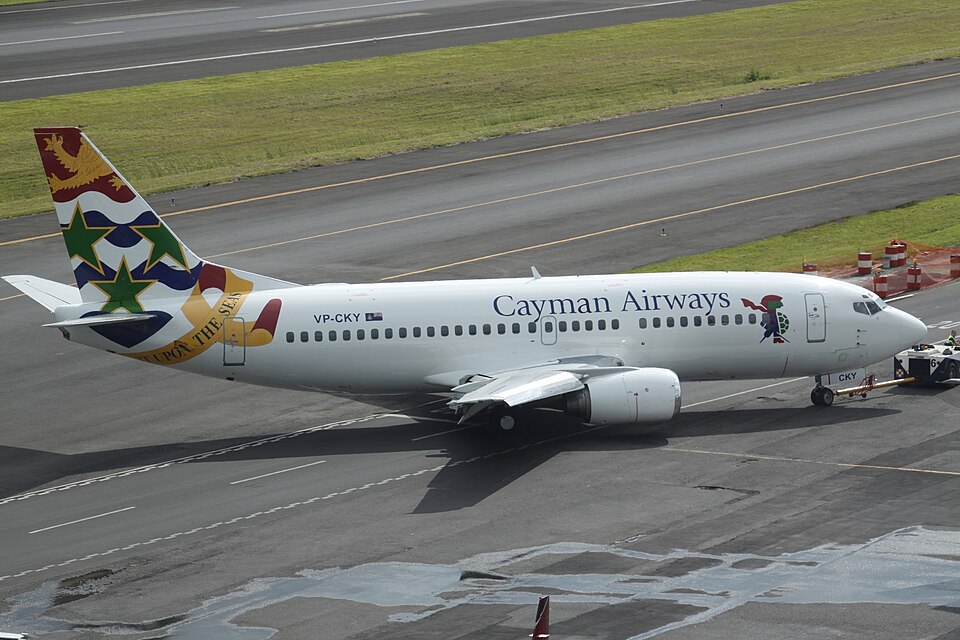
VP-CKY, a Boeing 737-300, was operating a scheduled passenger flight from Miami, Florida, to Grand Cayman, Cayman Islands, with six crew and 64 passengers on board. The commander acted as pilot flying (PF) and the co-pilot as pilot monitoring (PM). The crew received the ATIS for Owen Roberts International Airport at 2200 hrs local time, reporting calm surface wind, visibility 10 km, few clouds at 1,800 ft, broken clouds at 3,500 ft, temperature 24°C, and QNH 1011 hPa. They planned a visual approach to Runway 08.
Upon contacting Cayman Approach, the ATCO reported light to moderate rain showers at the airport with visibility 2 nm and showers approaching from the east-southeast. The aircraft was cleared to route via ATUVI to the Final Approach Fix (FAF) and descend to 1,500 ft. At 2238 hrs, when the crew reported passing ATUVI descending through FL130, the ATCO reported visibility on final approach less than 0.5 nm. The commander noted a "wall of build-up" on the weather radar.
The commander stated his intention to route right (west) of a line towards the VOR and position on base leg, with a backup plan to pass over the VOR and position east of the airport. At approximately 2248 hrs, the aircraft was at 1,500 ft on a 5.5 nm base leg for Runway 08. The crew was cleared for a visual approach and reported the field in sight shortly after. The controller cleared them to land, advising surface wind from 350° at less than 5 kt. Touchdown occurred at 2249:25 hrs.
At 2250 hrs, the ATCO asked if the aircraft was still on the runway. The commander queried the wind and was told the anemometer indicated calm while the digital system indicated 260° at 5 kt gusting 15 kt.
Recorded Data
Flight data from the Quick Access Recorder (QAR) showed the approach at 1,000 ft amsl with landing gear down, flaps passing Flap 15 towards Flap 30, and CAS 188 kt. Engines were at idle from 1,100 ft to 550 ft, with an average descent rate of 1,200 ft/min. The aircraft turned left to intercept the runway centreline, briefly crossing it at 800 ft, and established on final at approximately 400 ft.
During the landing, at 50 ft agl, the aircraft was at 160 kt CAS with a groundspeed of 175 kt. At about 3 ft agl, approximately six seconds after thrust levers were set to idle, the speed brakes deployed. The aircraft touched down about one second later at 157 kt CAS (166 kt groundspeed). Maximum braking was applied immediately, followed by reverse thrust four seconds later. Both were maintained until the aircraft slowed to approximately 22 kt groundspeed, at which point reverse thrust was cancelled. The distance from touchdown to that point was 1,027 m.
The aircraft touched down 634 m beyond the touchdown zone markers. When reverse thrust was cancelled, 139 m of landing distance available (LDA) remained. The aircraft began to turn at 6 kt groundspeed, 95 m from the end of the LDA.
Engineering Action
A peak vertical acceleration of 2.249g at touchdown triggered a Hard Landing inspection per the Aircraft Maintenance Manual. The Phase 1 inspection on 5 February 2014 revealed no damage, so the Phase 2 inspection was not performed.
Commander's Account
The commander reported seeing the west coast of the island, including the airport, beneath a cloud with a flat ceiling estimated at 1,200-1,400 ft amsl. The aircraft joined base leg approximately 5 nm west of the runway at 1,500 ft and 220 kt. Raining at the FAF prompted a left turn inside the FAF to avoid weather, intercepting final at about 4 nm. The commander briefed the co-pilot that the landing would use Flap 30 instead of Flap 40.
On final approach, the crew could see the runway through light rain. Just after descending through 50 ft radio altitude, a "wall of heavy rain" hit the windscreen. The commander considered it too critical to go around, maintained runway alignment using edge lights, and deployed speed brakes at an estimated 6 ft radio altitude. After touchdown, maximum reverse thrust and manual braking were applied. The aircraft stopped just before the turnaround bay. The commander noted difficulty selecting reverse thrust and that the brakes felt ineffective. He acknowledged the aircraft was faster than normal but expected speed to decrease below 200 ft.
Air Traffic Control Officer's Account
The ATCO, in the visual control room, saw the aircraft's lights on base leg and noted it appeared closer than normal. During landing, he observed the aircraft float before touching down just before Taxiway C. Based on the float distance and wet runway, he expected a go-around. After touchdown, he lost sight due to rain and spray from thrust reversers. He saw the red centreline lights at the end of the runway disappear as the aircraft passed, prompting his query.
Calculation of Ground Stopping Distance
The recorded ground distance of 1,027 m was compared with QRH calculations for a landing weight of 113,300 lb, VREF+25 kt, 10 kt tailwind, and maximum manual braking. For a dry runway, the calculated ground distance to a standstill was 785 m; for a wet runway with good braking, it was 1,205 m, including an air distance of 305 m.
Safety Recommendations
One Safety Recommendation relates to the reporting of serious incidents, and another to the reporting of surface winds at Owen Roberts International Airport.