History of the Flight
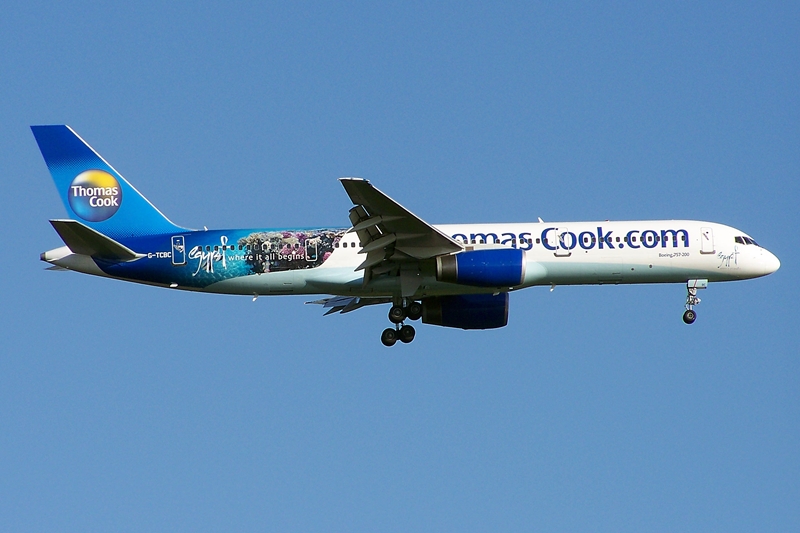
On 17 August 2013, a Boeing 757-236, registration G-TCBC, operated a commercial passenger flight from Newcastle International Airport (NCL) to Fuerteventura and return. The commander was the pilot flying for the return sector. The flight was uneventful until the ILS approach to Runway 23 at NCL. The aircraft overshot the centreline while capturing the localiser due to a radar vector with high groundspeed. The localiser and glideslope were subsequently captured, but the commander expressed concern about the aircraft's behaviour to the co-pilot several times. The aircraft was configured with landing gear down and flap 20, with intention to land with flap 25. The weather included a windshear report from an earlier aircraft and a wet runway.
Go-Around and Flap Overspeed
At 1600 hrs, after a preceding aircraft reported a possible birdstrike, ATC instructed G-TCBC to go around. The aircraft was at 1,500 ft amsl, 3.8 nm from the threshold, at about 140 kt. The commander selected maximum thrust and disconnected the autothrottle, but the autopilot remained engaged in localiser and glideslope modes, causing the aircraft to accelerate while descending. The commander disengaged the autopilot and pitched nose-up. The speed reached 187 kt and increased. The FLAP 20 limiting speed of 195 kt was exceeded by 18 kt before flaps began to retract. The trailing edge flaps retracted successfully, but the leading edge slats remained partly extended, triggering the 'LE SLAT DISAGREE' caution. The aircraft's altitude deviated almost 500 ft below the cleared altitude during vectoring.
QRH Actions and Diversion
The crew attempted to action the QRH checklist for the slat disagree message. Steps 1 to 4 were followed correctly, but step 5 was performed incorrectly: the alternate flaps selector was set to flap 1 instead of up. When the leading edge alternate flaps switch was set to ALTN, the slats ran to flap 1 and the caution cleared, but a 'TE FLAP DISAGREE' caution then appeared. The crew started the trailing edge flap disagree checklist but were interrupted by ATC. The commander then instructed selecting flap 5, deviating from the QRH. The co-pilot moved both the flap lever and alternate flaps selector to flap 5. The commander stated they needed a longer runway and decided to divert to Manchester Airport (MAN). The co-pilot informed ATC of the flap problem and diversion.
Fuel Situation and Arrival
During the diversion, the crew noted fuel remaining. At 1612 hrs, a forward fuel pump low pressure light illuminated, but no action was taken. A low fuel caution later appeared, and the co-pilot requested a priority landing. The crew declared a MAYDAY and squawked 7700. Despite not completing the QRH checklists, the crew eventually regained normal flap control by various selections. When the aircraft arrived at Manchester, total fuel was 700 kg below the final reserve figure, with an imbalance of 500 kg between tanks. No injuries or damage occurred.