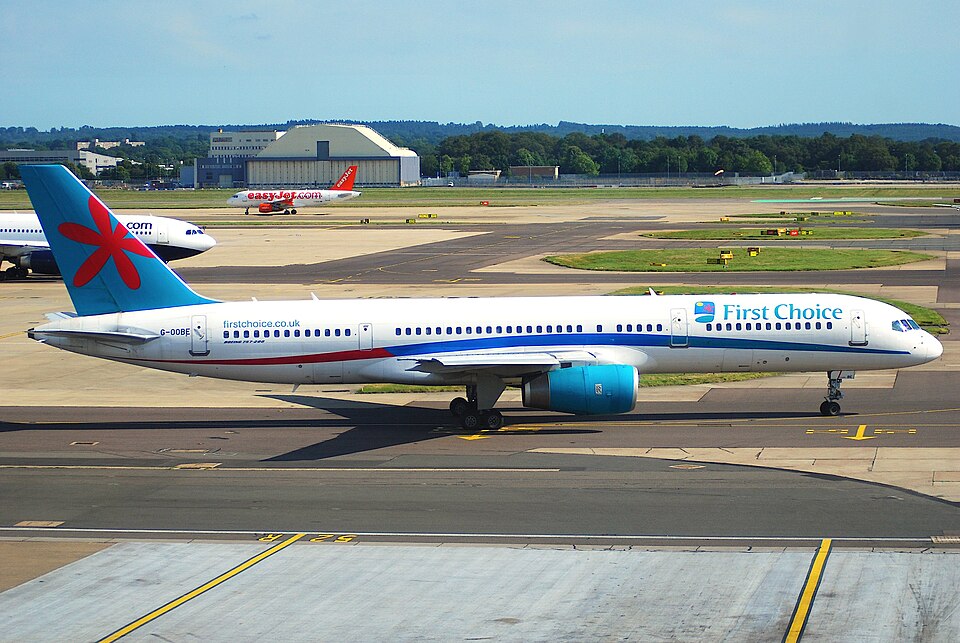
History of the Flight
The flight was a chartered holiday flight from Las Palmas Airport, Gran Canaria to Bristol Airport. The co-pilot was on his second of four planned sectors of supervised line flying following a five and a half month period of sick leave, and the commander was qualified as a Type Rating Examiner. Before this flight, the co-pilot had completed a three hour refresher flight in a simulator and had operated as pilot flying (PF) for the outbound sector, which was uneventful.
The flight from Gran Canaria proceeded normally. The aircraft was positioned for an approach to Runway 27 at Bristol Airport in strong, gusty winds. The crew set VAPP to 142 kt, adding 10 kt to VREF for the steady wind component without gust factor. The co-pilot was PF. The approach was stable until approximately 300 ft agl. Airspeed increased in gusty conditions, and the aircraft drifted high and left of the correct approach path. The commander called for a go-around.
Initial go-around actions were carried out by the PF. The commander selected flaps to the two-engined go-around position and raised the landing gear. The PF engaged the autopilot using the company mnemonic 'TAGL' but did not verbalise this action; the commander was unaware that the autopilot had been engaged. The commander noticed a high pitch attitude developing and speed reducing, and coached the PF to lower the nose, but the engaged autopilot delayed correction. The situation evolved as the aircraft approached the missed approach altitude of 3,000 ft with power reducing as the Automatic Flight Control System (AFCS) tried to level off. The lowest airspeed the commander recalled seeing was 121 kt. ATC cleared the aircraft to climb to 5,000 ft. The aircraft was accelerated, flaps were fully retracted, and the commander took control for the downwind leg. The second approach was uneventful and the aircraft landed safely.
Recorded Data
The approach commenced at approximately 1840 hrs with autopilot and autothrottle engaged; VREF was 142 kt. Stabilised approach criteria were met at 1,400 ft aal for landing with flap 25. The autopilot was disengaged at 600 ft aal. The go-around was commenced at 119 ft aal, with the aircraft left of centreline at 172 kt. The lowest recorded height during the go-around was 94 ft on the radio altimeter.
After pressing the GA switches, autothrottle and AFDS GA mode activated, annunciated on the FMA. Aircraft pitch increased from 2° to 12° nose-up, recording a vertical acceleration of +1.72g. Pitch continued to follow FD commands to 21° nose-up. After landing gear was selected up, pitch reduced slightly then increased to 22°, above the 19° commanded by the FD. The alt cap annunciation illuminated on the FMA at 1,460 ft, indicating the autopilot was starting to level at the missed approach altitude of 3,000 ft. Airspeed decreased rapidly through 160 kt with thrust reducing. Immediately after alt cap activation, the centre autopilot was engaged. Pitch attitude continued to increase through 27° with airspeed reducing through 151 kt. The GA mode was activated again. Selected airspeed remained 142 kt. Nose-up pitch exceeded FD command, reaching a maximum of 30.76° with a climb rate over 6,000 ft/min. Airspeed reduced below VAPP. Pitch remained high for 4 seconds then reduced steadily; airspeed reached 119 kt.
Pitch decreased rapidly from 26° as the aircraft reached the missed approach altitude of 3,000 ft and altitude hold activated. Airspeed reduced to a minimum of 110 kt before increasing. Stick-shaker was not activated. Nose-up pitch reduced to 8° and the autopilot was disconnected. Airspeed began recovering through 120 kt, but thrust was reduced, slowing acceleration until the aircraft descended back to 3,000 ft after peaking at 3,100 ft.
Flap 5 was selected at 150 kt, but acceleration was not commanded until 10 seconds later when selected speed was increased to 196 kt. The aircraft then accelerated normally. A right-hand circuit was flown to a further ILS approach followed by a normal landing.
Analysis (from the operator's investigation)
The operator's safety investigation considered that during the high workload period of the go-around, there was a degradation in the situational awareness of the crew. The crew were 'startled' and their performance was affected, as confirmed by their subsequent selection of flap 5 while the aircraft was not accelerating. This was eventually corrected and the aircraft landed safely.
The commander commented that the incident highlighted the importance of FMA monitoring by the PM. With hindsight, he also considered that he should have intervened earlier and taken control for the go-around.
Safety Action
As a result of the operator's safety investigation, both pilots received additional training before returning to flying duties. The operator's annual refresher training was modified to include a module to refresh all its Boeing 757 pilots on procedures for go-arounds with both engines operating. The operator's training department will also be reviewing how it develops the intervention skills of its training pilots.