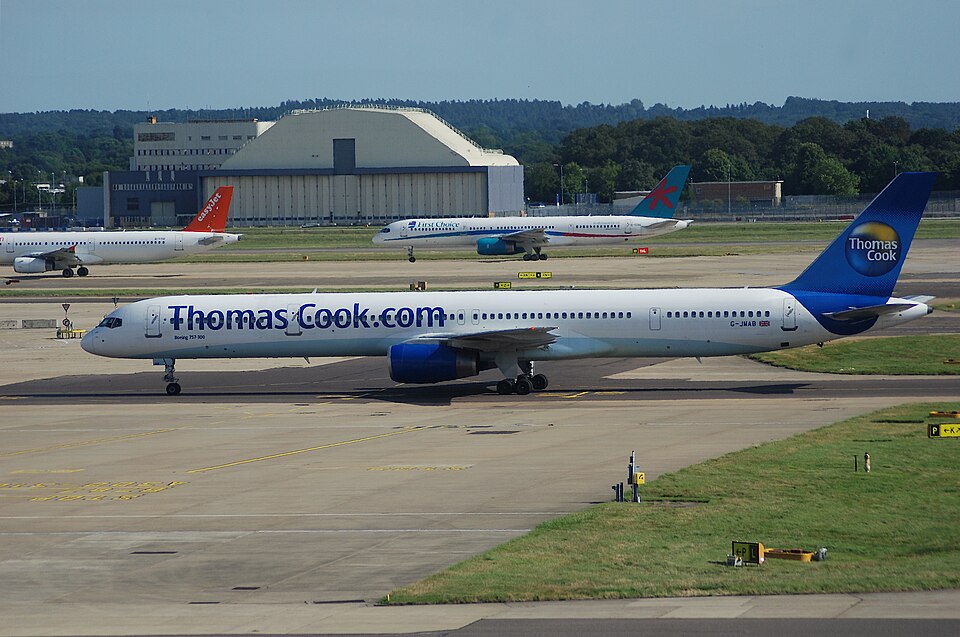
Incident Summary
On 31 October 2014, a Boeing 757-3CQ registered as G-JMAB was involved in a serious incident during takeoff from London Gatwick Airport. The aircraft, powered by two Rolls-Royce RB211-535E4-B-37 turbofan engines, was operating a scheduled passenger flight to Hurghada, Egypt, with 10 crew and 239 passengers on board. No injuries were reported, and the damage was limited to the slide carrier, pivot forging, actuator, and fuselage scuff marks.
Flight History
During the takeoff roll at approximately 70 knots, a 'wing slide' advisory message appeared on the Engine Indication and Crew Alerting System (EICAS). The crew continued the takeoff and assessed the situation after climbing. Following standard procedures and consultation with company operations, they decided to return to Gatwick. To reduce weight, the aircraft held for about 40 minutes to burn off fuel. No emergency was declared.
While on base leg descending to 3,000 feet with flaps 20, cabin crew and passengers heard bangs or felt shuddering. Two passengers reported seeing a white object detach from the right side. On final approach with flaps 30, the commander noted the control yoke offset to the left and the autopilot struggling to maintain wings-level. He disconnected the autopilot and applied significant left aileron to maintain the centerline. The aircraft landed safely and was towed to a stand, where the right over-wing slide was found missing.
System Description
The Boeing 757-300 is equipped with over-wing emergency escape systems consisting of two hatches and automatic slide deployment on each side. The slide activation system includes a gas bottle, valve, slide pack on a carrier, mechanical locking devices, and a pneumatic actuator. The system has interlocks to prevent unintended deployment. The actuator features a vent lever and a crank handle for manual override. The slide bay panel has a proximity switch that triggers an EICAS caution if opened.
Investigation Findings
Examination revealed that the right over-wing slide carrier had deployed and rotated outward, with the bay panel open and the slide missing. The flight data recorder showed the right wing slide door parameter changed from closed to open during the takeoff roll, and the autopilot required left control wheel input to maintain level flight. The investigation identified a series of technical issues with the slide panel and carrier locking devices that caused the slide carrier to deploy and the slide to unravel. A Service Bulletin addressing some of these issues had not been implemented on this aircraft at the time. Additionally, issues were found with aircraft door designations and the Quick Reference Handbook. Two Safety Recommendations were made.
Probable Cause
The probable cause, as stated by the investigation, is that a series of technical issues with the slide panel and carrier locking devices caused the slide carrier to deploy and the slide to unravel.