Incident Summary
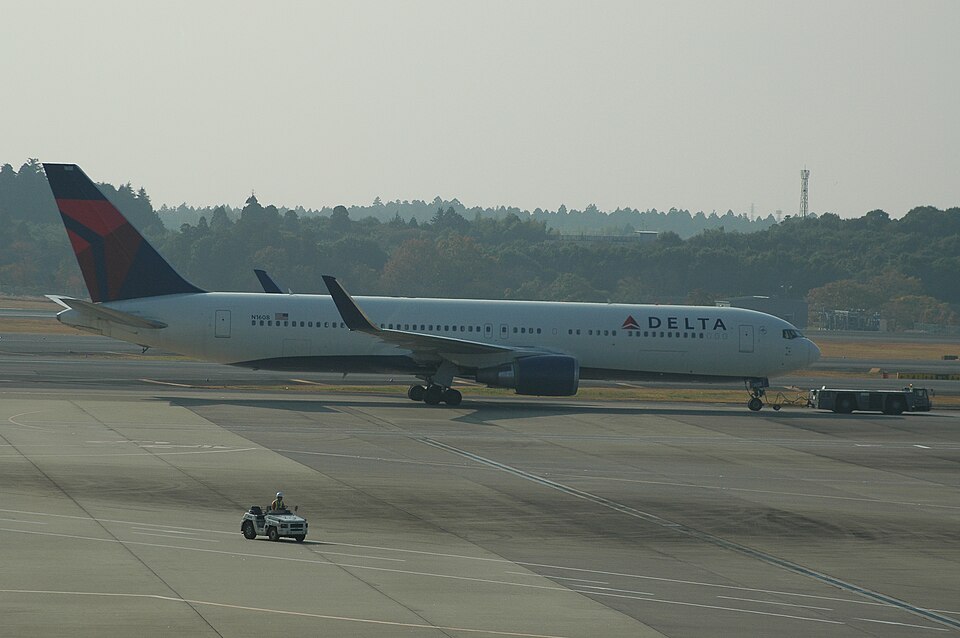
On 13 August 2017 at 1225 UTC, a Boeing 767-332ER (registration N1608) operating a commercial passenger flight from London Heathrow Airport experienced a cabin altitude increase to 15,900 ft. The flight crew donned their oxygen masks, initiated an immediate descent, and returned to Heathrow. No injuries were reported among the 11 crew and 208 passengers, and no damage to the aircraft was noted.
Flight History
The aircraft had arrived from Atlanta earlier that day with an advisory message 'r eng prv' displayed on the Engine Indication and Crew Alerting System (EICAS). Maintenance personnel found the right engine pressure regulating valve (PRV) worn and replaced it. A different crew was assigned the return flight to Atlanta. During a ground run requested by maintenance, no anomalies were detected.
During departure from Heathrow, the 'r eng prv' message reappeared. As the aircraft passed FL100, the commander and relief pilot executed the Quick Reference Handbook (QRH) checklist for the message while the co-pilot handled the aircraft. After completing the checklist, the warning persisted. The crew contacted maintenance via ACARS, who advised repeating the checklist at cruise altitude.
At the planned cruise altitude of FL320, the cabin pressure was slightly higher than normal but steady at about 7,000 to 7,500 ft. As the crew began to action the QRH, the cabin altitude warning sounded, the master warning light illuminated, and a 'cabin altitude' message appeared on EICAS. The cabin pressure rose rapidly; the commander attempted to close the outflow valve manually but noted it was nearly closed. Passenger oxygen masks automatically deployed. The crew donned their masks, declared an emergency to London ATC, and requested an immediate descent to FL250. They were later cleared to FL100. After descending below FL100, the crew removed their masks, entered a holding pattern to jettison fuel, and landed uneventfully at Heathrow. The landing weight was 341,900 lbs, 21,900 lbs above the maximum landing weight of 320,000 lbs.
The commander reported that the lenses in his oxygen mask were in poor condition, affecting his visibility, while the co-pilot's and relief pilot's masks had clear lenses. During the emergency, all but two passenger oxygen masks deployed, and one passenger fainted and was attended by a medically trained passenger. Medical personnel met the aircraft upon arrival.
Recorded Data
Digital Flight Data Recorder (DFDR) analysis showed the cabin altitude profile following the aircraft altitude, reaching 15,900 ft before descending. There was no evidence of the cabin altitude stabilizing at 7,000 to 7,500 ft as reported. The outflow valve position was not recorded. Approximately five minutes after takeoff, the right Environmental Control System (ECS) pack was switched off and the left pack changed to high-flow mode. Eleven minutes later, the right pack was switched on and the left returned to low-flow. At that time, a 'cabin alt > 10k ft' warning illuminated, followed by a 'cabin auto pressurisation warning fail'. After nine more minutes, as the aircraft descended to about 10,000 ft, the right pack was switched off again, the left pack changed to high-flow, and the 'cabin alt > 10k ft' warning cleared.
Aircraft Systems
Three systems were involved: engine bleed air, air conditioning, and cabin pressurisation. The bleed air system includes a high-pressure shut-off valve (HPSOV) and a PRV. An advisory message indicates when the PRV is open when commanded closed. The air conditioning system has two ECS packs, which automatically switch to high-flow if one pack fails. Cabin pressurisation is controlled by adjusting the outflow valve. In automatic mode, the cabin altitude control panel (CACP) can be set to auto 1 or auto 2. Manual mode allows the crew to adjust the outflow valve. If cabin altitude exceeds 10,000 ft, warning lights and EICAS messages activate; they clear below 8,500 ft. An 'auto inop' light indicates automatic control failure. Passenger oxygen masks deploy automatically when cabin altitude exceeds 14,000 ft.
Engineering Actions
Maintenance at Heathrow identified a fault in the auto pressurisation control causing low airflow. They replaced the right engine PRV controller (PRVC), both cabin pressurisation controllers, the right engine high-pressure controller, the outflow valve, and a worn right engine HPSOV. A leak check on the right PRV and PRVC sense lines was satisfactory. A ground run with cabin pressurisation using both left and right systems showed no anomalies, and the aircraft was released for flight.
The aircraft flew to Atlanta on a non-revenue flight, where the passenger oxygen system was inspected. Two sets of passenger masks (seats 5B/C and 18F/G) had not deployed; the oxygen generators were replaced and a drop test confirmed all masks deployed.
Components removed from the aircraft were examined by an overhaul organisation. The right engine PRVC failed a bench check due to a blown internal diaphragm, which would explain the 'r eng prv' message. The right engine PRV showed worn position switches, bushings, and internal link. Inspection of other components did not identify why the cabin failed to maintain pressure.