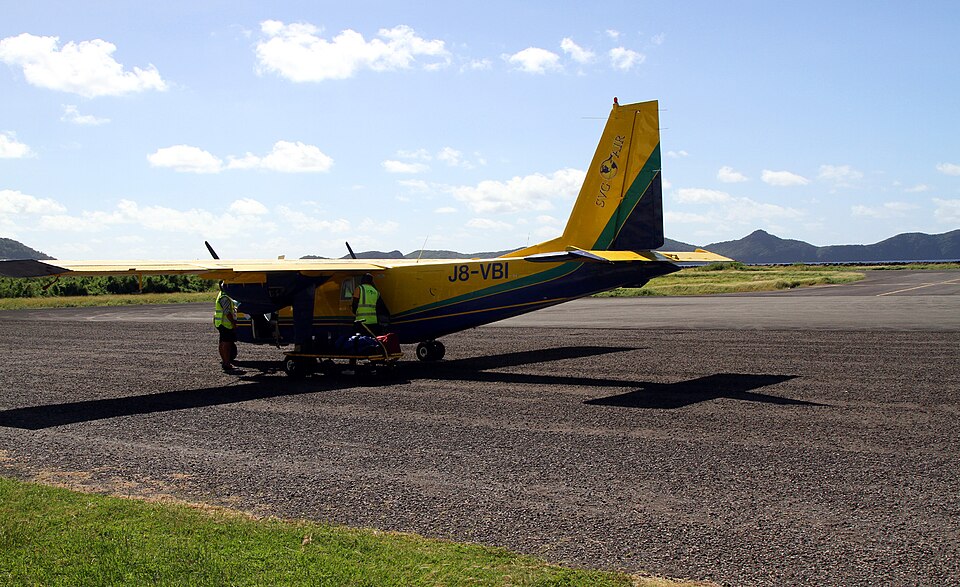
History of the Flight
The pilot, based at V.C. Bird International Airport in Antigua, reported for duty at 1100 UTC on 29 September 2021. After operating a return flight to Barbuda and another to Montserrat, the pilot went off duty at 1355 UTC. He resumed duty at 1930 UTC to repeat the same sequence. The aircraft, a Britten Norman 2B-26 Islander registration J8-VBI, departed Antigua at 2114 UTC for a 19-minute flight to John A. Osborne Airport, Montserrat, with one pilot and six passengers. Visual meteorological conditions prevailed, and no other traffic was in the area. The pilot flew a downwind leg for Runway 10 and commenced the approach at 65 kt, reducing to 60 kt at touchdown.
Accident Sequence
The pilot described the landing as smooth. After the main landing gear touched down, but before the nosewheel contacted the runway, the pilot applied brakes. He reported that the left brake felt spongy and ineffective, while the right brake felt normal. Unable to maintain directional control, the aircraft veered right within two seconds, departing the runway three seconds later. It crossed a grassed area and came to rest in a drainage ditch after striking an embankment. The left main landing gear collapsed, blocking the left cabin exit. The pilot evacuated via the flight deck door, and all six passengers exited through the right cabin door. Airport fire services arrived within a minute. There was no fire.
Ground Evidence
Skid marks on Runway 10 indicated the right main wheels began braking approximately 153 m from the threshold. The aircraft veered right and left the paved surface about 242 m from the threshold. Right wheel skid marks were more pronounced than left, confirming asymmetric braking. The nosewheel touched down as the left main gear crossed the runway centreline. After leaving the runway, grass marks showed continued right brake application relative to the left. The aircraft came to rest 160 m from the start of skid marks.
Aircraft and Brake Examination
The aircraft was not fitted with a flight data recorder or cockpit voice recorder. A passenger's video and CCTV footage helped reconstruct the ground track. The brake system examination, conducted under supervision of the East Caribbean Civil Aviation Authority, revealed a slight fluid leak from a piston in the left outboard brake calliper. The piston bore had scoring, and the O-ring seal was flattened, compromising sealing. This leak likely prevented full brake pressure on the left brakes, causing asymmetric braking. The pilot's use of incorrect braking technique compounded the directional control difficulty.
Maintenance and Personnel
The aircraft's Certificate of Airworthiness was valid, and maintenance followed an approved schedule. A 50-hour inspection was completed the day before the accident, during which the left outboard wheel and brake pads were replaced. The pilot held a valid Commercial Pilot's Licence and medical certificate, with 2,650 total flying hours (712 on type).
Investigation Findings
The investigation identified shortcomings in the operator's manuals, procedures, and regulatory oversight. One safety recommendation was made.