History of the Flight
The aircraft departed Dunkeswell Airfield on the morning of the accident with three passengers for a flight to Retford (Gamston) Airfield. After an hour on the ground, it departed with two passengers for Enstone Airfield. Both flights were uneventful. At Enstone, the pilot visually checked fuel levels, noting 390 litres (103 US gallons) on board, about half in the wingtip tanks. After about an hour, the pilot performed power checks and taxied to Runway 08 for a return flight to Dunkeswell with one passenger.
During the takeoff run, the left engine stopped and the aircraft veered left before halting. The pilot cited birds in the climbout area as a factor in the abandoned takeoff. The aircraft taxied to an area outside the Oxfordshire Sport Flying Club, where the pilot attempted to restart the left engine. During these attempts, the right engine also stopped but was restarted. After several attempts, the left engine started, emitting white and black smoke, and ran smoothly. The pilot then taxied to the threshold of Runway 08.
Accident Details
The takeoff run sounded normal, and the landing gear retracted at about 200 ft agl. A video recording captured the climbout: the aircraft made a climbing right turn; after 10 seconds, the wings levelled, the aircraft descended, and disappeared behind trees. Five seconds later, it appeared flying west over buildings at low height in a slightly nose-high attitude. The right propeller rotated slowly, left rudder was applied, and the aircraft yawed right. The left engine ran at high rpm, and the landing gear was extended. The aircraft turned gently right, flying northwest. The video cut away for 25 seconds, then showed a plume of smoke from buildings north of the runway.
The pilot reported that the right engine lost power during the climbing right turn. He recovered to level flight, selected the right fuel booster pump, and the engine recovered power. He decided to return to Enstone. When abeam the runway threshold, the right engine stopped. He feathered the right propeller, but single-engine performance was insufficient. He selected a ploughed field for a forced landing but found the left engine produced only about 57% of maximum power, causing him to crash into farm buildings.
A fire erupted after the impact. The pilot and passenger escaped through the rear cabin door. The pilot sustained minor burns; the passenger sustained burns, a fractured vertebra, chest impact injuries, and head lacerations.
Aircraft Information
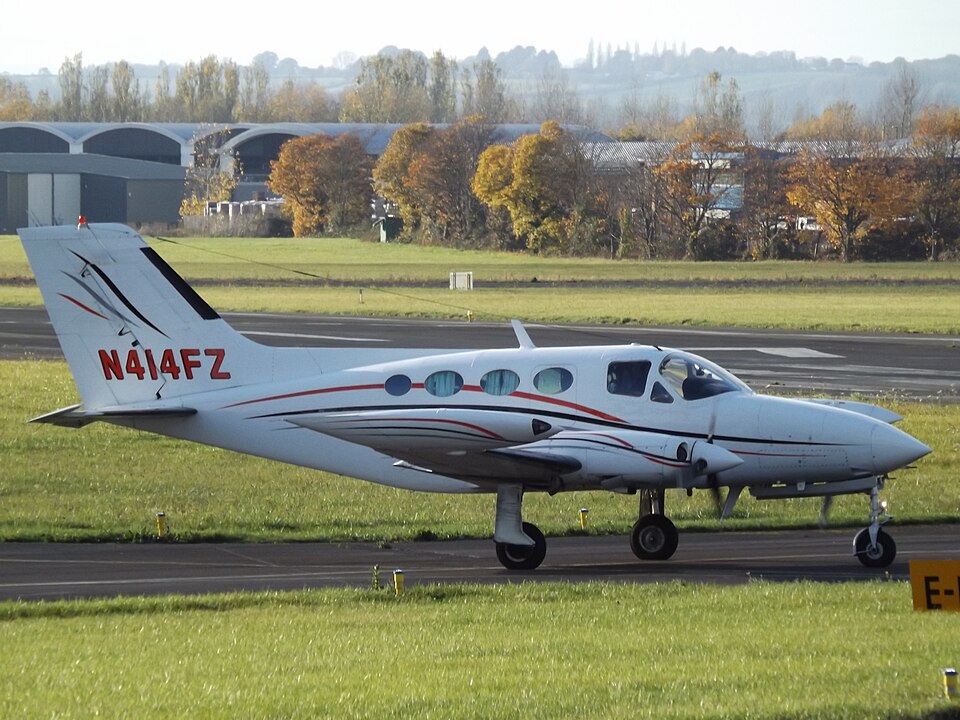
The aircraft was a 1971 Cessna 414 (serial no. 414-0175) with two Continental TSIO-520 piston engines. It was previously registered as G-AZFZ. The pilot, a 49-year-old private pilot with 1,194 hours (9 on type), held a Multi Engine Piston rating last renewed on 21 March 2018. He had accumulated 120.4 hours as PIC on MEP aircraft, including 8.5 hours in N414FZ.
The aircraft underwent a 50-hour maintenance check on 2 November 2017, including compliance with Teledyne Continental Service Bulletin 95-7 on both engines. A wiring defect causing a cylinder head temperature indication issue on the right engine was rectified. In March 2018, propellers were replaced due to wear; engine ground runs were satisfactory. The accident occurred about 5 flying hours after the aircraft was collected on 14 June 2018. The pilot reported no prior technical problems.