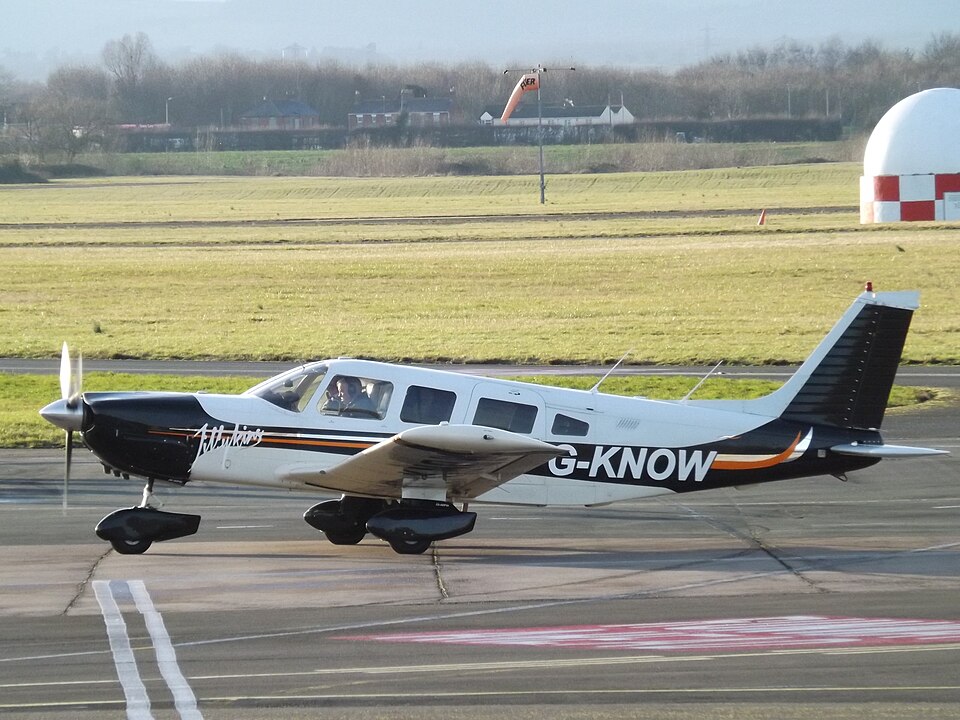
Aircraft and Flight Details
The accident involved a Piper PA-32-300, registration G-KNOW, manufactured in 1978 (serial no: 32-7840111). It was powered by one Lycoming IO-540-K1G5 piston engine. The flight was a private trip with one pilot and one passenger on board.
History of the Flight
The aircraft departed Lydd Airport at 1005 hrs for a flight to Lee-on-Solent Airport and return. The outbound leg took 61 minutes, with landing at Lee-on-Solent at 1106 hrs. The accident occurred during the return flight. G-KNOW took off from Lee-on-Solent at 1239 hrs, followed the coast eastbound before routing inland, reportedly to see a landmark.
Accident Sequence
At 1258 hrs, the aircraft was at 2,100 ft amsl heading east near Steyning. The pilot reported “a problem” and the engine lost power. The pilot turned right to a south-westerly heading, believing this would face into wind and avoid a built-up area. He transmitted a mayday call to Brighton City Airport. The passenger recalled the pilot trying to restart the engine two or three times and operating the mixture control lever. Witnesses heard the engine “revving” and “spluttering” before it stopped.
The aircraft glided, turned left towards Steyning Valley, descended along its western ridge, and then turned left towards rising ground. The aircraft’s true airspeed reduced to 67 kt with a descent rate of about 650 ft/min. The passenger noted the ground appeared steeper than it looked, and the aircraft struck the ground “hard”.
Injuries and Rescue
Both occupants sustained serious injuries. A helicopter emergency medical services (HEMS) crew heard the mayday and routed to the site. The HEMS crew and witnesses helped the passenger exit the aircraft and extricated the unconscious pilot. Both were airlifted to hospital.
Recorded Information
The aircraft was equipped with a GPS navigation unit that logged position and altitude. A “Switch fuel tanks” alarm feature was active, set to display a message every 15 minutes, but the audio alert was turned off. The engine monitoring unit (JP Instruments EDM-730) had stopped logging data in August 2017 due to full memory, so no engine parameters were recorded for the accident flight.
Additional Information
Before the flights, the pilot inspected fuel tank quantities and checked fuel samples. The passenger recalled the pilot explaining the need to regularly switch fuel tanks and operating the fuel selector lever during the flights. After the engine stopped, the pilot focused on restarting, then the mayday call, and then choosing a landing site. After the accident, a strong smell of fuel was noted, and fuel trickled from a wing tip. The HEMS pilot turned the fuel selector to the off position and switched off the magneto, starter, and other electrical switches. The aircraft force landed on an eastern face of Steyning Valley with gradients from 15° to 11°. Initial ground impact marks showed the left-wing tip struck first.
Probable Cause
The fuel tank being used ran out of useable fuel, causing the engine to stop. Relevant emergency checklists were not carried out.