Paraglider Crash in Puente Alto Injures Pilot and Passenger
A SkyWalk Join't 3 paraglider crashed into the ground near Las Vizcachas, Chile, on September 1, 2024. The pilot and passenger sustained serious spinal…
On August 14, 1968, a Sikorsky S-61L (registration N300Y) operated by Los Angeles Airways was involved in an aviation accident near Compton, California. 21 people were killed. Investigators recorded the probable cause as: the fatigue failure of the yellow main rotor blade spindle, causing separation of the blade which made the aircraft uncontrollable. This summary draws on records from the U.S. National Transportation Safety Board (NTSB) Aircraft Accident Reports; 1 related events involving the same aircraft type or operator are linked below.
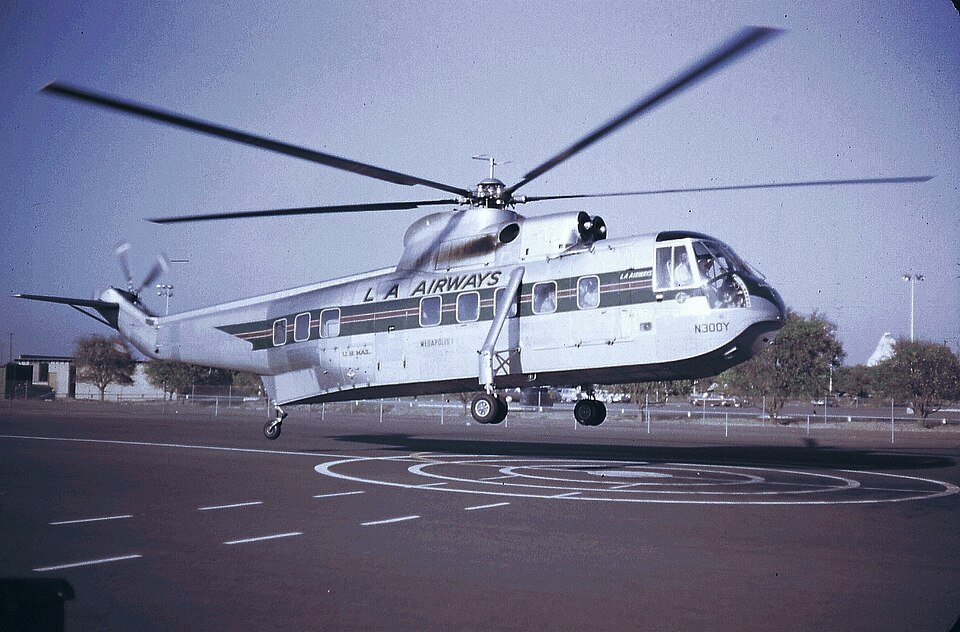
the fatigue failure of the yellow main rotor blade spindle, causing separation of the blade which made the aircraft uncontrollable.
— NTSB Determination
On August 14, 1968, at approximately 1035 Pacific daylight time, a Los Angeles Airways Sikorsky S-61L helicopter, operating as Flight 417, crashed in a recreation park in Compton, California. The aircraft was destroyed by impact and fire. All 18 passengers and three crewmembers were fatally injured.
**The flight**
Flight 417 was a regularly scheduled passenger flight from Los Angeles International Airport to the heliport at Anaheim, California. The crew consisted of Captain Kenneth L. Waggoner, who had accumulated 5,877 hours of total flying time with 4,300 hours in the S-61L; Copilot F. Charles Fracker, Jr., who had 1,661 total hours and 634 in the S-61L; and Flight Attendant James A. Bleck.
The aircraft, registration N300Y, was the prototype for the S-61L and had accumulated 11,863 hours. Its gross weight and center of gravity were within limits for the flight.
**Sequence of events**
The flight departed the Los Angeles ramp at 1026 under Visual Flight Rules. Witnesses described the weather as very good, with clear visibility below a cloud layer and light winds from the southwest.
At 1028:15, Los Angeles Helicopter Control cleared the flight to take off and proceed eastbound. After Helicopter Control reported difficulty hearing the flight, the captain checked an alternate transmitter, which was subsequently reported as loud and clear. At 1029:30, the flight reported to Hawthorne Tower that it was departing eastbound along Imperial Boulevard at 1,200 feet. Helicopter Control advised that radar service was terminated. The flight acknowledged, which was the last known radio contact.
According to 91 witness statements, the helicopter was proceeding along a normal flightpath when a loud noise or unusual sound was heard. Witnesses observed a main rotor blade separate from the aircraft. The helicopter fell in variously described gyrations, and the tail cone either folded or separated. Simulated flights later indicated the helicopter was likely at an altitude of 1,200 to 1,500 feet when the failure occurred.
**What the investigation found**
The main wreckage was located in a recreation park in a residential industrial area. The fuselage, both engines, the main rotor head, four main rotor blades, and the pylon assembly were in the main impact area. The fifth main rotor blade, painted yellow, was found approximately one quarter of a mile northwest, along with its sleeve and part of its spindle.
The spindle is part of the assembly that attaches the main rotor blade to the rotor head. Examination of the yellow blade's spindle revealed a fatigue fracture in the shank adjacent to the shoulder at the inboard end. The fracture was a high-cycle, low-stress fatigue type that had propagated through approximately 72 percent of the shank cross-section before failing completely. The Board determined that no other factors related to the operation of the flight were involved.
Laboratory studies identified several factors associated with the fatigue crack. The steel in the area of the fracture had a banded microstructure and a general hardness below the minimum specified for the spindle. A small surface flaw, similar to a corrosion pit, may have been present at the fatigue nucleus, which would increase stress concentration. Additionally, the spindle shank had been incompletely shot peened before nickel plating. The Board noted that nickel plating normally produces some residual tensile stress in the steel surface, which would tend to reduce fatigue strength.
The investigation reviewed the maintenance history of the spindle, which was required to be overhauled every 1,200 hours. During a salvage operation in 1966, the spindle was shot peened by a subcontractor and plated. Later that year, Sikorsky representatives determined the plating had insufficient hardness and recommended rework.
In May 1967, the spindle was shipped to Sikorsky for salvage. The purchase order and shipping documents specifically outlined stripping, replating, and shot peening. However, the requirement to shot peen was omitted from Sikorsky's work order operation sheet. The operator who performed the plating stated that since the spindle appeared to have been shot peened previously, he did not shot peen it. A Sikorsky quality assurance official stated that it is not uncommon to receive orders with unnecessary requirements, and that they would proceed with plating after satisfying themselves the part had been shot peened at some point.
The Board noted that the inadequate shot peening was not detected or corrected during this rework. A fatigue test program conducted by Sikorsky after the accident showed that salvaged spindles without shot peening had a fatigue life only one-fifth to one-tenth of the mean life of properly peened spindles.
The spindle underwent its sixth overhaul by Los Angeles Airways in June 1968. No cracks were detected during a magnaglo inspection, and the spindle was reinstalled on N300Y. The Board believed that the fatigue crack was present and large enough to be detected during this last inspection, noting that the magnaglo equipment should be capable of detecting cracks as small as 0.010 inch in length. It is not known why the crack was not detected.
The Board concluded that the inadequate shot peening contributed to the initiation of the fatigue crack, and that the omission of shot peening during the Sikorsky salvage had a direct bearing on the accident.
**Probable cause**
The National Transportation Safety Board determined that "the probable cause of this accident was the fatigue failure of the yellow main rotor blade spindle, causing separation of the blade which made the aircraft uncontrollable. The fatigue crack originated in an area of substandard hardness and inadequate shot peening."
A SkyWalk Join't 3 paraglider crashed into the ground near Las Vizcachas, Chile, on September 1, 2024. The pilot and passenger sustained serious spinal…
A Cessna 172N struck electrical cables while on final approach to land at Aucó Aerodrome in Chile. The pilot was uninjured, but the aircraft sustained damage…
A Bombardier DHC-8-402 suffered a tail strike during landing at Puerto Williams on September 9, 2024. All 76 occupants were unharmed, but the aircraft…
A MYD JS-MD 3 glider veered off the runway and struck a wall at Vitacura Aerodrome on January 6, 2025. The pilot was uninjured, but the aircraft sustained…
A recreational paraglider flight in Puchuncaví, Chile, ended with the pilot sustaining serious injuries after a rapid descent and impact with a hillside on…
A Tecnam P2006T landed on its belly at an aerodrome in Poland after the crew failed to confirm landing gear deployment. The incident resulted in no injuries…