Ultralight Crash in Chonburi Kills Pilot Due to Wing Fabric Failure
An X-AIR HAWK ultralight crashed in Chonburi, Thailand, killing the pilot and injuring a passenger. The accident was caused by deteriorated wing fabric and…
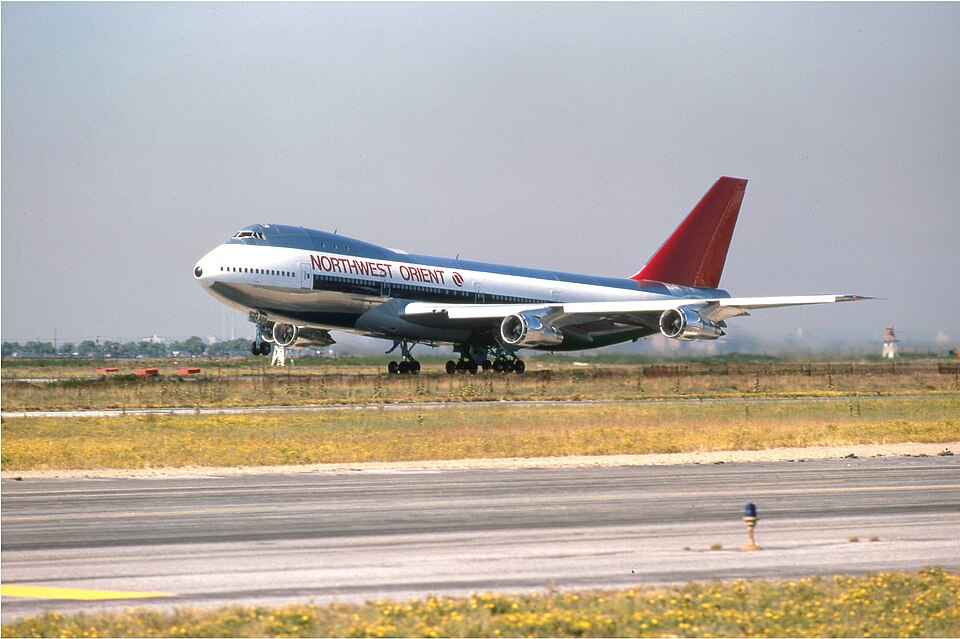
On April 12, 1972, a Boeing 747-151 (registration N606US) operated by Northwest Airlines was involved in an aviation accident near Honolulu, Hawaii. Investigators recorded the probable cause as: the entry of the aircraft into an area of unforecast and unexpected severe clear air turbulence when some occupants did not have their seatbelts fastened. This summary draws on records from the U.S. National Transportation Safety Board (NTSB) Aircraft Accident Reports; 9 related events involving the same aircraft type or operator are linked below.
the entry of the aircraft into an area of unforecast and unexpected severe clear air turbulence when some occupants did not have their seatbelts fastened.
— NTSB Determination
On April 12, 1972, Northwest Airlines Flight 22, a Boeing 747-151 (registration N606US), encountered unforecast severe clear air turbulence over the North Pacific Ocean. The turbulence lasted for 55 seconds, resulting in injuries to 14 people aboard. The aircraft was undamaged and continued to its scheduled stop in Honolulu, Hawaii.
**The flight** Flight 22 was a regularly scheduled passenger flight from Tokyo, Japan, to Minneapolis, Minnesota, with intermediate stops in Honolulu and Los Angeles. There were 186 passengers and a crew of 14 aboard.
The flight crew was highly experienced. Captain William Hazen Arnold had 23,978 total flight hours, including 952 in the Boeing 747. First Officer Harry L. Camp had 4,644 total hours, and Flight Engineer John O. Kelley had 10,872 hours.
The flight departed Tokyo at 1050 Greenwich Mean Time on an Instrument Flight Rules flight plan, cleared to climb to and maintain 33,000 feet. The crew reported encountering light turbulence during the climb through an overcast layer to approximately 22,000 feet. Above the overcast, the air was smooth, visibility was excellent, and stars were clearly visible. The crew observed lightning to the north and rearward of the aircraft, estimating the distance to be at least 50 miles. The climb continued to 33,000 feet, where the flight leveled off.
Shortly before reaching cruising altitude, the crew turned off the seatbelt sign. The purser then made an announcement advising passengers that although the sign was off, they should keep their seatbelts fastened while in their seats for their personal safety.
**The turbulence encounter** At 1140, approximately 30 minutes after reaching cruise altitude, the aircraft encountered unexpected light-to-severe turbulence. The aircraft's weather radar provided no forewarning.
Immediately upon encountering the turbulence, the seatbelt sign was illuminated, the autopilot was disengaged, and the captain flew the aircraft manually. The captain experienced no difficulty controlling the airplane.
Following the 55-second encounter, the second officer assessed the cabin and reported to the captain that nine passengers and five stewardesses were injured. All injuries occurred in the rear cabin areas. A young boy sustained a fractured left arm, and a young girl suffered a dislocated right shoulder. The other injured passengers and the five stewardesses received bruises, abrasions, and small lacerations. The Board noted that all of the injuries were sustained by persons not restrained by seatbelts; the injured stewardesses had been standing.
The captain discussed the situation with the parents of the two most severely injured children, weighing a return to Tokyo against continuing to Honolulu. The parents requested that the flight continue to Honolulu. The aircraft landed at 1739, and the injured were hospitalized. Maintenance personnel inspected the aircraft, found no turbulence damage, and returned it to service.
**What the investigation found** The Board's review of the flight data recorder showed that the aircraft was in level flight at approximately 33,000 feet when the turbulence hit. One brief, severe jolt produced a positive load factor of 1.52 g's and a negative load factor of about -0.91 g's. The aircraft gained about 1,000 feet of altitude during the encounter, though heading changes were minor. Airspeed fluctuated significantly, increasing to a peak of 315 knots, decreasing to 283 knots, rising again to 302 knots, and falling to 272 knots. The characteristic sine waves in the acceleration and airspeed traces suggested to the Board that the aircraft encountered two waves in the atmosphere.
The aircraft's gross weight and center of gravity were within allowable limits throughout the flight.
The captain had received a weather briefing prior to departure, and a smooth ride was forecast for the area of the encounter. Fifty in-flight reports from other aircraft in the area indicated no turbulence. The Board noted that the aircraft encountered the turbulence near the tropopause, near an upper-level trough, and near a jet stream, all of which are likely locations for clear air turbulence. The Board stated the turbulence was probably produced by gravity waves in the tropopause boundary.
The investigation noted that the Boeing Company's recommended severe turbulence penetration speed for the 747 was 280 knots indicated airspeed or 0.92 Mach, whichever is lower, and recommended using the autopilot in turbulence mode. The aircraft encountered the turbulence at approximately 300 knots. The flight data recorder indicated the crew made every effort to reduce to the penetration speed immediately. The captain elected to fly manually rather than use the autopilot's turbulence mode.
The investigation also found deficiencies in the aircraft's first-aid equipment. There were not enough large bandages, no pain-relieving medication for children, and no appropriate splints for immobilizing fractured limbs.
**Probable cause** The National Transportation Safety Board determined that "the probable cause of this accident was the entry of the aircraft into an area of unforecast and unexpected severe clear air turbulence when some occupants did not have their seatbelts fastened."
An X-AIR HAWK ultralight crashed in Chonburi, Thailand, killing the pilot and injuring a passenger. The accident was caused by deteriorated wing fabric and…
A Challenger II Special ultralight aircraft (U-B23) landed off-runway at Pai Airport, Mae Hong Son, on September 17, 2024, due to a gust of wind. No injuries…
The Polish aviation safety authority is investigating a serious incident involving an AT-3R100 aircraft that occurred on September 2, 2024. The investigation…
A SZD-48-3 glider suffered damage when its left wing struck a ground obstacle during a low final approach at EPWK on June 20, 2025. The pilot was uninjured.
A 39-year-old skydiver died after a hard landing near Leszno on May 1, 2026. The PKBWL preliminary report indicates the fatal impact resulted from a late,…
A student pilot crashed an SZD-50-3 Puchacz glider into the airfield fence during a solo training flight on June 6, 2026. The pilot was uninjured, but the…