Paraglider Crash in Puente Alto Injures Pilot and Passenger
A SkyWalk Join't 3 paraglider crashed into the ground near Las Vizcachas, Chile, on September 1, 2024. The pilot and passenger sustained serious spinal…
On March 31, 1975, a Boeing 737-200 operated by Western Air Lines was involved in an aviation accident near Casper, Wyoming. Investigators recorded the probable cause as: The National Transportation Safety Board determines that the probable cause of this accident was the failure of the pilot-in-command to exercise good judgment when he failed to execute a missed approach and continued a nonprecision approach to a landing… This summary draws on records from the U.S. National Transportation Safety Board (NTSB) Aircraft Accident Reports; 2 related events involving the same aircraft type or operator are linked below.
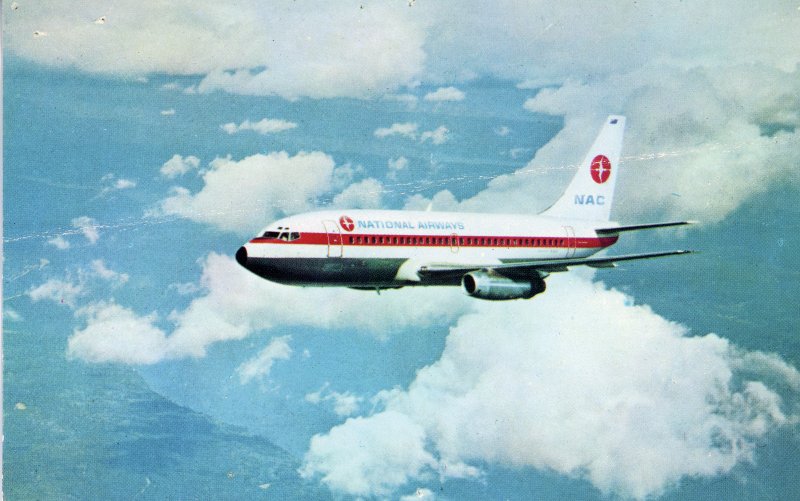
The National Transportation Safety Board determines that the probable cause of this accident was the failure of the pilot-in-command to exercise good judgment when he failed to execute a missed approach and continued a nonprecision approach to a landing without adequately assessing the aircraft's position relative to the runway threshold. Contributing to the accident were the excessive height and speed at which he crossed the approach end of the runway and the failure of other flight crewmembers to provide him with required callouts.
— NTSB Determination
On March 31, 1975, Western Air Lines Flight 470, a Boeing 737-200, overran the departure end of runway 25 at Natrona County International Airport in Casper, Wyoming. The landing was made following a nonprecision approach on a snow-covered runway with a tailwind and reduced visibility. Of the 99 persons aboard, four were injured, and the aircraft was substantially damaged.
### The flight
Flight 470 was operating as a scheduled passenger flight from Denver, Colorado, to Minneapolis, Minnesota, with an intermediate stop in Casper. It departed Denver with 93 passengers and six crewmembers. The captain had accumulated 2,000 hours in the Boeing 737. The first officer had about 8,900 flight-hours, with about 2,000 in the aircraft type.
Before the descent to Casper, the second officer prepared a landing data card based on the Casper weather report, which indicated an indefinite ceiling, obscured sky, 1-mile visibility in light snow, and a wind of 040 degrees at 12 knots. The card noted a reference speed of 130 knots indicated airspeed (KIAS) with 30 degrees of flaps. A notation on the card indicated that 30 degrees of flaps should be used due to en route icing.
Casper approach control cleared the flight for a localizer back course approach to runway 25. The controller advised that visibility was 1/2 mile variable with light snow, and the wind was 040 degrees at 10 knots. A few minutes later, the controller advised that runway 25 had been plowed, leaving about a quarter-inch of snow, and that a Convair 580 had reported braking action as poor.
Flight 470 reported at the Henning Intersection, the final approach fix. The tower cleared the flight to land, reporting the wind at 040 degrees at 8 knots, and advised of a disabled snow blower near the runway. The captain accepted the approach because conditions met criteria, though he stated he had mentioned to the crew the possibility of executing a missed approach and returning for a front course ILS approach to runway 08.
The aircraft was in the approach configuration with 30 degrees of flaps, the landing gear down, and an airspeed of 150 KIAS. The first officer called "1,000 feet above the ground. Both pilots stated the aircraft leveled at the minimum descent altitude. The first officer called the runway in sight directly below. He estimated the distance to the threshold was 1/2 mile, while the captain estimated it at 1/4 to 1 mile. The captain requested 40 degrees of flaps, but the second officer told him that only 30 degrees could be used.
The captain stated the aircraft crossed the threshold at 200 feet above the ground and at an airspeed not over 10 knots above reference speed. The first officer recalled the airspeed was 15 knots above reference speed. The aircraft flared and touched down firmly on the snow-covered runway. The first officer stated he saw the red runway edge lights shortly after reverse thrust was applied, and he believed touchdown occurred about 2,400 feet from the threshold. The captain realized the landing was in jeopardy when he saw the red lights, recognizing there was insufficient runway to go around. He attempted to steer the aircraft into the approach light structure.
The aircraft touched down. It ran off the departure end to the right of the centerline, destroyed three approach lights, struck a shallow irrigation ditch 280 feet off the runway end, and stopped about 800 feet beyond the departure end on a magnetic heading of 008 degrees.
### Evacuation and ground response
The pilots opened their windows and saw no fire. The captain attempted to use the public address microphone to order an evacuation, but it was stuck. The first officer turned off the battery switch, and the fire extinguisher handles were pulled.
The second officer entered the cabin and opened the right forward door, deploying the slide. The left forward door and both aft doors were difficult to open, requiring assistance from the second officer and an off-duty flight attendant. The left rear slide partially inflated until the second officer straightened it, and the left forward slide was punctured by barbed wire. The evacuation was delayed by passengers stopping to retrieve carry-on baggage. Three passengers were injured during the evacuation, and one passenger broke his wrist while helping others.
After the evacuation, two flight attendants reboarded the aircraft to obtain a first aid kit, oxygen bottles, and passenger belongings.
Meanwhile, Frontier Airlines Flight 603, a Convair 580, was holding on runway 3. The tower controller cleared the Convair for takeoff after relying on a county vehicle to report the runway clear of snow-removal equipment. As the Convair accelerated, the controller sighted three vehicles crossing the runway. These vehicles were transporting passengers from Flight 470. The Convair rotated and flew 60 to 80 feet above the vehicles.
### What the investigation found
The Board found no evidence of aircraft structure, component, or system failure before the aircraft left the runway. The gross weight and center of gravity were within prescribed limits.
The Board noted that localized snow showers had reduced visibility to less than 3/4 mile. After the runway was plowed, 2 to 3 inches of light snow had fallen, making the runway edge indiscernible. The lack of contrast and the 320-foot lateral displacement of the runway edge lights may have given the captain the false impression of being lower than he actually was.
The investigation found the approach was not stabilized. The airspeed was 15 to 20 knots above the reference speed, and the descent rate of 750 feet per minute was insufficient with a tailwind to place the aircraft at the minimum descent altitude at a sufficient distance from the threshold. The first officer did not make required descent callouts every 100 feet from 500 feet above the touchdown zone.
The Board concluded that the captain did not determine the effect of the tailwind on ground speed. Because the aircraft crossed the threshold at least 200 feet high and 10 knots fast, the captain should have begun a missed approach. Once the aircraft touched down and reverse thrust was selected, a go-around was impossible. The Board believed a decision to execute a missed approach and a full ILS approach to runway 08 would have been prudent.
The Board also noted that a more accurate landing weight calculation by the second officer would have shown the aircraft was several hundred pounds under the climb gradient limitation, which would have allowed the use of 40 degrees of flaps.
Regarding the evacuation, the Board found that the difficulties opening the cabin doors were likely due to the force required to pull the slide pack out of its container, rather than crash deformation. The Board considered the flight attendants' decision to reboard the aircraft questionable, as the potential for fire was very real with spilled fuel, hot electrical wiring, and the running auxiliary power unit. The Board noted that the airport manager and captain's decisions that no fire danger existed were premature, which led to emergency equipment not being readily available. The firetruck arrived 7 minutes or longer after the first notification.
The Board expressed great concern about the near-accident with Frontier Flight 603, concluding that the airport manager did not take positive action to close the airport or control non-radio-equipped vehicular traffic.
### Probable cause
The National Transportation Safety Board determines that the probable cause of this accident was the failure of the pilot-in-command to exercise good judgment when he failed to execute a missed approach and continued a nonprecision approach to a landing without adequately assessing the aircraft's position relative to the runway threshold. Contributing to the accident were the excessive height and speed at which he crossed the approach end of the runway and the failure of other flight crewmembers to provide him with required callouts.
A SkyWalk Join't 3 paraglider crashed into the ground near Las Vizcachas, Chile, on September 1, 2024. The pilot and passenger sustained serious spinal…
A Cessna 172N struck electrical cables while on final approach to land at Aucó Aerodrome in Chile. The pilot was uninjured, but the aircraft sustained damage…
A Bombardier DHC-8-402 suffered a tail strike during landing at Puerto Williams on September 9, 2024. All 76 occupants were unharmed, but the aircraft…
A MYD JS-MD 3 glider veered off the runway and struck a wall at Vitacura Aerodrome on January 6, 2025. The pilot was uninjured, but the aircraft sustained…
A recreational paraglider flight in Puchuncaví, Chile, ended with the pilot sustaining serious injuries after a rapid descent and impact with a hillside on…
A Tecnam P2006T landed on its belly at an aerodrome in Poland after the crew failed to confirm landing gear deployment. The incident resulted in no injuries…