Paraglider Crash in Puente Alto Injures Pilot and Passenger
A SkyWalk Join't 3 paraglider crashed into the ground near Las Vizcachas, Chile, on September 1, 2024. The pilot and passenger sustained serious spinal…
On January 9, 1983, an aircraft (registration N8444H) operated by Republic Airlines was involved in an aviation accident near Brainerd, Minnesota. Investigators recorded the probable cause as: The National Transportation Safety Board determined that the probable causes of the accident were "the failure of the captain to properly align the airplane with the runway in sufficient time to allow a touchdown with no drift and the position of a snowbank… This summary draws on records from the U.S. National Transportation Safety Board (NTSB) Aircraft Accident Reports; 1 related events involving the same aircraft type or operator are linked below.
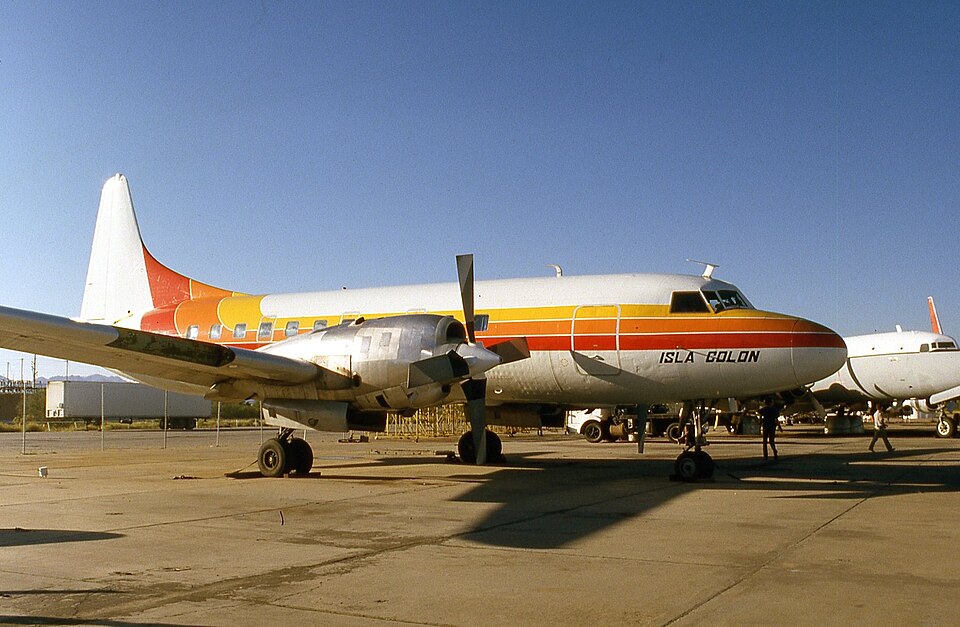
The National Transportation Safety Board determined that the probable causes of the accident were "the failure of the captain to properly align the airplane with the runway in sufficient time to allow a touchdown with no drift and the position of a snowbank on the edge of the runway the height of which exceeded that specified by regulation." The Board found that contributing to the accident were "the intensity changes of the runway lights and the snow-covered terrain, both of which affected the captain's visual landing perception. The absence of a NOTAM on the control of the airport lighting system and failures of the airport management and the company station manager to report the location of the snowbanks to the flightcrew also contributed to the accident."
— NTSB Determination
On January 9, 1983, Republic Airlines Flight 927, a Convair 580 (N8444H), landed off-center on a snow-covered runway at Brainerd, Minnesota. The airplane drifted to the right, and its right propeller struck a snowbank on the runway edge. A separated propeller blade penetrated the passenger cabin, fatally injuring one passenger and seriously injuring another. The National Transportation Safety Board investigated and found that the captain failed to align the airplane properly before touchdown, and that the snowbank exceeded regulated height limits.
### The flight
Flight 927 was a regularly scheduled passenger flight from Minneapolis, Minnesota, to Thief River Falls, Minnesota, with en route stops scheduled at Brainerd and Bemidji. The airplane carried 30 passengers and 3 crewmembers.
The flightcrew arrived at operations in Minneapolis at 1530 and reviewed the weather. The dispatch package included a Notice to Airmen (NOTAM) that runway 23 at Brainerd was 30 percent covered in compacted snow with good braking action. The terminal forecast called for a 700-foot overcast ceiling, 5 miles visibility, and fog, with a chance of 500-foot ceilings and 2 miles visibility in light rain showers and fog.
### The sequence of events
The flight departed Minneapolis at 1910. At 1920, the first officer contacted the Republic Airlines station agent at Brainerd for the latest weather. The agent reported an indefinite ceiling of 400 feet, sky obscured, with 1 mile visibility. This report was erroneous; the agent’s actual measurement was a 300-foot ceiling, which he thought he had transmitted.
At 1929, the first officer made an in-range call. The station agent reported calm winds, poor braking action, and "about an inch of slush and snow" on the runway. The first officer confirmed the poor braking and requested that the runway lights be turned to their brightest setting. The captain briefed a localizer instrument approach to runway 23.
The airplane passed the outer marker at 1937:31, and the landing gear was lowered. At 1938:38, the first officer reported that the airplane had descended to the minimum descent altitude (MDA) of 1,680 feet, which was 456 feet above the runway. At 1939:47, the first officer clicked his microphone 19 times to activate the airport lights, stating at 1939:49 that he had "clicked them all the way."
At 1939:51, the captain stated, "There's the flashers." Flight data recorder (FDR) data indicated the airplane was at 1,574 feet at this time, below the MDA. At 1940, the captain ordered the flaps set to 40 degrees. At 1940:05, the first officer asked, "Okay, you want to shut those off," followed by four microphone keyings. The captain replied, "Yeah, that's alot better."
At 1940:13, the flaps were extended to 40 degrees. The FDR indicated a sharp increase in the rate of descent, while airspeed decreased from 122 knots to about 100 knots. At 1940:30, the first officer stated, "you're on the left side of the runway," and the captain responded, "Ya, I'm trying to ease it back."
The right main landing gear touched down about 1,725 feet from the threshold, about 37 feet from the right edge of the 150-foot-wide runway. The touchdown was made in a right-wing-down attitude. The airplane was on a heading of 229 degrees but tracking at 235 degrees.
The airplane continued to the right for about 400 feet until the right main landing gear crossed through a snowbank located at the right edge of the runway, inside the runway lights. The right propeller struck the snowbank, and the No. 1 blade separated. The blade entered the cabin from beneath the first and second row of passenger seats on the right side. It severed the legs of a 68-year-old woman, who died from loss of blood, and severed the lower right leg of a 6-year-old girl.
The airplane straddled the snowbank for about 800 feet, crossed back onto the runway, and swerved back to the right through the snowbank, stopping off the right side of the runway.
The flight attendant opened the left rear service door, but the evacuation slide did not deploy automatically. She manually inflated the slide and instructed the passengers to evacuate. Fearing an explosion from the right engine, which was experiencing a postimpact fire in its turbine section, she instructed passengers to leave the fatally injured woman, whom she believed was dead. The captain and first officer later reentered the airplane to remove the woman and confirm no one else remained onboard.
### What the investigation found
The Board found that the runway surface was ice and compacted snow, covered by about 2 inches of wet snow. The snowbanks along runway 23 were 2 to 3 feet high and located about 10 feet inside the runway edge lights. Federal regulations and the airport's operations manual required snow to be positioned so that all airplane propellers would clear the banks. The Convair 580 propeller clearance was 12 to 18 inches.
The runway had been plowed two days before the accident, and airport management planned to have the snowbanks blown clear the following Monday. In the interim, the airport manager had not requested a NOTAM to warn pilots of the noncompliant snowbanks. The Republic Airlines station agent also failed to report the snowbanks to the flightcrew. The Board noted that the agent's measurement of the snow depth—using his fingers to estimate 1 inch of slush—was inaccurate and imprecise.
The investigation revealed that the airport was operating a test program for its lighting system, installed on December 8, 1982. The system allowed pilots to simultaneously control the intensities of both the high intensity runway edge lights and the approach lights via radio clicks. No NOTAM had been issued to inform pilots of this test program. When the first officer clicked his microphone four times at 1940:05 to dim the approach lights, he unknowingly dimmed the runway edge lights as well.
The Board concluded that the instrument approach was normal until just before touchdown, except for the premature descent below the MDA. The captain attempted to realign the airplane with the runway centerline at a very low altitude and overcorrected to the right. The Board believed that landing at night over featureless snow-covered terrain, combined with the uncommanded dimming of the runway edge lights, could have created an illusion that the airplane was higher than it actually was. This may have caused the airplane to touch down earlier than the captain anticipated.
A cockpit visibility study indicated that a 3-foot snowbank might block the captain's line of sight to the left runway lights, but would leave at least six lights visible on the right. The Board concluded the captain's line of sight was not severely limited, though he may have lost some peripheral cues. Once the airplane touched down with rightward momentum, the slippery runway prevented the captain from controlling its direction.
The right propeller likely failed instantaneously after striking the snowbank, causing the No. 1 blade to penetrate the cabin. The left propeller also separated when the airplane veered through the snowbank a second time.
### Probable cause
The National Transportation Safety Board determined that the probable causes of the accident were "the failure of the captain to properly align the airplane with the runway in sufficient time to allow a touchdown with no drift and the position of a snowbank on the edge of the runway the height of which exceeded that specified by regulation."
The Board found that contributing to the accident were "the intensity changes of the runway lights and the snow-covered terrain, both of which affected the captain's visual landing perception. The absence of a NOTAM on the control of the airport lighting system and failures of the airport management and the company station manager to report the location of the snowbanks to the flightcrew also contributed to the accident."
A SkyWalk Join't 3 paraglider crashed into the ground near Las Vizcachas, Chile, on September 1, 2024. The pilot and passenger sustained serious spinal…
A Cessna 172N struck electrical cables while on final approach to land at Aucó Aerodrome in Chile. The pilot was uninjured, but the aircraft sustained damage…
A Bombardier DHC-8-402 suffered a tail strike during landing at Puerto Williams on September 9, 2024. All 76 occupants were unharmed, but the aircraft…
A MYD JS-MD 3 glider veered off the runway and struck a wall at Vitacura Aerodrome on January 6, 2025. The pilot was uninjured, but the aircraft sustained…
A recreational paraglider flight in Puchuncaví, Chile, ended with the pilot sustaining serious injuries after a rapid descent and impact with a hillside on…
A Tecnam P2006T landed on its belly at an aerodrome in Poland after the crew failed to confirm landing gear deployment. The incident resulted in no injuries…