Paraglider Crash in Puente Alto Injures Pilot and Passenger
A SkyWalk Join't 3 paraglider crashed into the ground near Las Vizcachas, Chile, on September 1, 2024. The pilot and passenger sustained serious spinal…
On June 2, 1990, a Boeing 737-2X6C operated by MarkAir was involved in an aviation accident near Unalakleet, Alaska. Investigators recorded the probable cause as: The National Transportation Safety Board determined that the probable cause of this accident was "deficiencies in flightcrew coordination, their failure to adequately prepare for and properly execute the UNK LOC Rwy 14 nonprecision approach and their… This summary draws on records from the U.S. National Transportation Safety Board (NTSB) Aircraft Accident Reports; 2 related events involving the same aircraft type or operator are linked below.
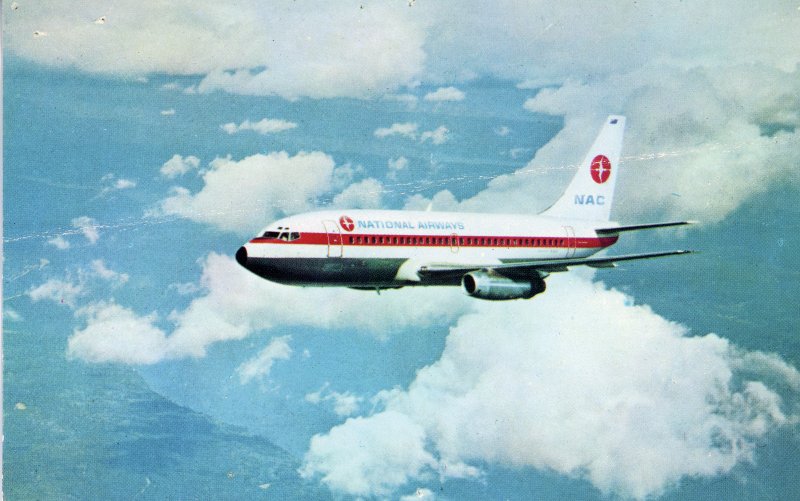
The National Transportation Safety Board determined that the probable cause of this accident was "deficiencies in flightcrew coordination, their failure to adequately prepare for and properly execute the UNK LOC Rwy 14 nonprecision approach and their subsequent premature descent."
— NTSB Determination
On June 2, 1990, at 0937 Alaskan Daylight Time, MarkAir flight 3087, a Boeing 737-2X6C, crashed into terrain about 7.5 miles short of runway 14 at Unalakleet, Alaska. The flight was executing a localizer approach in instrument meteorological conditions. The captain, the first officer, and one flight attendant sustained minor injuries, while a second flight attendant was seriously injured. The airplane was destroyed. There were no passengers on board.
### The flight
Flight 3087 was an extra section flight dispatched from Anchorage to pick up stranded passengers in Unalakleet. The departure was delayed until 0828 due to low ceilings and visibility at the destination.
The captain had accumulated about 12,000 total flying hours, with about 6,400 in the Boeing 737. The first officer had about 1,800 total flight hours but was new to the company and the airplane, with only 80 hours in the Boeing 737. This was the first time the two pilots had flown together.
### The approach and accident sequence
About 45 minutes after takeoff, Anchorage Air Route Traffic Control Center cleared the flight to descend to 8,000 feet. The center reported Unalakleet weather as a 500-foot overcast ceiling and 1 1/2 miles visibility, which was above the minimums for the localizer runway 14 approach.
During the descent, the captain briefed the approach. He told the first officer he planned to fly a teardrop course reversal instead of the standard procedure turn. He briefed the descent altitudes, stating, "Three thousand till we're inbound. DRIGE at fifteen. Five at, ah, 2.3 mile fix, then down to 360." He also asked the first officer to call out anything he questioned or did not like.
Around 0918, one flight attendant entered the cockpit and strapped into the jump seat. The pilots discussed the turnaround at Unalakleet, noting that the regular scheduled MarkAir flight was only 10 to 15 minutes behind them. The captain expressed concern about having both airplanes on the limited ramp space at the same time.
The airplane crossed the Unalakleet VOR at 0931 at about 4,500 feet and proceeded outbound. As the captain called for 10 degrees of flaps, he entered a right turn for the teardrop maneuver. About halfway through the turn, the airplane descended through 3,000 feet. At 0935, the captain stated, "Fifteen till 10 DME." The first officer replied, "You got the 10 in right," to which the captain did not respond.
The airplane intercepted the final approach course. At 0936:14, the captain stated, "1,500 to 10, what we're shooting for." Shortly after, he called for 30 degrees of flaps, and the first officer completed the landing checklist. At 0936:41, the captain said, "There comes the 10 to 1,500—500 feet is what we're headed for... 2.3 DME." The pilots then discussed reconfiguring the engine bleed switches for a gravel runway landing, a procedure they executed as the airplane descended through about 1,700 feet.
The airplane descended through 1,500 feet at about 9.5 DME. The first officer announced they were at 1,000 feet and that the instruments were cross-checked. At 0937:49, the first officer announced in a normal tone that he had ground contact. The airplane was at about 630 feet. Two and a half seconds later, the airplane struck the ground at an elevation of about 530 feet on Blueberry Hill. The crew evacuated the wreckage and were rescued by helicopter about an hour later.
### What the investigation found
The Board found no evidence of pre-impact failure in the airplane's structures, engines, or navigation systems. The ground proximity warning system (GPWS) did not sound because the airplane was configured for landing and no ILS glideslope was available, which was normal for the installed system during a nonprecision approach.
The investigation determined that the captain deviated from the published approach procedure. He descended below 3,000 feet before intercepting the inbound final approach course, and he descended below the 1,500-foot altitude limitation before reaching the final approach fix at 5 DME. The Board noted that the captain developed an erroneous mindset that the descent from 1,500 feet was to be initiated at 10 DME rather than 5 DME.
The Board believed this mindset may have been prompted by differences in approach chart formats. The captain used Jeppesen charts at MarkAir but National Ocean Service (NOS) charts in his Air National Guard flying. Jeppesen charts featured a 5-statute-mile airport reference circle, which on the Unalakleet chart intersected the final approach fix at 5 DME. NOS charts typically featured a 10-nautical-mile distance ring. The Board considered it possible that the captain saw the circle crossing the fix on the Jeppesen chart and, accustomed to NOS charts, assumed it was a 10-mile letdown instruction.
The Board found that the first officer failed to monitor the approach sufficiently to detect the captain's errors, or was hesitant to question him. The first officer was new to the airplane and stated he was "busy all the time." The Board noted that the non-standard procedure of reconfiguring the bleed valves at 1,700 feet distracted him during a critical phase of flight. Furthermore, the first officer had not yet received formal Cockpit Resource Management (CRM) training at MarkAir.
### Probable cause
The National Transportation Safety Board determined that the probable cause of this accident was "deficiencies in flightcrew coordination, their failure to adequately prepare for and properly execute the UNK LOC Rwy 14 nonprecision approach and their subsequent premature descent."
A SkyWalk Join't 3 paraglider crashed into the ground near Las Vizcachas, Chile, on September 1, 2024. The pilot and passenger sustained serious spinal…
A Cessna 172N struck electrical cables while on final approach to land at Aucó Aerodrome in Chile. The pilot was uninjured, but the aircraft sustained damage…
A Bombardier DHC-8-402 suffered a tail strike during landing at Puerto Williams on September 9, 2024. All 76 occupants were unharmed, but the aircraft…
A MYD JS-MD 3 glider veered off the runway and struck a wall at Vitacura Aerodrome on January 6, 2025. The pilot was uninjured, but the aircraft sustained…
A recreational paraglider flight in Puchuncaví, Chile, ended with the pilot sustaining serious injuries after a rapid descent and impact with a hillside on…
A Tecnam P2006T landed on its belly at an aerodrome in Poland after the crew failed to confirm landing gear deployment. The incident resulted in no injuries…