History of the Flights
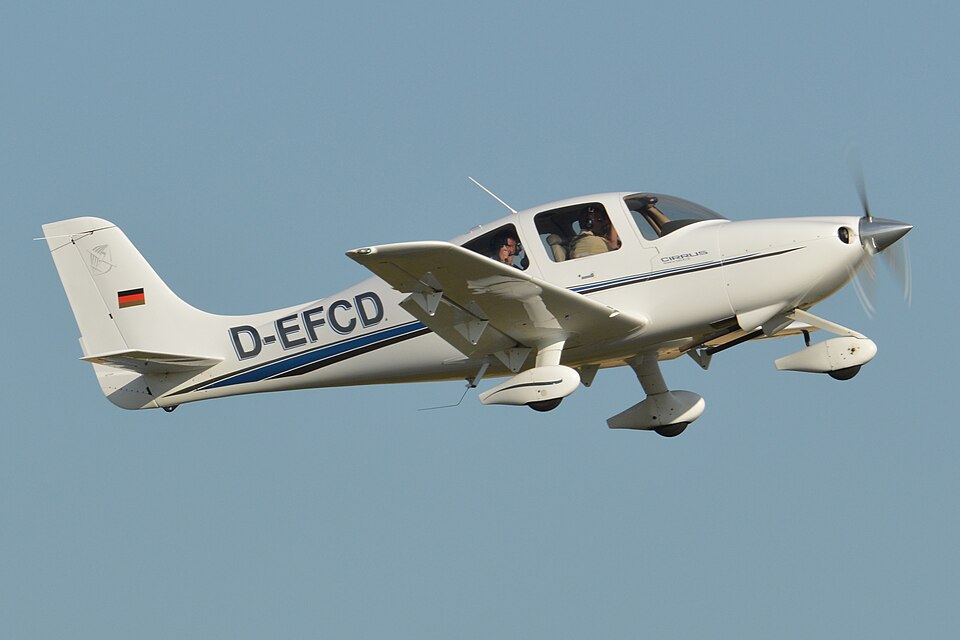
On 22 August 2021, two aircraft participating in a group cross-country flight in the Alps for German pilots to familiarize with mountain flying collided with terrain in the Vars valley. The first accident involved a Cirrus SR20 (registration D-EFCD) at 13:38 local time. The pilot, accompanied by a passenger, had taken off from Mont-Dauphin Saint-Crépin aerodrome at 13:31, bound for Barcelonnette. The aircraft entered the valley leading to Col de Vars at about 4,880 ft altitude with a height of approximately 195 ft. It climbed along the left side of the valley, passing over a power line at 13:35 and near the hamlet of Sainte-Catherine at 13:36:40. At 13:38:10, abeam Vars at 6,600 ft and height 430 ft, the pilot turned approximately 90° to the right, facing the terrain. The aircraft continued climbing in a straight south-westerly line to 6,900 ft while its height rapidly decreased. Witnesses observed it colliding with trees on a direct path.
The second accident involved a Reims Aviation Cessna FR172H (registration D-EFTP) at 16:24. The pilot, with two passengers, took off at 16:17 from the same aerodrome, heading in the same direction. At 16:21:15, it entered the valley at about 4,730 ft (height 275 ft). At 16:21:40, the height was approximately 80 ft. The pilot continued climbing along the left side. A witness reported the aircraft at low height with a steep nose-up attitude and low speed. At 16:23:50, after the valley split, the pilot turned 60° left instead of proceeding right towards the pass. The aircraft’s altitude increased to 6,270 ft while height quickly decreased. It touched down in a grass field facing the slope and performed a ground loop.
Site and Wreckage
The SR20 wreckage was found at 6,905 ft in a forest, three kilometers from the pass. The aircraft struck three trees with wings horizontal, then collided with the ground and turned over. The flaps were retracted; the engine was producing power with no anomalies. The airframe parachute was not activated.
The FR172 wreckage was located at 6,365 ft in a clear field with an average slope of 21%. Ground marks indicated a collision facing the slope, wings level, with a slight nose-down attitude. The left main landing gear was torn off, the left wing then touched the ground, and the aircraft spun 180°, stopping nose-downslope. Damage was major to the front section, and the right main and nose gear collapsed. The flaps were retracted; the engine was producing power with no anomalies.
Meteorological Information
At the time of the first accident, Météo-France estimated mean wind 250°, 10 kt, gusts 25-30 kt, moderate to strong turbulence, visibility >10 km, scattered clouds, temperature +16°C at 6,900 ft. Two other pilots reported strong turbulence, downdrafts, and a 30 kt tailwind in the valley. For the second accident, conditions were similar except temperature +13°C at 6,300 ft. Another pilot encountered intermittent downdrafts and strong turbulence requiring full throttle. However, the FR172 passengers reported calm air after takeoff.
Aircraft Information
The SR20 had an estimated total weight of 1,300 kg (MTOW 1,361 kg); center of gravity was within limits. The maximum climb gradient in the temperature conditions was between 4% and 4.5%, with a maximum rate of climb between 450 and 520 ft/min. Flight data showed an average rate of climb of 550 ft/min and a gradient of 5-6% while the terrain gradient averaged 8%. Ground speed decreased from 95 kt to 80 kt 15 seconds before impact.
The FR172 had an estimated weight of 1,137 kg (MTOW 1,157 kg); center of gravity was within limits. The maximum rate of climb in the temperature conditions was about 500 ft/min. No anomalies were found in the wreckage examinations.