History
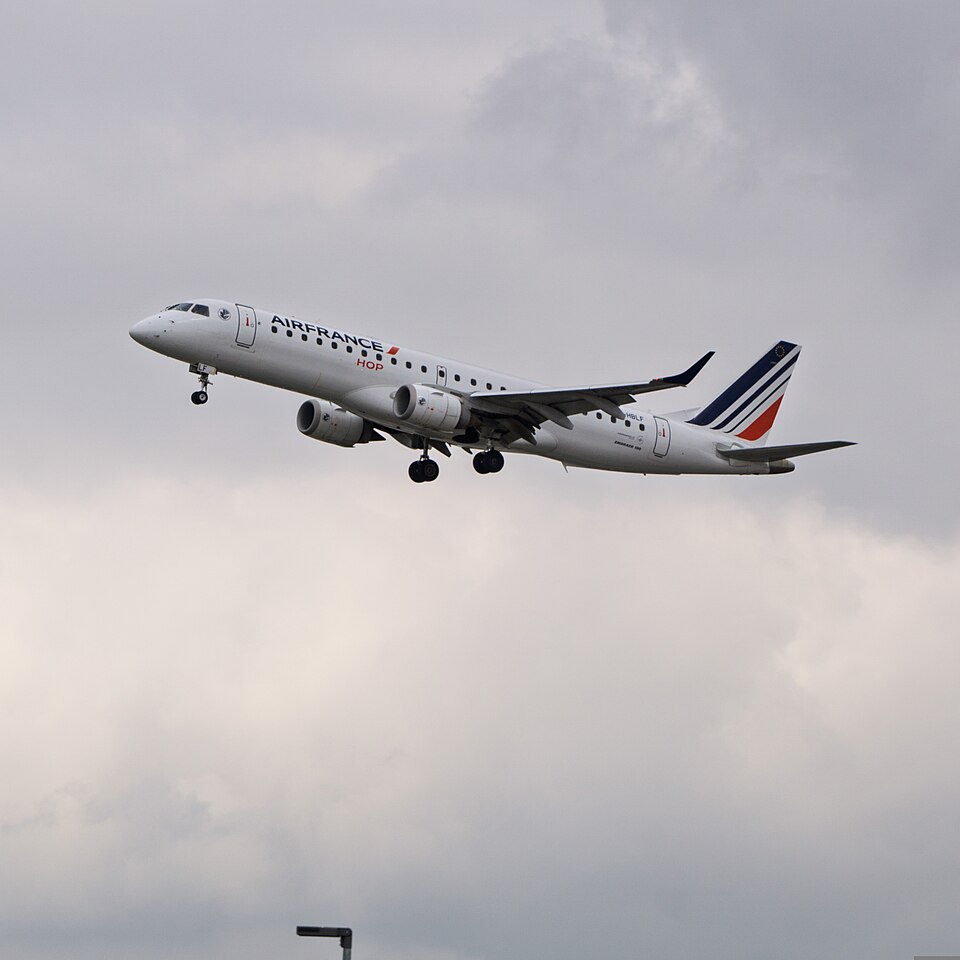
On 19 April 2014 at approximately 07:50 UTC, the crew of Embraer 190 registered F-HBLF contacted "De Gaulle Trafic" frequency to request pushback from stand J10 at terminal 2G for a flight to Clermont-Ferrand Auvergne airport. The apron management services agent instructed them to push back facing east.
A second aircraft parked at stand J11 also requested pushback. To allow it to begin its manoeuvre sooner, the agent then asked the crew of F-HBLF to be towed forward with the assistance of a tug after their pushback, facing south until abeam stand 12. This manoeuvre, consisting of a pushback followed by a forward tow, is referred to as a "push-pull."
During the pushback, the crew started both engines, which stabilised at ground idle. After the pushback from J10, the aircraft was positioned on the axis specified in the documentation. To align the aircraft onto the centreline of taxiway E7, the tug driver needed to make a turn of about 90° with a short radius. He positioned the tug at approximately 90° to the aircraft axis. When the tug began to pull, the safety cotter pins on the tow bar coupling head broke. The coupling head then remained connected only by an axle, allowing it to pivot horizontally.
Under the effect of inertia and the thrust of both engines at idle, the aircraft continued forward in a straight line. When the coupling head reached its stop, the aircraft pivoted to the right and collided with the tug, resulting in severe damage to the lower part of the fuselage.
Additional Information
The specific instructions for manoeuvring at apron stands (CPEX) published by Paris Aéroport, applicable from 21 December 2013, stated that pushback from J10 could be carried out in two ways: facing east on a specific axis, or facing north then west on taxiway P4. The north-west procedure was longer and seldom used. For the east-facing pushback, the instructions explicitly forbade pulling the aircraft forward again with a tug; departure was to be autonomous after pushback.
The apron management service's operations manual repeated this ban on "push-pull" departures from stand J10. However, the push-pull procedure was authorised and regularly used at other stands to facilitate traffic flow and avoid jet blast. Drivers indicated that they generally did not question requests from apron management agents, even when aware of the ban.
A history of similar events existed. In February 2008, the initial design for stand J10 included a push-pull procedure. On 12 April 2008, while a Fokker 100 was being pulled back by a tug, the tug collided with and punctured the aircraft's fuselage. This led to an urgent instruction on 24 April 2008 to modify the procedure to a pushback followed by autonomous departure. A new CPEX version on 3 September 2008 made this definitive. On 12 October 2009, during a pullback of an Embraer 170, the safety cotter pin on the tow bar broke and the tug collided with the aircraft. The following day, an explicit warning was added: "le pull est interdit" (pull is forbidden).
The source notes that for a pull forward after an east-facing pushback, the tug must be positioned at a sharp angle relative to the aircraft axis. In this configuration, the risk of breaking the safety cotter pins is greatly increased. In contrast, push-pull manoeuvres at other stands typically involve the tug approximately aligned with the aircraft axis, limiting that risk.
Lessons Learned and Conclusion
The apron management services agent requested a push-pull manoeuvre despite the ban in the operations manual for stand J10. The common use of this manoeuvre at other stands and the lack of explanation for the specific ban likely led the agent to request a non-standard procedure.
The tug driver did not question the request from the agent, which was relayed by the crew of F-HBLF. The operating instructions specify that pushback procedures are "according to instructions from ATC and validation by the aircraft Captain," but the tug driver followed the request.
To execute the pull, the tug driver had to set an excessive angle between the tow bar and the aircraft axis, causing the tow bar coupling head to disconnect. The aircraft's inertia from being moved and the idle thrust from its engines propelled it forward, resulting in the collision with the tug.
Following this event, the apron management services operations manual was modified to clarify the reasons for the ban on push-pull manoeuvres at stand J10.