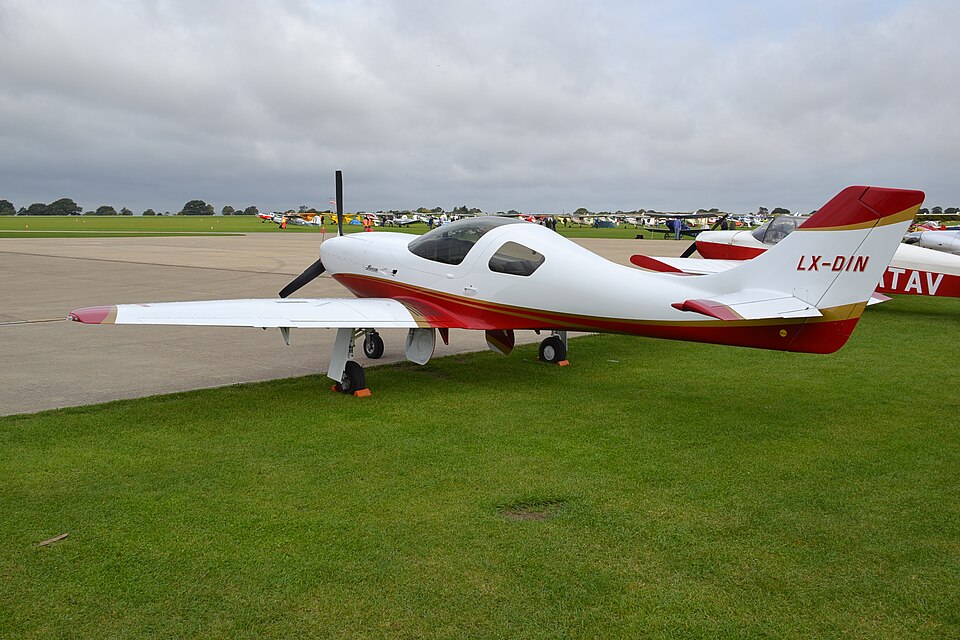
Accident Overview
On Monday, 12 July 2010, at approximately 1245 local time, a Lancair Legacy 2000, registration LX-DIN, experienced a runway excursion upon landing at Honningsvåg Airport Valan (ENHV), Norway. The aircraft was the first of a group of nine aircraft arriving from Rovaniemi, Finland (EFRO). The two persons on board, the commander and a passenger, were not injured. The aircraft sustained damage to the propeller and the leading edge of the left wing, and an approach light mast was broken.
Flight and Weather Conditions
The aircraft was operating under visual flight rules (VFR) in daylight. Weather reports included METAR ENHV 0950UTC: wind 170 degrees at 13 kt gusting to 23 kt, varying between 120 and 230 degrees; and SPECI ENHV 121013UTC: wind 170 degrees at 17 kt gusting to 30 kt, varying between 110 and 210 degrees. According to Avinor, the anemometer on runway 26 threshold indicated the main wind direction from 170 degrees with variations between 130 and 240 degrees. Mean wind strength in the final two minutes ranged from 14 to 21 kt, with gusts up to 33 kt. The AFIS officer informed LX-DIN and other aircraft that the wind speed exceeded the 20 kt limit applicable to regular air traffic.
Approach and Landing
The commander approached from the north at 2,000 ft. Noting observed and forecast gusts and varying wind direction, he increased approach speed and maintained approximately 100 kt for the final part, with full flaps (40°). The commander stated that the manufacturer's required landing distance for standard landings at the given mass, full flaps, and 80 kt over the threshold in no wind was 300 m; he habitually used 400 m for calculations and had previously landed LX-DIN in crosswinds exceeding 25 kt without issue.
During approach and landing, the commander did not notice gusts or turbulence. Touchdown occurred in the correct touchdown zone. He pulled the throttle to idle and applied brakes as usual, but retardation was almost unnoticeable, stating it felt as if the aircraft was being pushed by the wind. Midway down the runway he considered a go-around but deemed it unsafe as he doubted sufficient remaining runway length for a safe lift-off. The aircraft did not stop before the runway end, rolling off onto the sloping, stony runway extension. The propeller struck a stone and the left wing hit a light mast before stopping.
Aftermath
The AFIS officer observed the approach and landing, noting the approach was stable and the landing seemed fine, though the aircraft may have bounced slightly. He noted the landing time and lost sight of the aircraft after it passed taxiway B. He realized something was wrong when the fire truck drove onto the runway, and then saw LX-DIN west of the runway end. Fuel leaked from a damaged tank; airport fire and rescue services applied foam and secured the area. Police and an ambulance arrived. The AFIS officer transferred the other aircraft to Bodø frequency; all other aircraft diverted to Mehamn airport (ENMH), about 33 NM east.
Pilot and Aircraft Information
The commander, a 53-year-old male with a Private Pilot License (A), had 900 total flight hours, of which 800 were on the Lancair Legacy 2000 type. In the last 90 days he had flown 20 hours, with 5 hours in the last 24 hours. The aircraft, built in 2003, was privately operated. The commander reported no indication of brake or system malfunctions, believing the excursion was due to tailwind while on the runway.
Airport Characteristics
Honningsvåg Airport Valan is known for challenging conditions. The available landing distance for runway 26 is 800 m, with an asphalt surface 920 m long and 30 m wide. Runway 26 has a 1.2% downward slope for the first two-thirds. The threshold elevation of runway 26 is 13.3 m above mean sea level, and the opposite end is 6.9 m. AIP Norway includes cautions regarding turbulence and southern winds. Regional airline Widerøe operates with an upper wind limit of 20 kt for approach and landing, including gusts, when wind is from 140°–200°; if wind direction varies more than 60° within that sector, the limit is 15 kt. The airport has invested in safety improvements including upgraded safety areas, new approach aids, asphalt, and marking lights.
Comments from the Accident Investigation Board Norway
The AIBN noted that the ground roll exceeded the available landing distance despite touching down in the landing zone. The light mast and stony surface contributed to aircraft damage, though the aircraft had relatively low speed and did not go far off the end. High airspeed, runway slope, brake effect, and tailwind were factors in the occurrence.