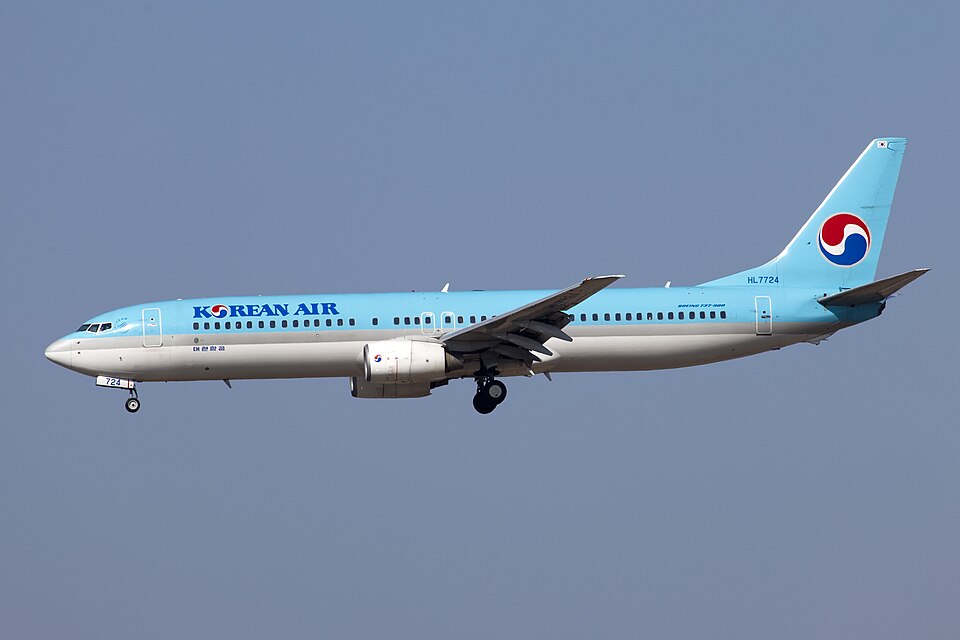
Incident Overview
On January 6, 2007, at approximately 12:16 Japan Standard Time, a Boeing 737-900 registered HL7724, operating as Korean Air Lines scheduled Flight 769, landed on a parallel taxiway located south of Runway 10 at Akita Airport in Japan. The aircraft had departed from Incheon International Airport, Seoul, Republic of Korea, at 10:35. All 133 persons on board—the captain, first officer, seven other crewmembers, and 124 passengers—were uninjured, and the aircraft sustained no damage.
Flight and Approach
The aircraft flew under instrument flight rules at FL310, then descended for a VOR/DME No.1 approach to Runway 10. At 12:06, the crew contacted Akita Tower, reporting they were on the arrival route towards Runway 10. The tower cleared the aircraft to land on Runway 10 and instructed them to report passing the OMONO initial approach fix. The aircraft reported OMONO at 12:11:57 at about 3,200 feet, and the tower replied, “Runway 10, cleared to land, wind 130 at 9.” No further communication occurred until after landing.
Cockpit Voice and Data Recorder Details
According to the Digital Flight Data Recorder and Cockpit Voice Recorder, at 12:12:35, at an altitude of approximately 2,700 feet and about 7.4 nautical miles from the threshold, the first officer called “Runway in sight,” and the captain responded, “I have it in sight.” Between 12:14:09 and touch down, the crew discussed the runway alignment. At 12:14:09, the captain asked, “What is at the center is a runway, isn’t it?” The first officer replied that PAPI was on the left and the runway on the right. The captain then commented on a wide feature to the right, and at 12:14:52, stated, “I’ll make a landing there.” The autopilot was disengaged at 12:14:54. At 12:15:07, the GPWS called “Minimum,” and subsequent callouts included “Five Hundred,” “Stabilized,” and altitude callouts from 50 to 10 feet. The aircraft touched down at 12:15:53 as indicated by a ground altitude of zero feet on the DFDR, approximately 0.8 nautical miles from the threshold.
After landing, the captain realized the aircraft was on a taxiway and remarked, “But why is the indication like this, for the runway?”
Crew Statements
The captain stated that during the VOR No.1 approach, moderate rain and strong crosswinds (about 30 knots at 2,000 feet) were encountered. At around 2,000 feet, he saw a blurred shape of the aerodrome in the rain. The first officer’s statements were not separately excerpted in the source.
Investigation Details
The Japan Transport Safety Board investigated the serious incident, which was classified as similar to “Landing on a closed runway” under Japanese regulations. An accredited representative and an adviser from the Republic of Korea participated. The investigation included interviews, examination of the head-up display, and analysis of flight data and cockpit voice recorders. The United States, as the state of design and manufacture, did not appoint a representative.