Accident Summary
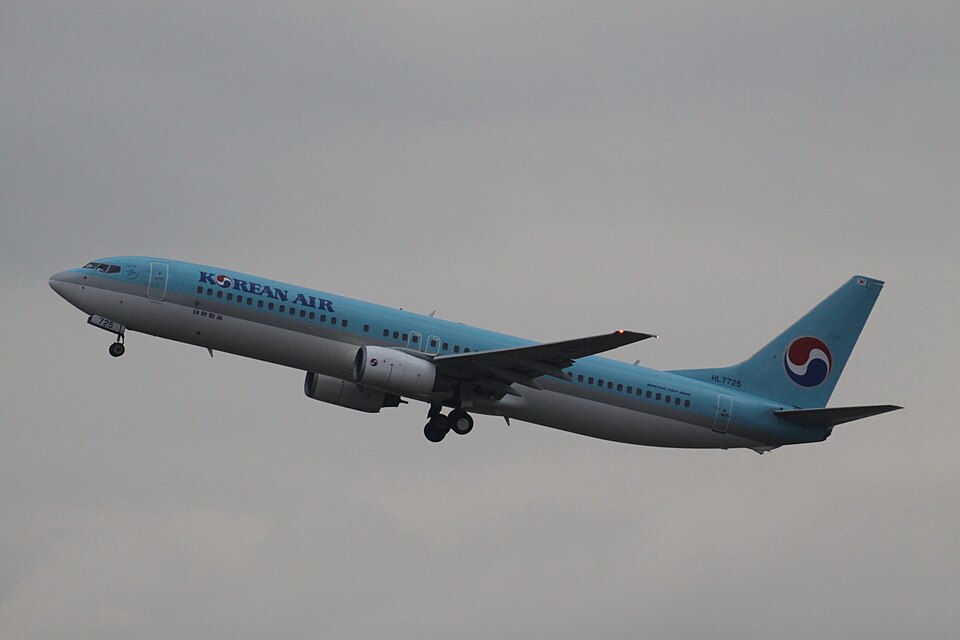
On Monday, April 9, 2018, a Boeing 737-900 registered HL7725, operated by Korean Air Lines Co., Ltd., was conducting scheduled flight 733 from Jeju International Airport to Kansai International Airport. At around 21:33 Japan Standard Time, during a go-around following a bounced landing on runway 06L, the aircraft sustained damage to the lower aft fuselage and the tail skid. There were 99 persons on board, comprising the pilot in command (PIC), seven other crew members, and 91 passengers. No injuries were reported.
Flight History
The approach was conducted under ILS for runway 06L. The captain, serving as pilot flying (PF), and the first officer (FO), as pilot monitoring (PM), had disengaged the autopilot and auto-throttle at approximately 1,200 ft radio altitude. The wind at the time included a tailwind component; the captain received wind information from the controller after passing BERRY waypoint, indicating wind from 030° at 30 kt, but later the landing clearance stated a crosswind of 3 kt. The captain planned an earlier idle thrust and flare to avoid a long touchdown. The FO noted the approach was stable except for lower-than-usual engine thrust.
At about 21:32:54, the captain moved the thrust levers to idle while initiating a flare at 2° pitch angle at approximately 30 ft radio altitude. The captain attempted to raise the nose and reduce the descent rate but found the maneuvers slightly delayed. The FO, perceiving the flare as insufficient and the descent rate high, pulled the control column without a call-out; the captain followed the FO's input. At 21:32:57, the right main landing gear touched down at a pitch angle of about 3.5°, and all spoilers deployed. After the left main gear touched down, the aircraft bounced. The maximum vertical acceleration recorded was 1.87 G.
Executing a go-around, the captain increased pitch; the pitch angle reached about 10° as the aircraft climbed. Approximately two seconds after the initial touchdown, both main landing gears made contact again. The FO noticed the high pitch angle and attempted to control the column. The crew did not realize the tail had struck the runway until scratch marks were found on the lower aft fuselage by mechanics after parking.
Damage
The aircraft sustained substantial damage: scratch marks approximately 210 cm in length and up to 36 cm in width on the lower aft fuselage, and damage to the tail skid. The tail skid is designed to prevent or reduce damage from a tail strike during excessive nose-up attitudes in takeoff or landing.
Personnel Information
The PIC was a 45-year-old male holding an airline transport pilot certificate with a Boeing 737 type rating. He had a total flight time of 5,893 hours, with 216 hours on the accident aircraft type. The FO was a 33-year-old male with a commercial pilot certificate and Boeing 737 type rating, totaling 1,796 flight hours, 792 hours on type.
Meteorological Information
Aeronautical weather observations at the airport at the time showed wind from 010° at 3 kt at 21:30, with visibility 10 km or more, scattered clouds at 3,000 ft. The anemometer was located about 450 m beyond the runway 06L threshold and 150 m north of the centerline. The controller provided this wind information to the aircraft. Upper-level winds from the Significant Weather Observation Chart indicated westerly winds aloft, decreasing near the surface.