Incident Summary
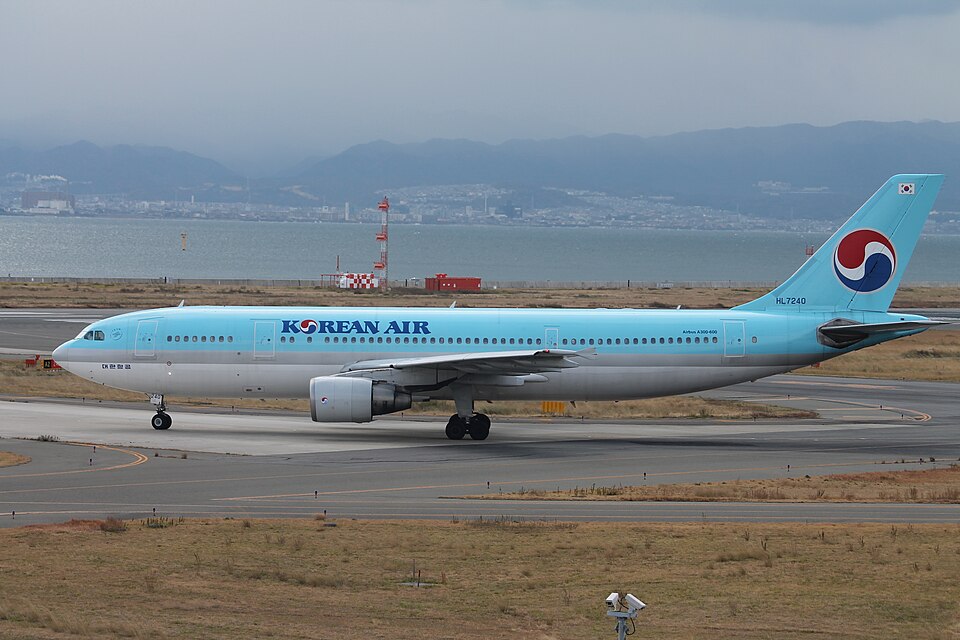
On June 23, 2009, at approximately 19:36 Japan Standard Time, Korean Air Flight KAL755, an Airbus A300B4-600R registered HL7240, experienced a cabin decompression while cruising at an altitude of about 33,000 ft over the vicinity of Hikari City, Yamaguchi Prefecture, Japan. The aircraft was operating a scheduled passenger flight from Jeju International Airport to Chubu Centrair International Airport. There were 164 people on board, including two pilots, eight cabin attendants, and 154 passengers. No injuries were reported, and the aircraft sustained no damage.
Flight History
The aircraft departed Jeju International Airport at 19:03:32. During climb, the engine anti-ice valves opened briefly at around 19:14:17 at an altitude of about 27,500 ft. The aircraft leveled off at 33,000 ft at 19:17:00. At 19:35:40, the wing anti-ice valves opened. Approximately one minute later, at 19:36:43, the No. 1 engine bleed valve closed, followed by the No. 2 engine bleed valve at 19:36:52, which turned off both packs. The crew noticed the cabin decompression and initiated an emergency descent. The aircraft began descending at about 19:38:40 at a rate of approximately 5,000 ft/min after receiving approval from air traffic control. The oxygen masks were deployed. The aircraft leveled off at about 9,400 ft at 19:47:00, then climbed to about 10,300 ft before landing at Chubu Centrair International Airport at 20:34:53.
Crew Actions
According to the pilot in command (PIC), after turning on the wing anti-ice, the ECAM displayed multiple fault messages including "ENG BLEED 1 FAULT," "ENG BLEED 2 FAULT," "PACK 1 FAULT," and "PACK 2 FAULT." The cabin altitude indicator showed abnormally high readings. The PIC and first officer experienced symptoms of hypoxia, such as dizziness and nausea, prompting them to don oxygen masks. The PIC attempted to manually close the outflow valves, but they did not respond. An emergency descent was declared, and the oxygen masks were manually released for passengers. After descending to 10,000 ft, the cabin altitude indication remained red, and a further descent to 9,000 ft was requested. All systems returned to normal during subsequent descent. The PIC confirmed no injuries among passengers and crew.
Investigation
The Japan Transport Safety Board investigated the serious incident. The aircraft's digital flight data recorder and cockpit voice recorder were analyzed. Inspections were conducted on the airframe and components, including at facilities in Canada. The investigation did not identify a probable cause for the decompression.