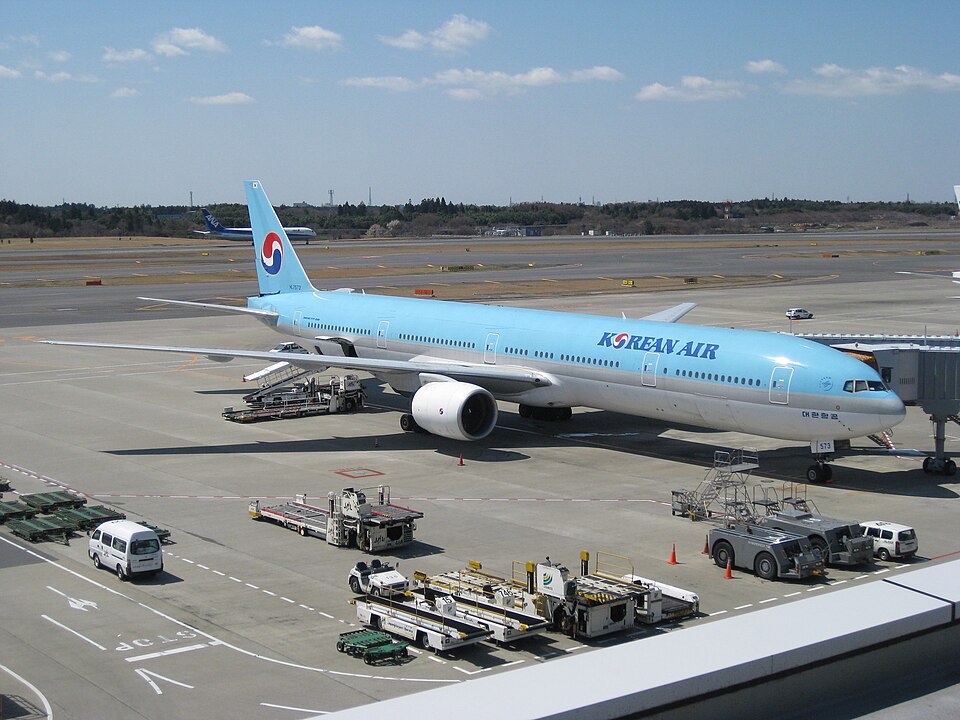
Summary
On June 29, 2018, at approximately 12:43 Japan Standard Time, Korean Airlines flight 703, a Boeing 777-300 registered HL7573, was forced to halt on taxiway K at Narita International Airport after its right main landing gear aft axle fractured during landing. The aircraft had touched down at 12:37 and was taxiing without issue until another aircraft reported seeing what appeared to be smoke near the right main landing gear. The ground controller instructed the aircraft to stop, and the captain complied. The aircraft remained on the taxiway until all 335 persons on board disembarked via buses around 14:20.
Flight History
Flight 703 departed Incheon Airport at 10:38 with 335 persons on board: the captain, 15 crew members, and 319 passengers. The approach and landing on runway 16L were normal. After touchdown, the aircraft decelerated and began taxiing. At 12:41, another aircraft reported sighting something like smoke on the right main landing gear. The ground controller directed the flight to halt, which the captain did at 12:43 between taxiway intersections E6 and E7.
Damage to Aircraft
Examination revealed the right main landing gear aft axle was fractured. Additional damage included:
- R-MLG truck beam damaged
- R-MLG steering system damaged
- Hydraulic hoses for brake and steering systems cut
- Hydraulic fluid leakage
- Brake components damaged
- Electric cables and junction box of the R-MLG damaged
No fire occurred. The aircraft was classified as slightly damaged.
Investigation
The Japan Transport Safety Board (JTSB) investigated the incident, with accredited representatives from the Republic of Korea and the United States participating. The fractured axle was attributed to a failure during landing. The aircraft's maintenance history included periodic inspections and overhauls, but the axle fracture was not anticipated. The JTSB noted that the aircraft's vertical acceleration at touchdown was 1.41 G, below the hard landing threshold of 1.9 G. No probable cause was stated in the report.
Additional Information
The main landing gear steering system uses hydraulic pressure to operate the aft axle. The pivot bore of the axle had press-fitted bushings lubricated by grease. Routine visual inspections did not cover hidden portions of the pivot. Similar axle cracks had been reported in a 2012 fleet team digest. The aircraft had accumulated 69,674 flight hours and 20,673 cycles at the time of the incident.