Introduction
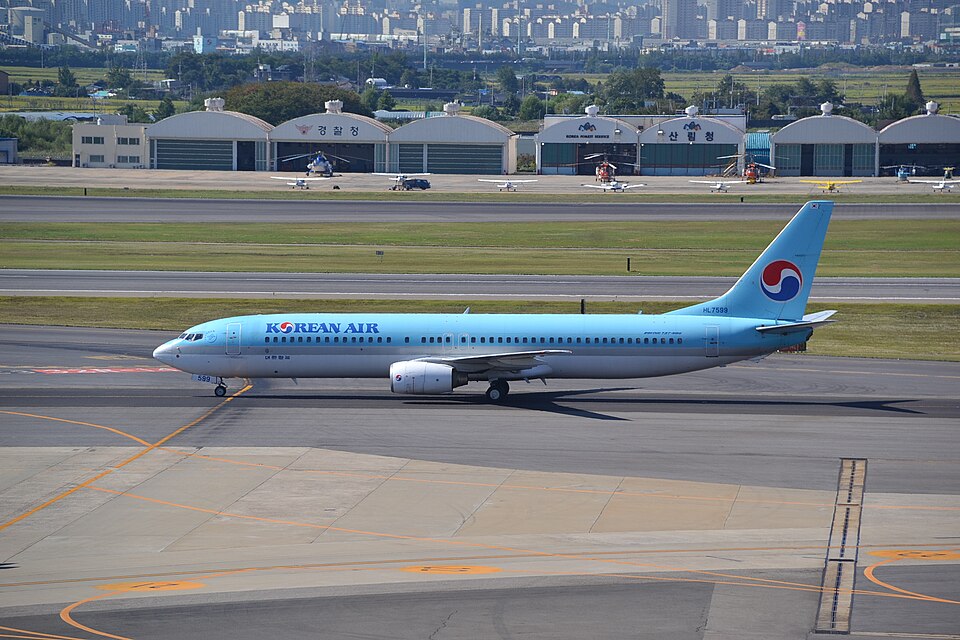
On August 5, 2013, at 19:42 Japan Standard Time, a Boeing 737-900 operated by Korean Air as scheduled flight KAL 763 landed on runway 10 at Niigata Airport. The aircraft was unable to stop within the runway and came to rest with its nose gear in the grass area at the easterly end of the runway. The aircraft carried a total of 115 persons: a captain, eight crewmembers, and 106 passengers. No injuries occurred.
Flight History
The aircraft departed Incheon International Airport at 18:09 under instrument flight rules. The flight plan estimated a total elapsed time of 1 hour 46 minutes to Niigata Airport, with Narita International Airport as the alternate. The captain served as pilot flying (PF) in the left seat, and the first officer (F/O) served as pilot monitoring (PM) in the right seat.
At 19:37:36, the aircraft made initial contact with Niigata Tower and was instructed to continue the approach for runway 10. At 19:38:27, the tower issued a landing clearance for runway 10 and reported wind from 040° at 4 kt. The autopilot was disengaged at about 1,000 ft altitude with an airspeed of 151 kt, followed by the auto throttle disconnection. The aircraft passed the runway 10 threshold at 150 kt and touched down at 143 kt with a vertical acceleration of 1.34 G. Speed brakes deployed automatically, and thrust reversers were used. At 19:41:06, the captain stated, "We are going to roll to the end of runway." The F/O responded affirmatively. The captain called for reverse idle at about 80 kt, and thrust levers were retarded. The speed brake lever stowed at 73 kt. The aircraft overran the runway.
Probable Causes
The Japan Transport Safety Board determined that the serious incident likely occurred because the captain did not reduce the aircraft's speed sufficiently while approaching the runway threshold lights, which he misunderstood as the stop bar lights for intersecting runway 04/22. When he realized there was no runway beyond those lights, the aircraft could not stop within the runway. Contributing factors included the crew's misinterpretation of an ATC instruction to "cross runway 04/22" as a clearance to cross during landing roll rather than a taxi instruction after vacating, and the captain disarming the autobrakes at about 70 kt, followed by inadequate manual braking. Additionally, the crew lacked familiarity with Niigata Airport's intersecting runway, and limited visual cues at night hindered their speed judgment at low speeds.