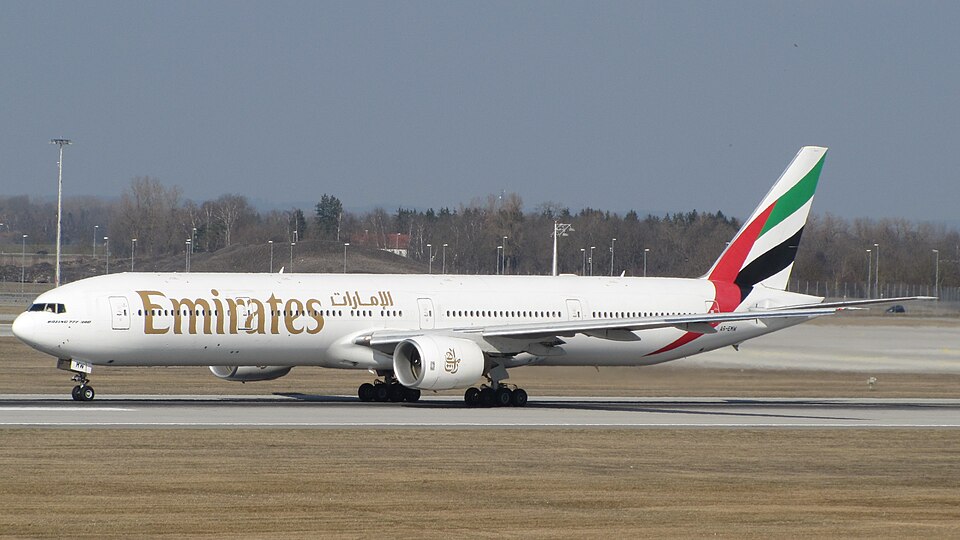
Accident Overview
On 3 August 2016, an Emirates Boeing 777-31H aircraft, registration A6-EMW, operating scheduled passenger flight UAE521, departed Trivandrum International Airport, India, at 0506 UTC for a flight to Dubai International Airport, United Arab Emirates. The aircraft carried 282 passengers, 2 flight crew, and 16 cabin crew members.
Approach and Landing Attempt
The commander attempted a tailwind manual landing during an ATIS-forecasted moderate windshear warning affecting all runways at Dubai. The tailwind was within the aircraft's operational limitations. During the landing on runway 12L, the commander, who was the pilot flying, decided to execute a go-around because he was unable to land the aircraft within the runway touchdown zone. The go-around decision was based on the perception that the aircraft would not land due to thermals, not a windshear encounter. The commander elected to fly a normal go-around, not the windshear escape maneuver.
Go-Around and Accident Sequence
The flight crew initiated the FCOM Go-around and Missed Approach Procedure. The commander pushed the TO/GA switch, but because the aircraft had touched down, the TO/GA switches became inhibited and had no effect on the autothrottle. The flight crew stated they were unaware of the touchdown, which lasted six seconds. After becoming airborne during the go-around, the aircraft climbed to 85 feet radio altitude. The flight crew did not observe that both thrust levers remained at idle and engine thrust remained at idle. The aircraft quickly sank, and the commander initiated the windshear escape maneuver too late to avoid impact. Eighteen seconds after go-around initiation, the aircraft impacted runway 12L at 0837:38 UTC, slid on its lower fuselage for approximately 800 meters over 32 seconds, and came to rest adjacent to taxiway Mike 13.
Damage and Evacuation
The aircraft remained intact during the slide, but several fuselage-mounted components and the No. 2 engine/pylon assembly separated. During evacuation, several passenger door escape slides became unusable. Many passengers evacuated with their carry-on baggage. The commander and senior cabin crew member evacuated after the center wing tank explosion; all other occupants evacuated via operational escape slides in approximately 6 minutes and 40 seconds. Twenty-one passengers, one flight crew member, and six cabin crew members sustained minor injuries; four cabin crew members sustained serious injuries.
Post-Accident Fire
Approximately 9 minutes and 40 seconds after the aircraft came to rest, the center wing tank exploded, causing a large section of the right wing upper skin to separate. The panel fell to the ground, striking and fatally injuring a firefighter. The aircraft was eventually destroyed by the subsequent fire.
Safety Actions and Investigation
Following the accident, the operator (Emirates), the General Civil Aviation Authority, Dubai Airports, and Dubai Air Navigation Services implemented several safety actions. The Air Accident Investigation Sector issued safety recommendations to multiple entities.
Probable Cause (Official Findings)
The Air Accident Investigation Sector determined that the causes of the accident are: (a) During the attempted go-around, except for the last three seconds prior to impact, both engine thrust levers, and therefore engine thrust, remained at idle; the aircraft's energy state was insufficient to sustain flight. (b) The flight crew did not effectively scan and monitor primary flight instrumentation parameters during the landing and attempted go-around. (c) The flight crew were unaware that the autothrottle had not responded to move the thrust levers to TO/GA after the commander pushed the switch. (d) The flight crew omitted engine thrust verification steps of the FCOM go-around procedure. Contributory factors included: (a) Inability to land within touchdown zone due to early flare and wind shift; (b) Commander's perception that aircraft was airborne when pushing TO/GA; (c) Inaccurate situation awareness and stress leading to unawareness of touchdown and inhibited TO/GA; (d) Reliance on automation and lack of training for go-arounds from close to runway with inhibited TO/GA; (e) Failure to monitor flight mode annunciations due to procedural gaps; (f) Operator's policy requiring autothrottle use without considering inhibited TO/GA scenarios; (g) FCOM procedure lacking verbal verification callouts for thrust; (h) Aircraft systems not alerting crew to inhibited TO/GA; (i) Systems not alerting to configuration-thrust inconsistency; (j) Air traffic control not passing critical windshear information from preceding aircraft; (k) ATC modification of go-around procedure coinciding with landing gear retraction, increasing workload.