Incident Overview
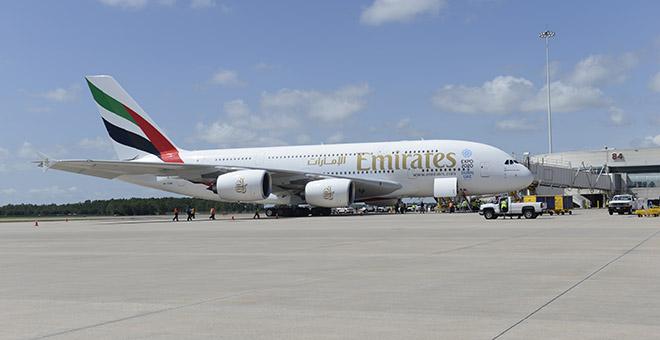
On 18 August 2023, an Airbus A380-800 registered A6-EOM, operated by Emirates, was on approach to Nice-Côte d’Azur Airport performing flight EK77 from Dubai. While on an RNP 04L approach over the sea approximately 15 km off the coast of Cap d’Antibes, at an altitude of about 3,500 ft and a speed of 212 kt, the pilot monitoring selected configuration 1. The crew perceived a muffled noise followed by slight vibrations. They continued the approach and landed without any warning being activated.
Damage and Inspection
On the ground, an inspection revealed that leading edge slat No 2 of the right-hand wing was significantly damaged: the upper and lower skin of the trailing edge was torn over approximately two-thirds of the slat, and the honeycomb structure was partially missing.
Examination and Reclassification
The BEA initially classified the occurrence as an accident due to potential altered performance or flight characteristics. Examinations under UV light and analysis of deformations excluded the hypothesis of a mid-air collision with a bird or drone. Further investigations on the damaged slat and a similar slat from another occurrence identified bonding ruptures between the honeycomb and the skin, some associated with bonding defects. The cause of these defects has not yet been identified. Airbus informed the BEA that it was continuing to search for the cause as part of continuing airworthiness under EASA supervision.
Subsequent simulations by Airbus showed that the damage had no measurable effect on the aeroplane's flight properties and performance, with no loss of lift affecting safety margins. Consequently, the BEA reclassified the occurrence as an incident.
Additional Information
The aircraft, MSN 187, was delivered new to Emirates in August 2015 and had accumulated 3,084 flights and 30,455 flight hours at the time of the incident. The damaged slat was the original. In the seven months following the incident, three other Airbus A380s operated by Singapore Airlines experienced similar damage to leading edge slats (one slat No 2 and two slat No 4s). These occurrences did not lead to investigations by authorities.
Structure of Leading Edge Slats
The A380 slats consist of a metal box connected to the wing structure and a trailing edge made of a metal sandwich composite structure riveted to the box. In the event of major damage to the trailing edge, the main part of the slat remains intact, and the risk of total slat loss does not exist; only fragments from the trailing edge may separate.
Manufacturer Actions
Airbus recorded the three other similar occurrences and carried out examinations revealing internal structural defects that may have led to these incidents. Airbus is continuing analysis to determine the cause of these defects. Pending conclusions, inspections on all A380s operated by the two concerned operators found no similar damage. Airbus plans to issue two service bulletins to all A380 operators in January 2026, introducing repetitive inspections during A and C checks to identify possible cracks or delamination on trailing edges of leading edge slats.