Introduction
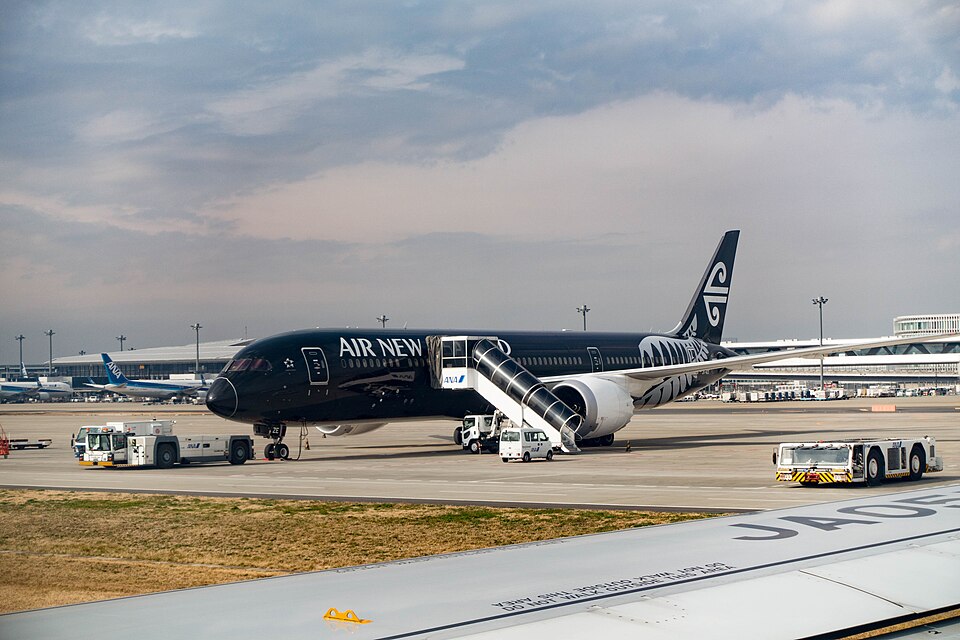
On 5 December 2017, a Boeing 787-9 operated by Air New Zealand on a scheduled passenger flight from Auckland to Narita, Japan, experienced an engine anomaly during climb. The flight crew shut down the affected Rolls-Royce Trent 1000-J2 (Package C) engine (serial number 10231) and returned to Auckland International Airport without further incident.
The following day, 6 December 2017, another Air New Zealand Boeing 787-9 on a scheduled passenger flight from Auckland to Buenos Aires, Brazil, experienced an engine anomaly during climb. The flight crew received over-temperature alerts for the right engine, reduced its thrust to idle, and returned to Auckland without further incident. The affected engine was serial number 10227.
Both events occurred during the climb phase of flight. Initial borescope inspections found that a turbine blade in the intermediate-pressure turbine (IPT) module had fractured and separated from the IPT disc. Features indicating corrosion fatigue cracking were identified. In the first occurrence, the released blade caused significant damage to the IPT and low-pressure turbine modules, with debris striking the right horizontal stabilizer, wing underside, and fuselage rear. The second occurrence had damage mainly confined to the IPT module.
Background
The Rolls-Royce Trent 1000 is one of two engine types for the Boeing 787. It was certified by the European Aviation Safety Agency (EASA) in 2007 and approved for extended diversion time operations (EDTO) up to 330 minutes. The Boeing 787-9 was certified by the U.S. Federal Aviation Administration (FAA) in June 2014. Air New Zealand, a launch customer for the 787-9, had regulatory approval for 330-minute EDTO since September 2016.
At the time of these incidents, the engine manufacturer had a separate management programme for cracking of intermediate-pressure compressor blades. However, the IPT blade issue was distinct.
IPT Blade Cracking
According to the engine manufacturer, there had been six in-flight IPT blade separations in Trent 1000 engines worldwide before the Air New Zealand incidents. All eight incidents (including the two New Zealand ones) occurred during take-off or climb, when stress is highest. The manufacturer stated that the blade separations followed cracking in the blade shank initiated by a "corrosion fatigue mechanism." It was likely that a combination of environmental and operational factors, potentially operator-specific, were involved.
To address the issue, the manufacturer issued a service bulletin (Non-Modification Service Bulletin Trent 1000-72-AJ575, November 2016) to replace all IPT blades with redesigned blades made from a different alloy and with an improved corrosion-protective coating. Modifications could only be done at approved overhaul facilities. Due to the large number of engines requiring modification, a risk mitigation programme called the Corrosion Fatigue Lifing (CFL) model was instituted. This model predicted crack propagation and defined the engine cycles at which engines must be removed for modification, based on material fatigue theories, laboratory analyses, and engine health monitoring data. EASA airworthiness directive 2017-0056 mandated the CFL model actions.
The Transport Accident Investigation Commission (Commission) opened inquiries AO-2017-009 and AO-2017-010 for the two incidents. The investigations continued with assistance from involved organizations.