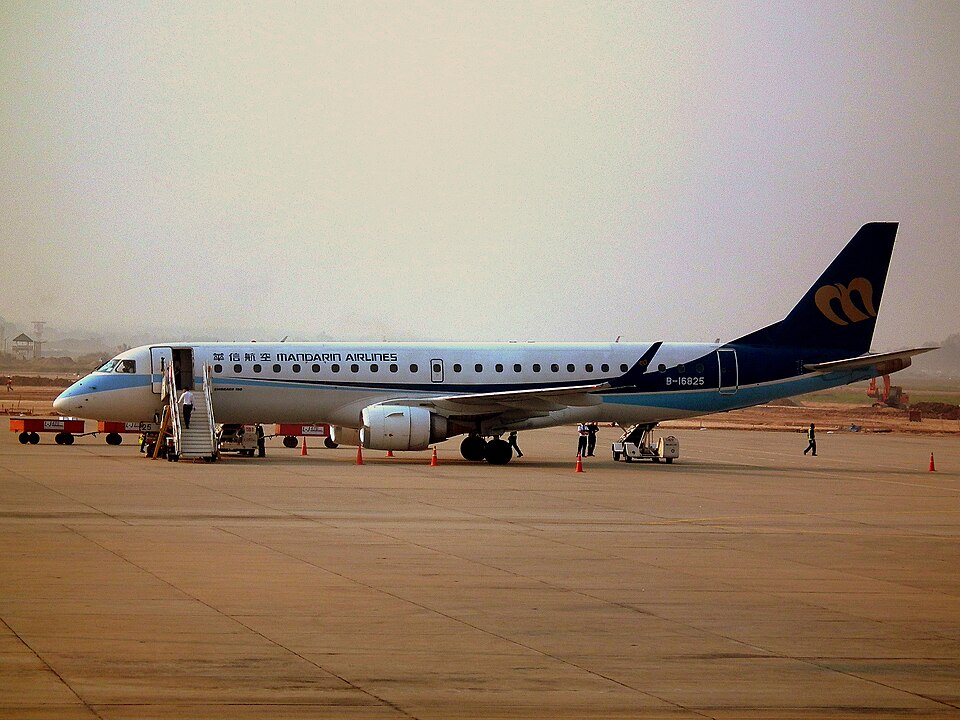
Incident Overview
On August 17, 2012, Mandarin Airlines flight AE369, an Embraer ERJ-190 with registration B-16825, departed Songshan Airport for Magong Airport. The aircraft carried 2 pilots, 1 flight engineer, 3 cabin crew, and 104 passengers, totaling 110 occupants. All occupants were uninjured.
Flight and Weather Information
During cruise, the flight crew received ATIS O indicating weather conditions that did not meet the approach criteria for the VOR/DME 20 runway. The aircraft slowed in anticipation of holding at the TOMMY waypoint. Kaohsiung Approach Control later advised of updated ATIS P, which met the criteria. The crew briefed for the approach and configured the aircraft with Flaps 5 and auto brakes set to medium.
Landing and Runway Excursion
The aircraft touched down at 2124 on runway 20. During the landing roll, it veered left onto the grass, struck four manholes, and then impacted the K1 taxiway edge light manhole, causing the nose landing gear to collapse. The aircraft came to a stop.
Investigation Findings
The investigation by the Aviation Safety Council (ASC) found that the flight crew executed an early flare, failed to retard the throttles to idle, and continued to apply back pressure during the float, resulting in touchdown beyond the runway's touchdown zone. The crew did not execute a go-around or rejected landing. After touchdown, they did not use optimal deceleration procedures and mistakenly believed the aircraft was hydroplaning, leading to the decision to steer onto the grass at the runway end.
Additional findings included that the aircraft's auto brake and reverse thrust systems had no recorded faults. There was no evidence of hydroplaning. The runway's cross slope was measured to be less than 1%, below the minimum requirement of 1%. The runway surface friction and markings met standards. The ERJ-190 flight manual did not contain wet runway landing distance data, and the operator's manuals lacked standard callouts for deviations from normal operations.
Probable Cause
The probable cause, as determined by the ASC, is the flight crew's improper landing technique: early rotation, failure to reduce throttles to idle, continued back pressure during float resulting in touchdown beyond the landing zone; failure to go around or abort landing; after touchdown, failure to use optimal deceleration, mistaken belief of hydroplaning, and maneuvering the aircraft off the runway onto the grass, causing the nose gear to strike the taxiway edge light manhole and resulting in nose gear damage.