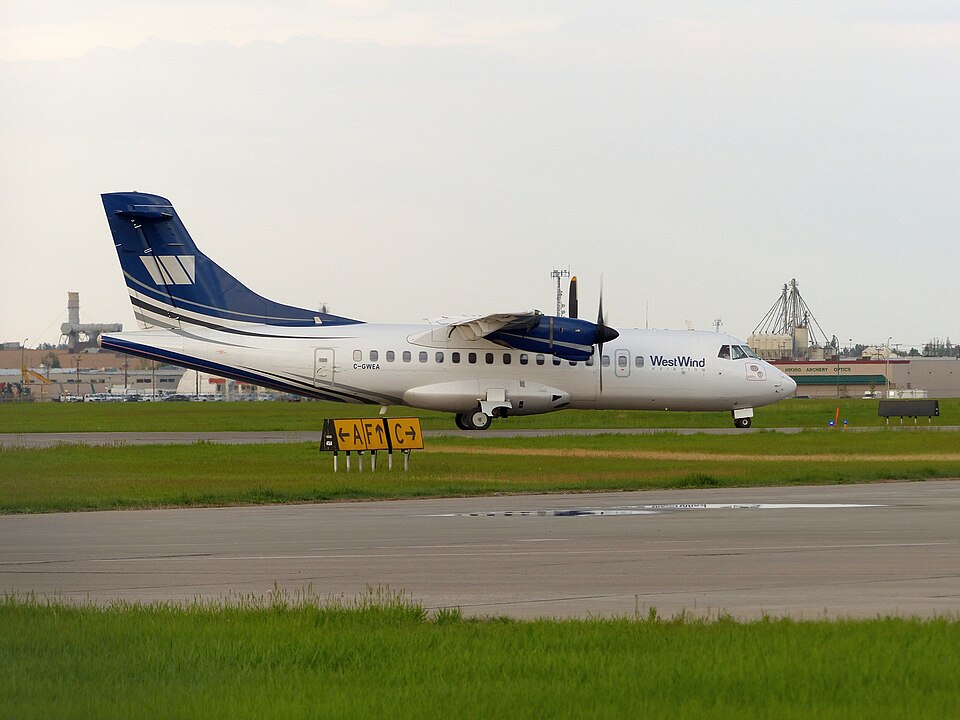
Accident Overview
On 13 December 2017, an Avions de Transport Régional ATR 42-320, registration C-GWEA, serial number 240, operated by West Wind Aviation L.P. as flight WEW282, crashed 17 seconds after takeoff from Fond-du-Lac Airport in Saskatchewan. The aircraft was departing for Stony Rapids Airport with 3 crew members and 22 passengers. The collision caused significant damage, one passenger death, and two serious life-changing injuries.
Pre-Flight and Icing Conditions
The flight crew and dispatcher were aware of forecast icing along the route. The aircraft flew from Saskatoon/John G. Diefenbaker International Airport to Prince Albert (Glass Field) Airport without difficulty, then proceeded toward Fond-du-Lac Airport. On approach, the aircraft encountered in-flight icing, and the crew activated anti-icing and de-icing systems. However, residual ice accumulated because the de-icing boots were not designed to shed all ice, and anti-icing systems did not prevent ice on unprotected surfaces. Post-accident analysis of flight data recorder data showed drag increased by 28% and lift decreased by 10% shortly before landing at Fond-du-Lac at 1724 Central Standard Time. After landing, the aircraft was on the ground for approximately 48 minutes. Although no precipitation or fog was observed, weather conditions were conducive to ice or frost formation. Residual mixed ice on the aircraft acted as nucleation sites, causing additional ice or frost to form on critical surfaces.
Inspection and Departure Decision
After passengers boarded, the first officer completed an external inspection using inadequate equipment—walking around and looking at the left wing from the top of the stairs at the left rear door without a flashlight on the dimly lit apron. He informed the captain that some ice was present, but the captain did not inspect the aircraft or arrange de-icing. Company departures from remote airports with surface contamination had become common practice due to inadequate de-icing facilities, normalizing this unsafe behavior. The flight crew, influenced by continuation bias, decided to proceed, perceiving initial cues supporting their plan as more compelling than later cues suggesting a different course of action.
Departure and Loss of Control
At 1812 Central Standard Time, in darkness, the aircraft began its takeoff roll on Runway 28 and became airborne 30 seconds later. Due to residual ice from the approach and additional ice accreted during the ground stop, drag increased by 58% and lift decreased by 25% during takeoff. Immediately after liftoff, the aircraft rolled left without pilot input due to asymmetric lift distribution from uneven ice contamination. The captain reacted as if the aircraft were uncontaminated, expecting normal handling qualities, but diminished roll damping caused unexpected dynamic response. Although the investigation determined that ailerons had sufficient roll control authority to counteract asymmetric lift, the roll disturbance developed into an oscillation with growing magnitude, and roll control was lost. This loss of control, consistent with known risks of ice contamination, led to the aircraft colliding with terrain 17 seconds after takeoff with a 30° left bank and relatively level pitch.
Impact and Injuries
The sudden vertical deceleration caused severe structural damage. The main landing gear at the bottom of the center fuselage was rigid and did not absorb or attenuate impact loads, causing the wing support structure to fail and the wing to collapse into the cabin. Reduced survivable space between the floor above the main landing gear and the collapsed upper fuselage resulted in crushing injuries to passengers in the middle-forward left section. One passenger died, and two others in that area sustained serious life-changing injuries. Collapse of floor structure compromised restraint systems, leading to velocity-related injuries. Most passengers did not brace for impact, resulting in jackknifing and flailing injuries. The flight attendant seat failed on impact due to unapproved repairs, impeding her ability to perform evacuation and survival actions.
Investigation Findings
The investigation found that the ATR 42 was not designed with crashworthy principles, as design standards at certification did not specify minimum loads for fuselage impact energy absorption. The landing gear housing did not deform, and unattenuated acceleration caused the wing to collapse. The ailerons had sufficient authority, but the unexpected handling qualities due to ice contamination led to loss of roll control.