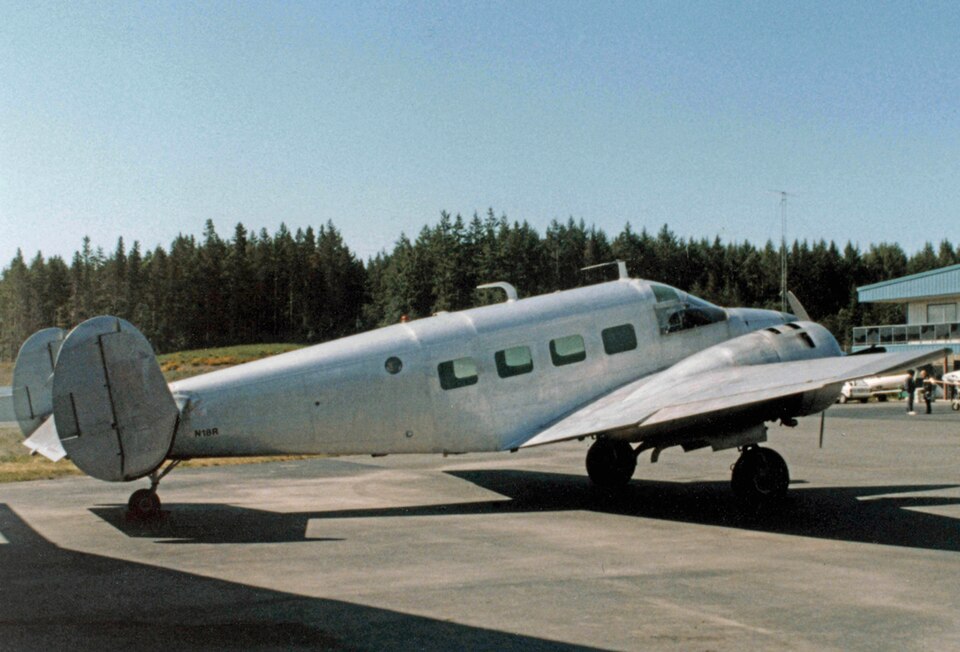
Accident Summary
On the day of the accident, the pilot, who also served as president, director of operations, and chief pilot for the on-demand passenger and cargo operation, departed from his home airport using runway 9L and proceeded eastbound. He advised the air traffic controller that he was turning downwind. Witnesses reported that the airplane did not sound like it was developing full power. The airplane climbed to approximately 100 feet above ground level, then banked left, began losing altitude, and impacted a tree, a fence, and two vehicles before coming to rest in a residential area. A postcrash fire ensued, consuming most of the cabin area and the left wing.
Examination Findings
Examination of the accident site revealed that the airplane struck a tree with its left inboard wing about 20 feet above ground level. Multiple tree branches with propeller cuts were found near the base of the tree, and propeller strike marks on the ground corresponded to the location of the No. 1 (left side) propeller. There were minimal propeller marks from the No. 2 (right side) propeller. Inspection of the propellers showed that the No. 1 propeller blades had chordwise scratching and S-bending, consistent with operation at impact, but the No. 2 propeller blades lacked such damage, indicating the No. 2 engine was not producing power at the time of impact.
No evidence was found that the pilot attempted the manufacturer's published single-engine procedure, which would have allowed him to maintain altitude. Instead, the left and right throttle control levers were in the full-throttle position, the mixture control levers were in the full-rich position, neither propeller was feathered, and the landing gear was down.
Postaccident examination of the No. 1 engine revealed no preimpact malfunction or failure. However, the No. 2 engine's condition would have resulted in erratic and unreliable operation; the engine could not produce full rated horsepower because compression on four of its nine cylinders was below specification and both magnetos were not functioning correctly. Moisture and corrosion were found inside the magneto cases; the left magneto sparked internally in a random pattern and its point gap exceeded the required tolerance. The right magneto's camshaft follower exhibited excessive wear, and its points would not open, rendering it incapable of supplying electrical energy to its spark plugs. Additionally, the main fuel pump could not be rotated by hand, exhibited play in its gear bearings, and had internal corrosion.
When not flying, the airplane was kept outdoors. Large amounts of rain had fallen during the week before the accident, which could have led to the moisture and corrosion in the magnetos.
Maintenance Issues
According to the source, the pilot had been experiencing problems with the No. 2 engine for months but continued to fly the airplane, despite his responsibilities as president, director of operations, and chief pilot to ensure airworthiness. During this period, he would take off with the engine shuddering and circle the departure airport to gain altitude before proceeding to the destination.
The night before the accident, the director of maintenance (DOM) replaced the No. 1 cylinder on the No. 2 engine, which had a crack in the fin area and oil seepage. After the replacement, the DOM did not perform a compression check or check the magnetos; such checks would likely have revealed the low compression in four remaining cylinders, malfunctioning magnetos, and the need for further maintenance. Review of the airplane's maintenance records showed no entry for the cylinder installation. The last recorded maintenance was an annual and 100-hour inspection approximately 11 months before the accident.
Probable Cause
The pilot's improper response to a loss of power in the No. 2 engine and his failure to ensure that the airplane was airworthy. Contributing to the accident was the inadequate engine maintenance by the operator's maintenance personnel.