Flight History
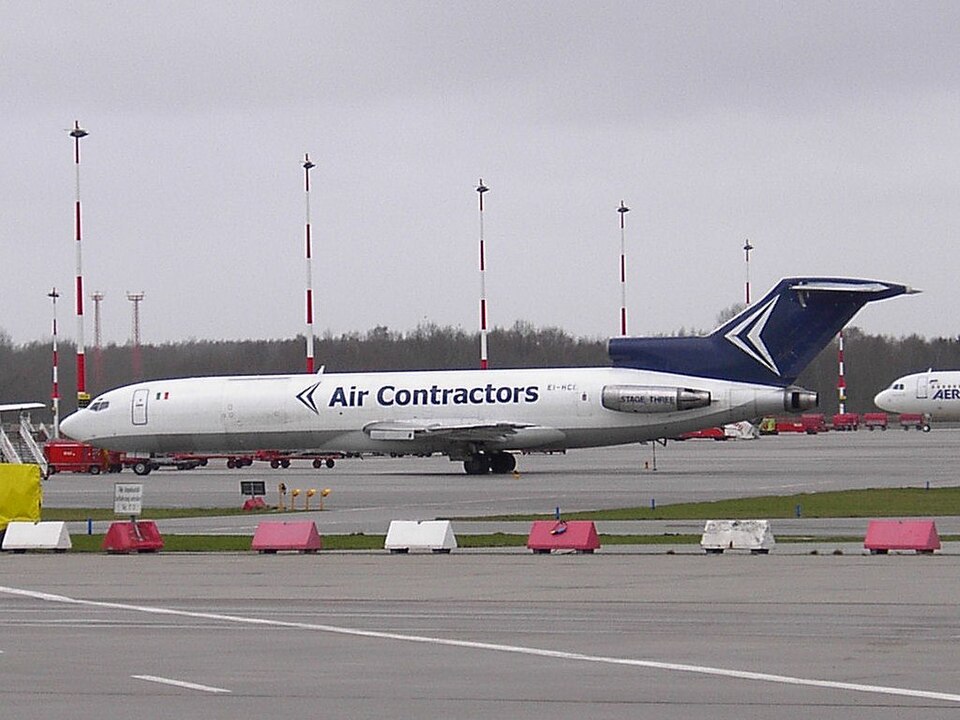
On 14 September 2001, a Boeing 727-223RE (registration EI-HCI) was operating a scheduled cargo service. The three crew members reported at 0330 UTC in Copenhagen, Denmark. The aircraft, already loaded with containers and loose cargo, flew to Orebro, Sweden, where all cargo was unloaded. It then flew empty to London Luton Airport, arriving at 0835 UTC. The next departure, to Brussels, was scheduled for 1035 UTC.
At Luton, the aircraft was loaded by a contracted handling company. The takeoff mass was calculated at 150,526 lb (68,339 kg), well below the maximum of 177,600 lb (80,630 kg). The crew prepared for a flap 5° takeoff from Runway 26, with V1/Vr of 121 kt and stabilizer trim set at 4.66 units.
After pushback at 1055 UTC, the aircraft taxied for departure. The runway was dry, with wind from 330° at 13 kt. The commander, the handling pilot, initiated rotation at 121 kt, but the aircraft did not respond. He increased aft control column movement significantly, but still no response. He then used the electric trim switches to apply nose-up trim; the aircraft rotated and lifted off. After takeoff, he delayed the initial turn as per the Standard Instrument Departure until confident of control. Normal control was regained, and the flight continued to Brussels.
Upon landing in Brussels, ground crew discovered the cargo was not distributed per the load plan. The actual container positions were recorded and compared to the planned load. A revised loadsheet showed that the center of gravity (CG) was close to the forward limit for takeoff and outside the forward limit for landing. Two additional aft trim units should have been set.
Loading Procedures
The handling company had written procedures for cargo aircraft. Audits in June and August 2001 did not identify significant issues. The aircraft's upper deck could hold 12 bulk containers, each occupying full width and height. Containers were secured with floor locks.
For empty positioning flights, all locks should be in the UP position. On arrival, locks were kicked down and reset per the next load plan. The loadplan was compiled in a remote office and sent to the cargo shed. A ramp coordinator supervised loading. Containers were moved by transporter and lifted onboard by highloader. At least four people manhandled each container into position. The first container had to be loaded in Bay A, then Bay B, then aft bays. After the first container, access from the flight deck to the load area was blocked. The commander received the final loadplan and loadsheet when loading was complete; there was no requirement to check the final load.
Loading History
Before the incident, the aircraft had been loaded in Copenhagen with aft bays L and M unused; all locks were up in those bays. At Orebro, all cargo was unloaded. At Luton, loading was delayed because the loadplan was not ready. At 1000 UTC, a three-minute silence was observed for the September 11 events; the loading crew and flight crew stood on the ramp.
Aware of the delay, the dispatcher contacted the office and jotted down details for the first container (Bay A) and the rearmost container (Bay M). These were loaded before the loadplan was available. However, the rearmost container was mis-identified for one with a similar number and loaded in Bay K instead of Bay M. During loading, the ramp coordinator drove the transporter and could not see into the rear of the aircraft. He was the only one with a loadplan copy; the print was small. Remaining containers were loaded forwards from Bay K, except one in Bay B. After loading, one empty bay was visible in the doorway, whereas there should have been three empty bays. This discrepancy was not noticed. A loading crew member checked locks and signed the loadplan. The loadplan and loadsheet were presented to the commander, who signed.
Flight Recorder Analysis
The aircraft was fitted with a Sundstrand Digital Flight Data Recorder (DFDR) that recorded mandatory and additional parameters, including control column position. Analysis corroborated crew statements. At rotation initiation (airspeed ~122 kt), the control column moved aft, but no change in pitch attitude occurred for about 5 seconds. The control column moved to nearly full aft and remained there until lift-off. Pitch rate was about 1° per second, less than normal. The data could not precisely determine lift-off time but inferred airborne between 140 and 150 kt. A comparison with a previous takeoff showed little lag and normal pitch response.
The cockpit voice recorder data had been overwritten by subsequent flights.
Other Information
Further loadsheets prepared for the investigation showed that the actual CG was close to the forward limit for takeoff.