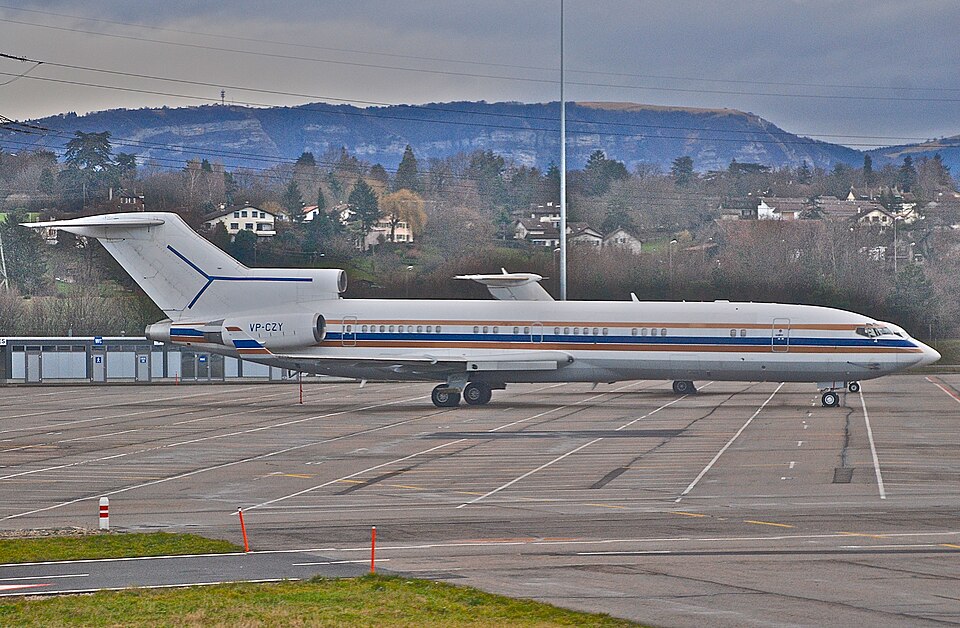
Incident
On 30 October 2001 at 1915 UTC, a Boeing 727-2P1 (registration VP-CZY) sustained substantial damage during landing at London Luton Airport. The aircraft was on a private flight from Istanbul, Turkey. There were five crew members and three passengers on board; none reported injuries.
Aircraft and Crew
The aircraft, manufactured in 1979, was powered by three Pratt & Whitney JT8D-217C/17(BFG) turbofan engines. The commander, aged 36, held an Airline Transport Pilots Licence and had 6,650 total flying hours, including 92 hours on type. In the last 90 days he had flown 101 hours, with 8 hours in the last 28 days.
Sequence of Events
The aircraft was vectored for an approach to Runway 26. The Luton ATIS for 1830 hrs reported surface wind 220°/16 kt (varying 260° to 140°), visibility 8 km, cloud base 2,000 ft, temperature 14°C, and windshear on final approach.
The approach was uneventful with continuous light turbulence causing indicated airspeed variations of ±5 kt. The calculated approach speed (Vref) was 129 kt; the crew added 12 kt for variable wind and reported windshear, setting a bug speed of 141 kt. The pilot estimated crossing the runway threshold at 50 ft at 135 kt.
At about 20 ft above the runway, the pilot felt the aircraft sink rapidly and raised the nose to 7°-8° pitch up. This had little effect on the descent rate, and the aircraft touched down firmly on both main wheels and bounced. The pilot raised the nose further to cushion the bounce, and during the second touchdown the tail skid struck the ground.
Damage
After clearing the runway, another pilot reported debris on the runway. Inspection revealed the tail skid plate had been scraped off, the tail skid had been depressed by about 3 inches, two-thirds of the No 3 VHF aerial had broken off, and the aircraft skin around the aerial had buckled.
Conclusion
The pilot reported that windshear, the uphill aspect of the runway, and insufficient currency on type all contributed to the incident.