Background
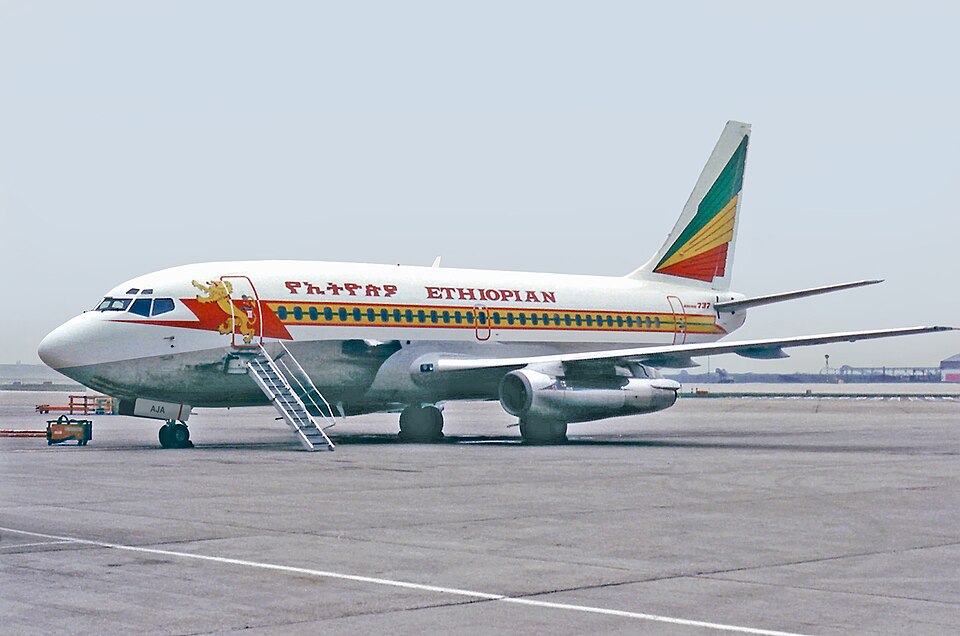
Ethiopian Airlines Flight 604 was a scheduled passenger service from Addis Ababa to Bahar Dar and Asmara, operated by a Boeing 737-200. The first leg of the flight proceeded without incident.
Sequence of Events
At 09:50, the engines were started normally and the aircraft taxied to the take-off position. The flight crew elected not to use engine bleed air during take-off to gain additional thrust. The airplane accelerated normally during the take-off roll and passed V1 (take-off reject speed). As it neared VR (rotation speed), the crew observed a flock of pigeons lifting off from the left side. The captain took control from the copilot and initiated a pull-up.
Shortly after rotation, at an airspeed of 146 knots and altitude of 5,730 feet above mean sea level, the airplane struck the flock of pigeons. Loud bangs were heard. The captain called for gear up, and the copilot complied. At approximately 100–200 feet above the ground, both engines began backfiring. The crew experienced considerable power loss, and the aircraft started mushing down. The captain then advanced the thrust levers to full power ("firewalled"). The engines responded, and the airplane began to gain altitude.
Encouraged by the altitude gain, the captain executed a right turn away from Lake Tana, heading back to the take-off runway for landing. During the first 32 seconds after impact, the aircraft climbed from 5,730 to 6,020 feet and accelerated from 146 to 154 knots. Both engines continued to surge; exhaust gas temperature (EGT) gauges indicated the top extreme, and engine pressure ratio (EPR) gauges fluctuated around 1.6. The captain reduced engine thrust to prolong engine life, which decreased the frequency of surges.
The airplane entered an approximate 90-degree right turn, maintaining 6,020 feet while speed increased to 162 knots. It then began another right turn onto the downwind leg for return to runway 04. Altitude reached 6,410 feet and speed 173 knots. On downwind, the aircraft climbed to 7,100 feet. Within about five seconds, both engines lost power completely. The copilot pointed out a cleared area slightly ahead and to the right; the captain turned toward it and performed a gear-up landing. The aircraft broke up, and a fire erupted.
Aftermath
Out of the 104 occupants on board, 35 suffered fatal injuries.