Incident
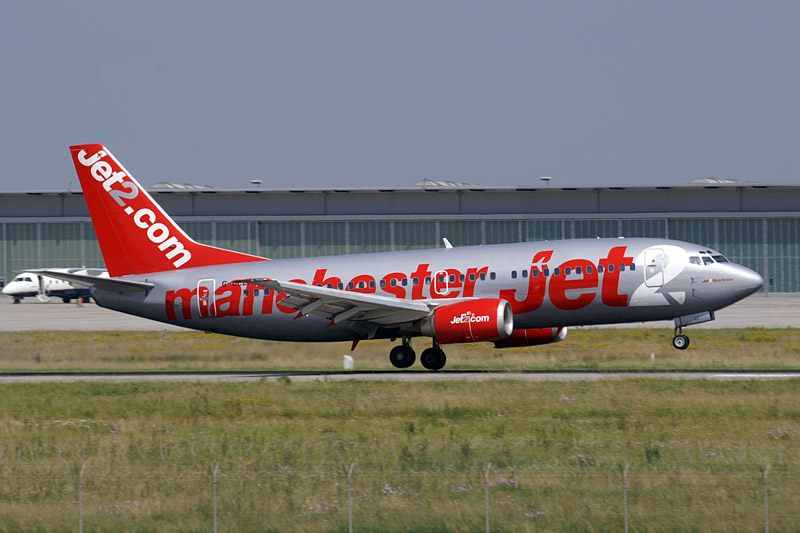
On 19 October 2009, a Boeing 737-300, registration G-CELI, was operating a commercial passenger flight from Manchester Airport to Budapest. The aircraft departed the stand at 1259 hrs UTC. The ATIS report at 1250 hrs indicated a surface wind of 180°/11 kt, variable between 140° and 210°, visibility over 10 km, temperature 13°C, and a dry surface.
Takeoff and Swing
The aircraft taxied for a full-length takeoff on Runway 23 Right. The takeoff mass was 51.4 tonnes, and a flap 5 takeoff was planned with reduced thrust using the assumed temperature method. Takeoff speeds were V1 = 126 kt, Vr = 137 kt, and V2 = 144 kt. The co-pilot was the handling pilot; control was transferred from the commander after alignment on the runway. ATC reported the wind at takeoff time as 200°/7 kt.
Soon after the commander made a routine "EIGHTY KNOTS" call, the crew experienced a rapid swing to the right. The co-pilot recalled applying full left rudder pedal, but it was insufficient. The commander took control and rejected the takeoff. The aircraft was approaching the runway edge, and a combination of rudder and nosewheel steering reportedly regained the centerline.
Post-Incident Actions
The crew brought the aircraft to a stop on the runway, attended by airport fire services. No obvious defects were visible. After inspection, the aircraft taxied to a remote stand, where passengers disembarked. Both flight crew described the swing as unexpected and sudden, more violent than simulator practice for engine failure.
Examination
Initial examination revealed the steering metering valve was leaking and was replaced. Nosewheel steering and rudder systems were tested per maintenance manual and found satisfactory. Tyre pressures and wheel braking were checked with no faults. The flap system showed no asymmetry. A maintenance test flight was conducted without incident, and the aircraft returned to service with no further directional control problems reported.
The steering metering valve was sent to an overhaul agency. Before disassembly, internal leakage was within limits. Minor wear was found on internal components, but it was thought not to significantly affect valve operation.
Maintenance History
The steering metering valve had been installed in May 2000. It was removed on 5 December 2007 due to leakage during a C Check, repaired, and reinstalled. At removal after the incident, time since overhaul was 20,198 hrs and cycles since overhaul 14,304. There was a long history of directional control problems on G-CELI during landing roll, including entries on 22 May 2008, 27 May 2008, 26 April 2009, 14 May 2009, 29 May 2009, and 8 June 2009. These involved reports of requiring full rudder or limited effect. Various components were replaced or checked, including the rudder pedal steering actuator and a relay. No faults were found on most checks.
Flight Recorder Data
The aircraft had a 25-hour FDR and 2-hour CVR. Due to age and regulations, rudder control surface position was not recorded; rudder pedal position was recorded. Tiller and nosewheel steering were not recorded. FDR data showed that as the aircraft accelerated, increasing right rudder pedal was required to maintain heading. At about 83 kt, the rudder pedal deflected further right, reaching full travel one second later. Maximum lateral acceleration to the right of 0.3 g occurred about two seconds later, at which point the crew rejected takeoff. A heading change of about 10° to the right was recorded. Subsequently, a large left rudder pedal input to just under full travel was recorded, followed by maximum lateral acceleration to the left of 0.3 g and return to runway heading. During deceleration, increasing right rudder pedal was required.
Simulation
A desktop simulation by the aircraft manufacturer used FDR data and a mathematical model to calculate behavior. The simulation, with wind set to 7 kt from 200°, showed that the heading change to the right resulted from the rudder pedal input to the right. The simulation results matched heading and lateral acceleration data, supporting that the swing followed the rudder pedal input.
Conclusion
The flight crew did not recall any significant rudder pedal input before the swing, although flight data showed this occurred. The simulation indicated the aircraft's behavior was consistent with the observed rudder pedal input and confirmed no other directional control input. Recorded heading showed no change prior to the rudder input that would be expected from a nosewheel steering input. The aircraft had a long history of directional control problems on the ground, but all occurred during landing roll, not takeoff. The steering valve leak was unlikely to have affected its operation.