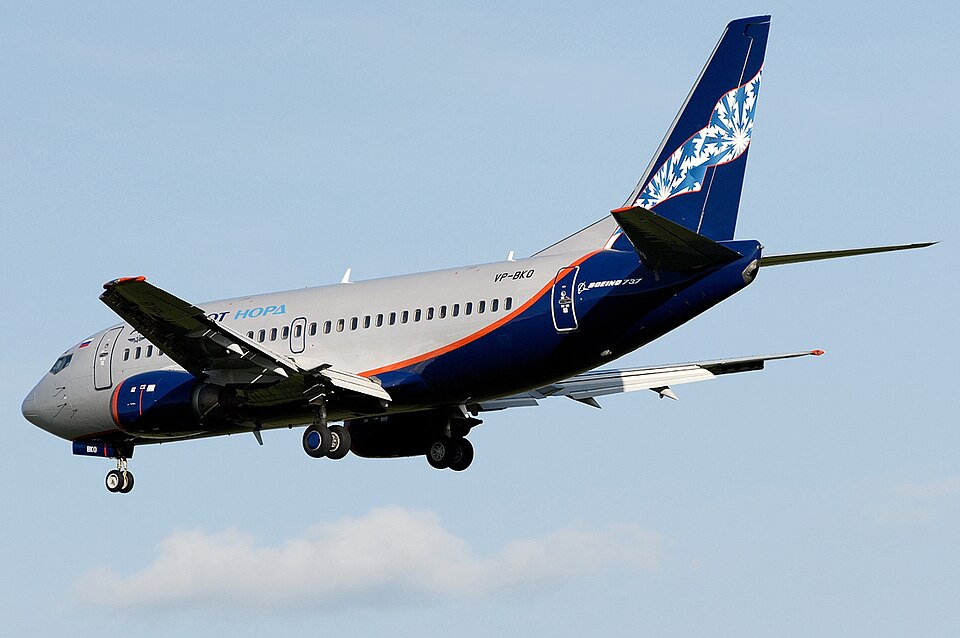
Accident Overview
On September 13, 2008, an Aeroflot–Nord flight crew, consisting of a captain and a copilot, operated scheduled domestic passenger flight AFL821 from Moscow (Sheremetyevo, UUEE) to Perm (Bolshoye Savino, USPP). The aircraft, a Boeing 737-505 registered as VP-BKO, carried 4 flight attendants and 82 passengers, totaling 88 people. The passenger manifest included citizens of Russia, Azerbaijan, Belarus, Germany, Italy, China, Latvia, Turkey, Uzbekistan, Ukraine, and France.
Flight Preparation and Departure
The aircraft payload was 8,079 kg. The takeoff weight was approximately 54,000 kg (maximum 60,554 kg), with a center of gravity (CG) at 20.61% MAC. The calculated landing weight was 49,700 kg (maximum 49,895 kg), with a CG of 21.9% MAC. Both were within Boeing 737-500 FCOM limitations. The pre-flight briefing was conducted on time per standard procedures. All crew members passed a medical check at Aeroflot–Russian Airlines' medical office on September 13, 2008, at 1948 hours and received flight permissions. Based on dispatch information (aircraft condition, aeronautical and weather information, load data, and operational flight plan), the pilot-in-command decided to proceed at 1955 hours. Takeoff occurred at 2113 hours without delay.
Flight and Descent
Climb and level flight at FL290 (9,100 meters) proceeded without deviations. At 2245 hours, the crew began descent from flight level to waypoint Mendeleyevo. After passing Mendeleyevo, the aircraft flew via the outer marker (705 PX) of Runway 21, the initial approach fix for Runway 21 (heading 212° magnetic), following Perm Approach Control instructions. After overflying the runway with heading 110° magnetic, the crew turned right for the back course and began maneuvering for an ILS approach to Runway 21.
Accident Sequence
After the base turn, while approaching the landing course at 600 meters with both autopilot and autothrottle disengaged, the aircraft started climbing to 1,300 meters, rolled 360° over the left wing, and collided with the ground. The aircraft was totally destroyed and partially burned in the ensuing ground fire. All passengers and crew members died due to ground impact. The accident occurred at 2310 hours, 12.4 km from the aerodrome reference point of Perm Airport, azimuth 60° magnetic. The accident site elevation is 153 meters.
Investigation Findings
The official investigation determined the immediate cause as spatial disorientation of the crew, particularly the captain who was the pilot flying at the final stage, leading to a left flip-over, steep descent, and crash. The spatial disorientation occurred during night operations in clouds with both autopilot and autothrottle disengaged. Contributing factors included a lack of proficiency in aircraft handling, crew resource management, and upset recovery skills using "western"-type attitude indications, which differ from those on previously flown aircraft (Tupolev 134, Antonov 2). The systemic cause was insufficient management by the airline of flight and maintenance operations for the Boeing 737 type, including maintenance deficiencies that led to prolonged throttle stagger exceeding AMM limitations, increasing crew workload. Additionally, forensic medical examination confirmed the presence of ethyl alcohol in the captain's body before his death, and his recent work schedule was conducive to fatigue and did not comply with national regulations.