Flight Details
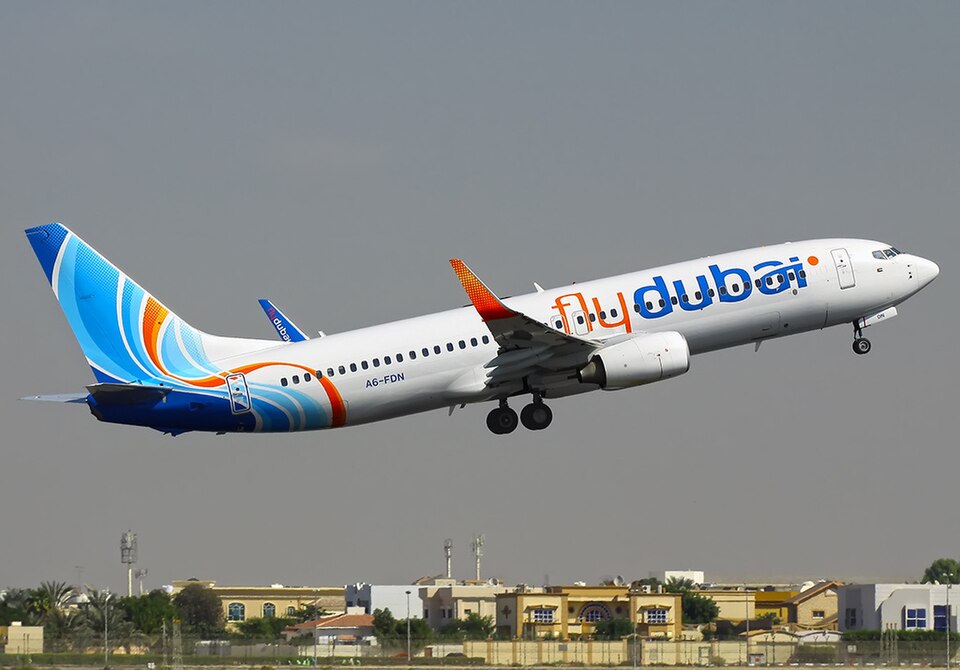
At the overnight into 19 March 2016, a Flydubai Airlines flight crew, consisting of the pilot-in-command (PIC) and first officer (F/O), was performing the round-trip international scheduled passenger flight FDB 981/982 on the route Dubai (OMDB) – Rostov-on-Don (URRR) – Dubai (OMDB) using a Boeing 737-8KN aircraft, registration A6-FDN. The aircraft took off from Dubai Airport at 18:37 on 18 March 2016 under instrument flight rules (IFR). It reached flight level 360 (FL360) at 18:59:30 and maintained that level until descent initiation at 22:17.
Sequence of Events
Before descent, the crew contacted air traffic control (ATC) for Rostov-on-Don Airport actual weather and active runway data. During the glideslope approach for runway 22 (magnetic heading 218°), the crew reported a windshear warning activation. At 22:42:05, from an altitude of 1080 ft (330 m) above runway level, they performed a go-around. The aircraft then held at FL080 and later FL150. At 00:23 on 19 March, the crew requested descent for another ILS approach. The autopilot was disengaged at 2165 ft QNH (575 m QFE), and the autothrottle at 1960 ft QNH (510 m QFE). During this approach, the crew decided to go around again. At 00:40:50, from 830 ft (253 m) above runway level, they initiated the maneuver. After reaching 3350 ft (1020 m) above runway level, the aircraft transitioned to a steep descent and impacted the ground at 00:41:49, approximately 120 m from the runway 22 threshold, with a nose-down pitch of about 50° and indicated airspeed of about 340 kt (630 km/h). The aircraft disintegrated on impact, and all 62 occupants were killed.
Investigation Findings
The official investigation determined the probable cause: the accident occurred during the second go-around due to incorrect aircraft configuration and crew piloting, resulting in loss of the PIC's situational awareness in nighttime instrument meteorological conditions (IMC), loss of control, and impact with the ground. The accident was classified as a Loss of Control In-Flight (LOC-I) occurrence. Contributing factors identified included: the presence of moderate to strong windshear requiring two go-arounds; the PIC's psychological readiness and mindset focused on landing despite the first go-around; loss of PIC's leadership and confusion after initiating the go-around; absence of specific go-around maneuver type instructions in documentation; uncoordinated crew actions during the second go-around, including applying maximum thrust per Windshear Escape Maneuver while retracting landing gear and flaps, causing substantial nose-up moment; the PIC's prolonged failure to create required pitch; insufficient knowledge of stabilizer manual trim operation, leading to 12 seconds of continuous nose-down trim and aircraft upset with negative G; potential somatogravic pitch-up illusion; psychological incapacitation of the PIC leading to spatial disorientation; absence of psychological incapacitation criteria in the airline operations manual; possible operational tiredness due to 6-hour flight with 2 hours intense workload at a circadian low point. The investigation could not determine the impact of the head-up display (HUD) due to lack of objective information but noted its features could have affected the PIC's situational awareness.