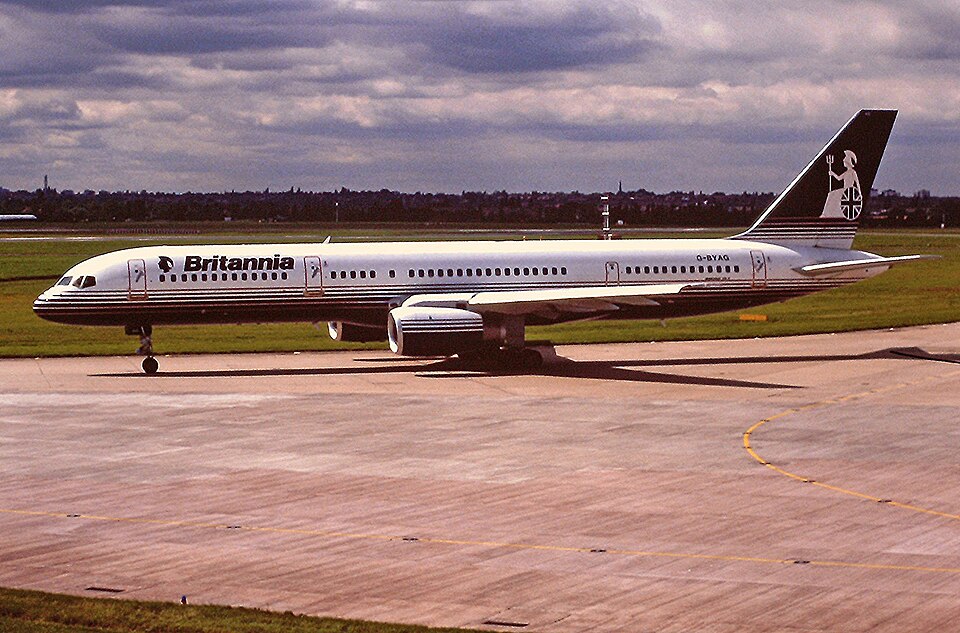
History of the Flight
The aircraft was a Boeing 757-204, registration G-BYAG, powered by two Rolls-Royce RB211-535E4 turbofan engines and manufactured in 1993. It was operating a holiday charter flight from Cardiff Airport, UK, to Girona Airport, Spain, on 14 September 1999. The commander, aged 57, held an Airline Transport Pilot's Licence and had 16,700 hours total flying experience, with 3,562 on type. The first officer, aged 33, held a Commercial Pilot's Licence (Frozen ATPL) and had 1,494 hours total, with 1,145 on type.
The flight was routine until arrival in the Girona Control Zone around 2120 UTC. The crew elected to fly a VOR/DME procedure to Runway 02 due to wind direction and wet runway conditions. Thunderstorm activity was present, and the 2130 UTC METAR included wind 350/6 kt, visibility 4 km, thunderstorm with heavy rain, and cloud layers.
Upon becoming visual, the aircraft was not adequately aligned with the runway, and a change in wind direction favored the reciprocal runway, so a missed approach was carried out. The aircraft was then positioned for an ILS approach to Runway 20. The autopilot and autothrottle were engaged until the decision to land. Twenty seconds before touchdown, ATC reported surface wind 150°/6 kt.
The commander saw the runway lights at about 500 ft agl and decided to land at the decision height of 251 ft (altitude 720 ft). After that, he lost outside visual references. Two automatic audio cautions of excessive sink rate were given by the GPWS just before touchdown. FDR data showed the aircraft contacted the runway very hard in a 2° nose-down attitude at 141 kt, bounced, and touched down again approximately 140 m further on. Both FDR and CVR recordings stopped shortly after the second touchdown. ILS reception continued until the recorders stopped. Interruptions to electrical power supply at the airport and surrounding area were reported around the time of the accident.
Engineering Examination
Examination revealed that the nose landing gear (NLG) collapsed due to failure of its supporting structure. The right engine nacelle and parts of the forward fuselage then contacted the runway. The first structural contact on the runway occurred 557 m from the start of Runway 20 and 2 m right of the centerline, close to the second touchdown position. The runway was 2,400 m long and 45 m wide. From that point, the aircraft tracked along the runway near the centerline for 630 m before veering right and departing the paved surface 1,556 m from the runway start.
After a run of about 343 m across flat grassland, the aircraft ran diagonally over a substantial earth mound, becoming semi-airborne. It struck and severed several medium-sized trees, predominantly with the right wing, and the right engine nacelle hit the boundary fence. The aircraft, yawed considerably to the right, passed through the fence, re-landed in a field, and both main landing gears collapsed.
It came to rest after a 244 m slide across the field, with the fuselage almost structurally severed at two points, NLG and both engines detached, and the underside of the left wing torque box split open near the wing root. The aircraft stopped outside the airport boundary, about 35 ft below the runway's southern end, 171 m right of the centerline, after a total ground run from the first contact of about 1,730 m. The three fuselage parts remained upright, connected by cables and wires, but rolled 8-16° to the left. There was no fire.
Injuries and Evacuation
The aircraft had 235 passenger seats; 233 passengers, 3 infants, and 9 crew were on board. Cabin crew described the first touchdown as heavy, followed by a second, much heavier impact during which some overhead lockers and passenger service units opened. Main interior lights failed at the second impact, but emergency lighting illuminated immediately in all sections.
Floor and seat disruption occurred around the fuselage breaks and in the flight deck; some overhead equipment was displaced. All cabin occupants remained conscious without incapacitating injuries. It was dark and raining heavily outside. Evacuation began using emergency lighting; assistance was needed in disrupted areas. Three of eight exits could not be opened. The aircraft was evacuated rapidly without external help. Rescue and Fire Fighting Services arrived about 20 minutes after the accident and spent another 50 minutes recovering occupants to the terminal. Forty-four persons, including the commander, received hospital treatment.
Further Information
The Spanish Air Accidents Investigation Commission (CIAIAC) is investigating the accident under ICAO Annex 13, with accredited representatives from the UK (State of Registry) and USA (State of Design and Manufacture).