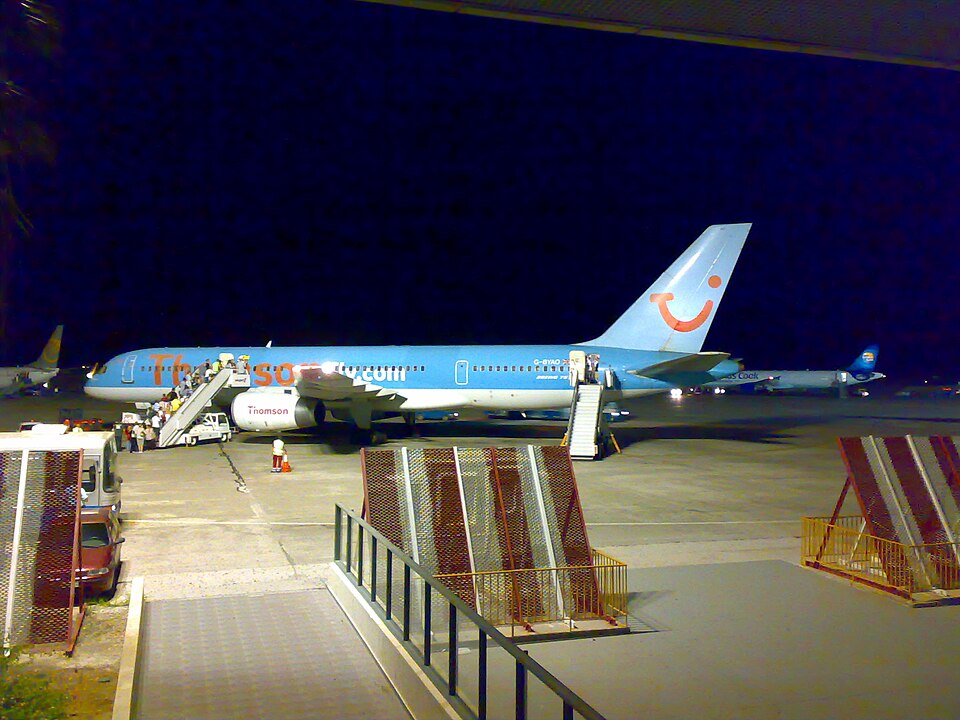
Incident Overview
On 12 May 2005 at 1648 UTC, a Boeing 757-204 (registration G-BYAO) sustained a tailstrike while departing from Runway 06L at Manchester Airport. The aircraft, manufactured in 1994 and powered by two Rolls-Royce RB211-535E4-37 turbofan engines, was operating a scheduled passenger flight to Las Palmas, Gran Canaria. On board were 8 crew members and 234 passengers; no injuries were reported.
Flight History
The co-pilot was the pilot flying. During the takeoff roll, the commander observed the co-pilot applying what he considered excessive into-wind aileron, approximately half of full control wheel deflection to the right, which was later reduced as speed increased. Upon rotation at VR (144 kt), the aircraft initially remained wings level. The commander noted a normal rotation rate until 8° nose-up, after which the rotation rate increased rapidly, and he was unable to arrest the pitch input. The co-pilot felt the aircraft was slightly nose-light and that the rotation rate was too high up to 10° nose-up, continuing to pull the control column at about 2.5° per second.
Personnel in the airport's Visual Control Room and the crew of another aircraft at a nearby holding point observed significant smoke emanating from the aircraft's tail as it lifted off. The commander heard a loud bang, and the co-pilot felt a bump as the aircraft passed through 12° nose-up attitude. The commander informed ATC of a suspected tailstrike and requested radar vectors for a return. The aircraft depressurized as part of tailstrike procedures and flew at 5,000 ft.
Performance and Procedures
The aircraft's takeoff weight was 100,410 kg, with a center of gravity at 22.5% MAC, within limits. The crew computed takeoff speeds with 15° flap: V1=141 kt, VR=144 kt, V2=148 kt, and selected a stabilizer trim of 4.7 units (FDR showed 4.5 units) and Derate One thrust (EPR 1.63). Manufacturer's recommended parameters were VR=143 kt, stabilizer 4.55 units, EPR 1.64. The manufacturer's guidance emphasizes a smooth continuous rotation at VR toward 15° pitch to ensure tail clearance, with rotation rates between 2 and 2.5° per second. The operator's procedures called for rotation at 2.5° per second to 15°.
FDR data showed no stabilizer trim inputs during rotation before gear retraction. The variable headwind component contributed to a liftoff speed lower than intended, compounding the reduced tail clearance.
Aftermath
Runway 06L was inspected multiple times over 24 hours, but no marks or debris were found. The aircraft landed overweight (12 tonnes above maximum landing weight) on Runway 06R, touching down gently and using full runway length with minimal braking. After vacating, the Airport Fire and Rescue Service assessed the brakes, which were deemed safe. Passengers disembarked normally.
Operator Actions
The operator subsequently amended procedures to improve flying continuity and guidance for newly trained co-pilots and incorporated advice from the Boeing 757 Flight Crew Training Manual regarding takeoffs in gusty wind and strong crosswind conditions.
Probable Cause
The investigation determined that the tailstrike resulted from an excessive rate of rotation during takeoff, exacerbated by a variable headwind component that led to a liftoff speed lower than intended, further reducing tail clearance.