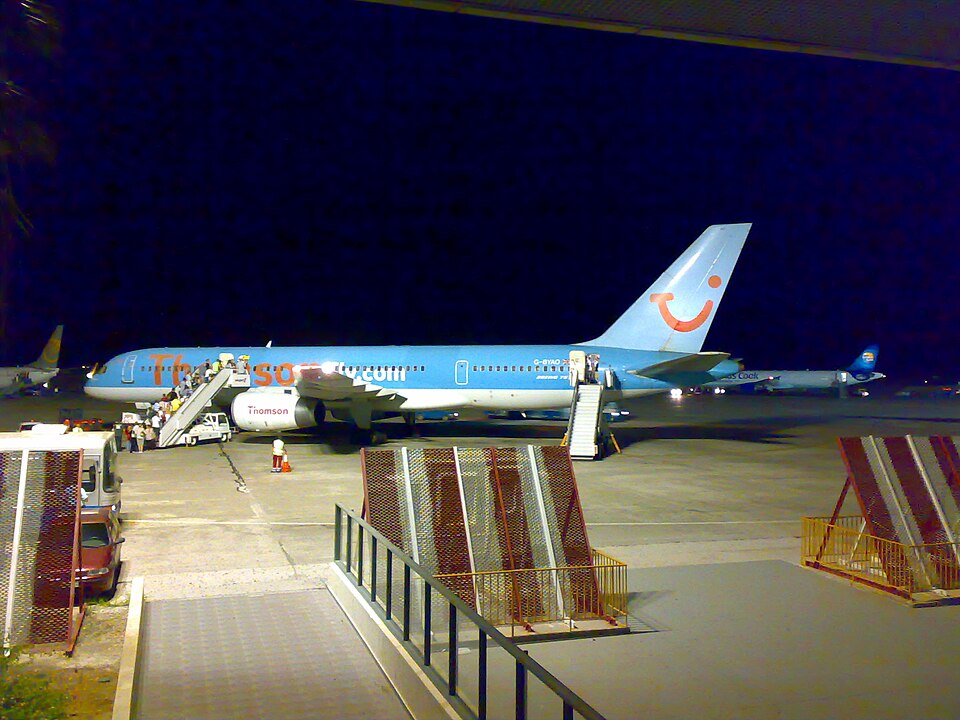
Incident Summary
On 22 October 2006, a Boeing 757-204, registration G-BYAO, was operating a scheduled passenger flight from Newcastle to Larnaca. Approximately five minutes after reaching cruising level FL 370 over the North Sea, the cabin manager reported a blue-grey haze and unusual smell in the passenger cabin. The commander observed a fine haze but no smell. The crew declared a PAN and diverted to London Stansted Airport. During descent, the haze worsened and fumes appeared on the flight deck, prompting a MAYDAY declaration. The aircraft landed without incident and evacuated after stopping on a taxiway. Some passengers received minor abrasions while using escape slides.
History of the Flight
The takeoff and climb were uneventful. At FL 370, the cabin manager contacted the flight crew about a haze and smell. The commander inspected the cabin and saw a fine blue-grey haze. He asked the cabin manager to monitor. Shortly after, the haze worsened. The commander instructed a PAN declaration and descent to Stansted. The pilots performed QRH checklists for smoke or fumes. During descent, fumes were detected on the flight deck, and oxygen masks were donned. A MAYDAY was declared. London Terminal Control provided vectors for Runway 23. The commander briefed the cabin manager and passengers about the diversion. After landing, the commander ordered an evacuation. Both rear doors were opened by a cabin crew member who initially had difficulty but succeeded by applying more force. All escape slides deployed on opened doors. Passengers evacuated via rear doors; no airstairs were available. Fire and Rescue Service marshalled passengers to coaches.
Aircraft Information
The Boeing 757-204 had eight cabin doors with escape slides and door power assist. The aircraft was powered by two Rolls-Royce RB211-535E4-37 turbofan engines. Bleed air from the engines supplied the air conditioning system. The No 1 bearing on the low pressure shaft used a cast iron seal ring to prevent oil leakage.
Examination Findings
Initial examination of the engines and air conditioning system could not reproduce the haze. A planned proving flight was aborted during takeoff roll when smoke entered the flight deck and cabin. Further ground runs at higher power identified the No 2 (right) engine as the source. The engine was removed and strip examined. Oil pooling was found in the fan casing, and oil streaking was observed on compressor blades. The No 1 bearing floating seal ring had fractured in two places, with radial and longitudinal fractures allowing oil to escape into the compressor airflow. This oil entered the bleed air system and the cabin air conditioning.
Safety Recommendations
Two Safety Recommendations were made by the AAIB (not specified in the source beyond mentioning they were made).