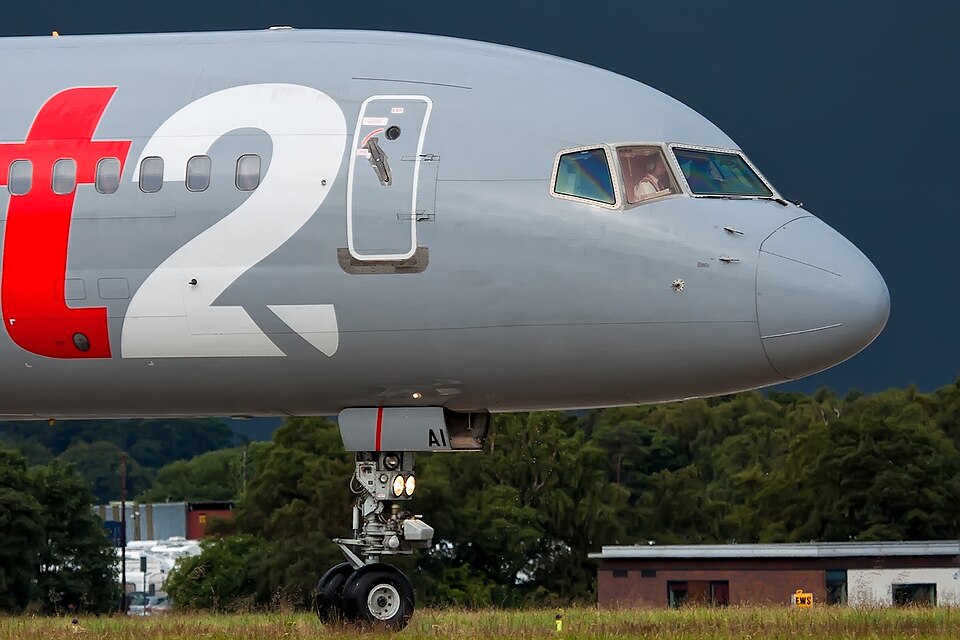
History of the Flight
The aircraft was on a scheduled passenger flight from Leeds-Bradford Airport to Larnaca Airport, Cyprus. While cruising at Flight Level 390 in Bulgarian airspace, approximately 2 hours and 50 minutes into the flight, the crew observed L AC BUS OFF and L GEN OFF warning captions on the lower EICAS display, along with multiple flight instrument failures. The commander executed the Quick Reference Handbook (QRH) drill for the L GEN OFF caption, which included resetting the left bus tie; power was momentarily restored before being lost again. During the second power loss, a thin haze of smoke and a strong smell of electrical burning entered the flight deck. The crew donned oxygen masks and goggles, declared a MAYDAY, and initiated an immediate descent and diversion to Kavala Airport in Greece, approximately 38 nm south. Two minutes after the initial power loss, the auxiliary power unit (APU) was started and powered the left AC electrical bus for 17 seconds before another loss. No further attempts to supply power to the left AC bus were made. The aircraft landed normally at 1156 hrs, and by final approach the fumes had dissipated. Passengers disembarked normally.
Previous Maintenance Actions
Thirteen flights prior to the incident, the aircraft had experienced an L AC BUS OFF event. Inconclusive troubleshooting led to the left integrated drive generator (IDG) being disconnected and the defect deferred in the aircraft's Technical Log. On the return flight to Manchester Airport, approximately 2 hours and 20 minutes into the cruise at FL380, the left AC bus again lost power, accompanied by L AC BUS OFF and L GEN OFF messages, but no smoke or fumes. The crew performed QRH actions, including starting the APU, which successfully powered the left AC bus from the APU bus, allowing the aircraft to continue to Manchester for an uneventful landing. After landing, the crew successfully reconnected the left AC generator to the bus. The Bus Power Control Unit (BPCU) built-in test equipment recorded LH GEN DP TRIP and MAIN BUS/OVERLAP ZONE fault messages on both occasions.
Further maintenance troubleshooting identified an open circuit at pin 12 of the D1014P plug, which mates with the D1114J bulkhead connector at the left pylon bulkhead. The wiring loom between the D1014P plug and the left IDG was replaced, and after a successful operational check, the left AC generator system was declared serviceable.
Post-Incident Maintenance Actions
After the incident flight, visual inspection of the circuit breakers for the left generator and left bus tie revealed no defects, and the smoke source was not determined. Examination of the BPCU's built-in test equipment showed fault messages LH GEN DP TRIP and MAIN BUS/OVERLAP ZONE. The left Generator Control Unit (GCU) and BPCU were replaced. The engines were ground run for 45 minutes, during which both AC power generation systems operated correctly with no electrical burning or smoke. The aircraft was then ferried to Manchester Airport with only the flight crew and two maintenance personnel on board.
Subsequent investigations included wiring continuity checks per the Fault Isolation Manual, replacement of the left GCU, BPCU, and circuit breakers for the left generator and left bus tie, but these did not resolve the defect. On the morning of the incident flight, further troubleshooting revealed an open circuit at pin 12 between the D1014P plug and the D1114J bulkhead connector at the left pylon bulkhead. The wiring loom between D1014P and the left IDG was replaced, and after a successful check, the system was declared serviceable.
Examination of the D1114J Bulkhead Connector
The D1114J bulkhead connector was sent to the AAIB for detailed examination. It was found that pin 12 at the 30-way connector was open circuit, and the central area of the connector's rear face was coated with soot. Disassembly showed that crimp terminals at pins 11 and 12 had parted from their wiring, and the connector's backshell was loose due to stripped threads. Pin 11 connects an earth shield to the left IDG exciter field wiring; pin 12 connects a winding around the 'A' output AC phase to the left generator differential protection current transformer. The crimp terminals were withdrawn and examined using visual and scanning electron microscopy. Both showed that the multi-strand wire had completely parted within the crimped portion, with heavy black corrosion products on the exposed surface. The wire end had a rounded appearance with no evidence of ductile overload. A dark-colored powder removed from inside the connector showed high levels of copper, carbon, silicate, and oxygen, consistent with corrosion of internal components. All crimp terminals were renewed, the bulkhead connector was replaced, and wiring continuity was checked and found satisfactory. No further recurrence of the fault occurred.
Analysis
The cause of the intermittent disconnection of the left IDG from the left AC electrical bus was traced to a corroded crimp terminal at pin 12 of the left pylon's D1114J bulkhead connector. The backshell of the connector was loose due to stripped threads, probably from previous over-tightening, allowing moisture to enter and cause corrosion. The loose backshell also prevented support of the wiring loom, enabling vibration during flight and promoting mechanical damage to wires at their attachment to the crimp terminals. Loss of electrical continuity at pin 12 caused the left IDG's differential protection current transformer to erroneously sense zero current in the 'A' output AC phase, leading the left GCU, via BPCU logic, to disconnect the left IDG from the left AC bus. The intermittent nature of the connection made diagnosis difficult. Additionally, loss of continuity at pin 11 disconnected the earth shield from the left IDG's exciter field wiring, potentially allowing electromagnetic interference to affect exciter field voltage and output AC voltage. The aircraft manufacturer confirmed that reduced AC voltage can cause fuselage-mounted electrical motors and transformers to overheat, producing a hot electrical smell and possibly light smoke, without leaving visible evidence after cooling. This may explain the smoke and fumes during the incident flight, as no visible electrical overheating damage was found on other components.