Summary
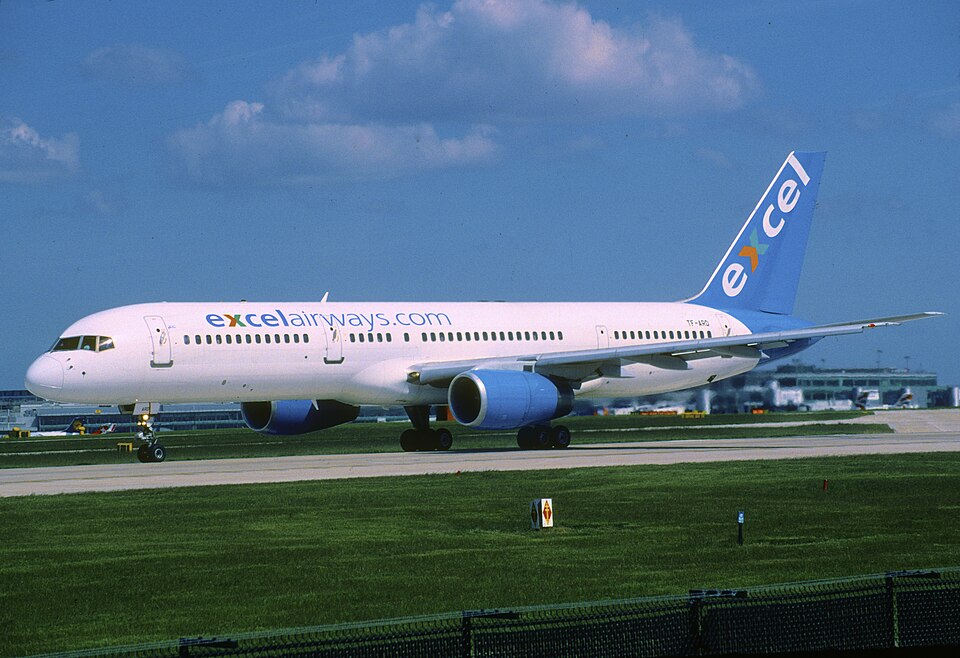
On 20 August 2005, a Boeing 757-225 (registration TF-ARD) operating a public transport flight from Palma, Majorca to London Gatwick encountered a small but intense area of hail associated with a cumulo-nimbus cloud shortly after takeoff. The hail caused damage to the aircraft's radome, both landing light lenses, and the co-pilot's windscreen. No injuries to the 9 crew and 229 passengers were reported. The flight continued to its destination and landed normally.
History of the Flight
The aircraft had arrived from London Gatwick at 1020 hrs under good weather. After turnaround, the co-pilot was to be the pilot flying for the return leg. Weather deteriorated with a thunderstorm and heavy rain over the airport. Departures were delayed, and the standard instrument departure for runway 06R was cancelled; aircraft were cleared to maintain runway heading to assigned altitudes. TF-ARD pushed back at 1150 hrs and after a delayed taxi, received clearance to maintain runway heading to 3,000 ft. The rain had stopped by then.
The aircraft ahead, an A321, had the same clearance. Its commander reported a small weather return at about 5 nm and made a 10° right turn to avoid it. Later, a larger active cell appeared at 15 nm and he turned left 50°; he did not encounter heavy rain, hail, or severe turbulence.
TF-ARD took off on runway 06R. The weather radar was on, set to 20 nm range and 5° up tilt. Only green returns (no active cells) were displayed. At about 3,000 ft, the aircraft encountered heavy hail of very short duration but extremely loud. The autopilot remained engaged; the weather radar failed. The crew continued the climb in IMC without further precipitation. The co-pilot's windscreen was cracked but only the outer layer was damaged. As no other abnormalities were noted, the crew decided to proceed to Gatwick rather than return to Palma and risk more severe weather.
During the flight, cabin crew inspected the engine nacelles and wing leading edges; no damage was apparent. The flight crew heard no unusual noises and fuel consumption was normal. The aircraft landed at Gatwick with the co-pilot as PF, who had adequate visibility. The aircraft taxied to a remote stand for passenger disembarkation.
Weather Conditions
The synoptic situation at 1200 hrs showed an active cold front over Majorca moving slowly southeast. Satellite pictures indicated a line of thick frontal cloud extending northeastwards to the southern coast of France. A cumulo-nimbus cell was situated over the southwest of Majorca near Palma Airport. The Terminal Area Forecast and METARs for the period included thunderstorm and hail forecasts.
Aircraft Damage
Inspection revealed the outer layer of the co-pilot's windscreen was crazed with eight crack initiation points and over 32 impact points. The commander's windscreen was unaffected. Both wing root landing light lenses were shattered. The radome was severely damaged, with large areas missing from its forward region; it remained securely attached. Due to the flight duration, it could not be determined if radome tears were directly from hail or from aerodynamic loads.
Three cabin window outer panes (adjacent to seats 19A, 23F, 24F) had shallow gouges (4-5 cm long, 2 mm deep) likely caused by pieces of shattered landing light lenses. Several small impact points were found on the fuselage, wings, and stabilizers, all within maintenance limits. The weather radar was found serviceable. The damaged components were replaced, and the aircraft returned to service.
Flight Recorder Data
The 25-hour FDR showed no abnormal accelerations during the departure. The CVR recording of the incident was overwritten after landing. The FDR sample rate for normal acceleration was half that required by JAR Ops, a matter under investigation by the Icelandic AAIB.
Analysis
Given the weather conditions, the crew used the weather radar per SOPs. The FDR data did not clearly identify where the hail encounter occurred, but the A321 commander and B757 crew both recalled an altitude of about 3,000 ft. It is likely that the small weather return observed by the A321 commander was the area of hail hit by the B757. The B757 probably did not fly through the larger active cell that the A321 turned to avoid. The hail may have fallen from the anvil of a cumulo-nimbus cloud separated from the main cell. Despite the damage severity, the aircraft remained safe and able to return to Gatwick.