History of the Flight
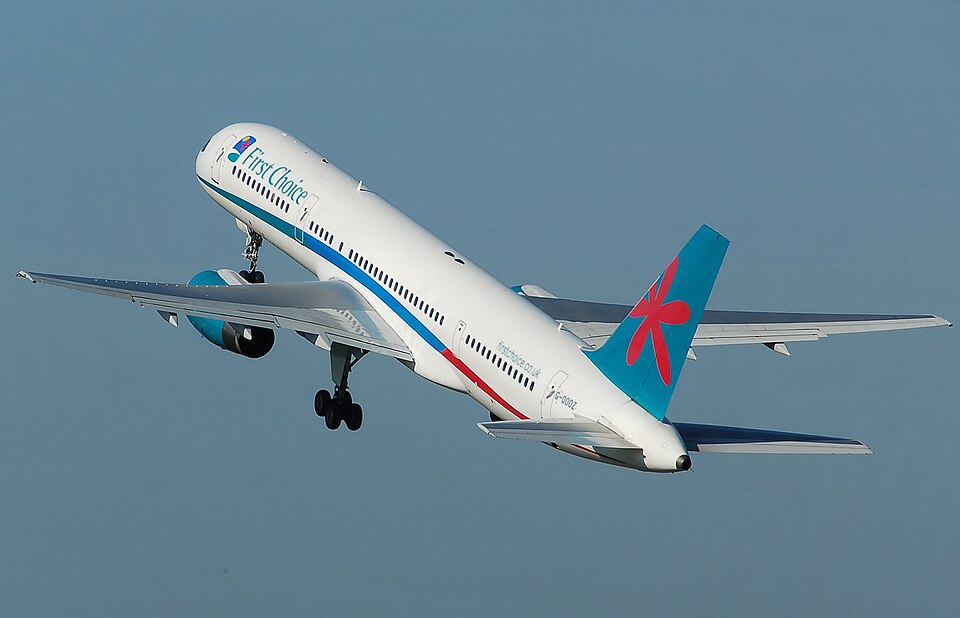
On 22 June 2009, a Boeing 757-236, registration G-OOOZ, was en route from Boa Vista, Cape Verde, to Manchester, UK, with 8 crew and 230 passengers. Approximately two hours into the flight, while passing reporting point BIMBO, about 202 nm north of Lanzarote, the crew conducted a routine fuel check. The fuel total was 300 kg below the planned quantity expected at that stage. The co-pilot re-checked the calculations and noted that the centre tank contents had reduced to zero an hour earlier than anticipated. The right fuel tank quantity began decreasing at a rate of about 300 kg per minute.
The crew consulted the Quick Reference Handbook and performed a visual inspection of the engine from the cabin, which did not reveal anything unusual. The right engine fuel flow was normal, but the tank contents continued to drop. A FUEL CONFIG message appeared on the Engine Indicating and Crew Alerting System (EICAS), indicating a fuel imbalance. A second visual check confirmed fuel leaking from the underside of the right engine nacelle.
The crew declared a MAYDAY and requested diversion to Porto Santo (PXO). They shut down the right engine as the aircraft descended through FL280. The cabin crew and passengers were informed, and emergency services were requested. A VOR approach to Runway 36 in good weather was completed, and the aircraft stopped on the runway without further incident. No fire or abnormalities were noted by the airport fire and rescue service, and the aircraft taxied to its stand. A fuel imbalance of 3,300 kg was recorded at shutdown.
Investigation
The investigation was initiated by the Gabinete de Prevenção e Investigação de Acidentes com Aeronaves (GPIAA) in Portugal. Since the United Kingdom was the State of the Operator and State of Design of the engine, the investigation was delegated to and conducted by the AAIB. Post-flight examination revealed a rupture of a low-pressure (LP) fuel pipe between the fuel cooled oil cooler (FCOC) and the high-pressure (HP) engine-driven fuel pump.
Engineering Description
The fuel pipe is located on the right side of the engine. It comprises an assembly of three rigid stainless steel tubes connected by two flexible segments. The flexible segments have an inner core of polytetrafluoroethylene (PTFE) within a double-layer braided stainless steel sheath, enclosed in an outer silicone rubber sleeve for fire protection. The braiding consists of two strands; the outer braid has nine wires per strand, and the inner braid has eight wires per strand. The rupture occurred close to the HP fuel pump inlet.
Microscopic inspection of the rupture site revealed localized but extensive inter-braid fretting in both inner and outer braids. The stainless steel braid wires were worn and notched due to relative movement between overlaying strands. This damage had completely severed some wire strands, leaving the inner core unsupported and allowing the PTFE tube to rupture and burst through the compromised braid region. Damage was also apparent on the outer surface of the PTFE core tube, causing significant weakening. Wear was evident throughout the lower flexible hose but not on the upper section.
Manufacturer's Testing
The engine manufacturer conducted a series of engine runs on a test bed to investigate vibration and fuel pump pressure ripple effects on the fuel lines. Tests were performed with both types of HP fuel pump (gear-type with different numbers of teeth) to determine vibration and pressure peaks, and to identify engine running conditions producing these peaks. One pump tested was the one removed from G-OOOZ.
Results showed that the HP fuel pump created a 'pump ripple' in the operational speed range (85% to 95% N3), which decayed with axial distance from the pump inlet. The ripple was present with either pump, but the two pumps created different fundamental frequencies based on gear teeth count. The pump from G-OOOZ produced the highest pressure ripple levels, indicating accelerated wear. Pressure peak harmonics coincided with peak acceleration data recorded in the fuel tube assembly, confirming that maximum fuel tube vibrations occurred due to pressure ripple effects.
Safety Action
The engine manufacturer identified 11 previous events since June 1999, five of which led to in-flight engine shutdowns. The failed tube from G-OOOZ had completed 5,986 hours and 1,657 cycles, significantly below the recommended life of 15,000 hours or 4,750 cycles. It was an original part and had not been reworked. A hardware redesign has been initiated, with design definition planned before the end of May 2011.