Incident
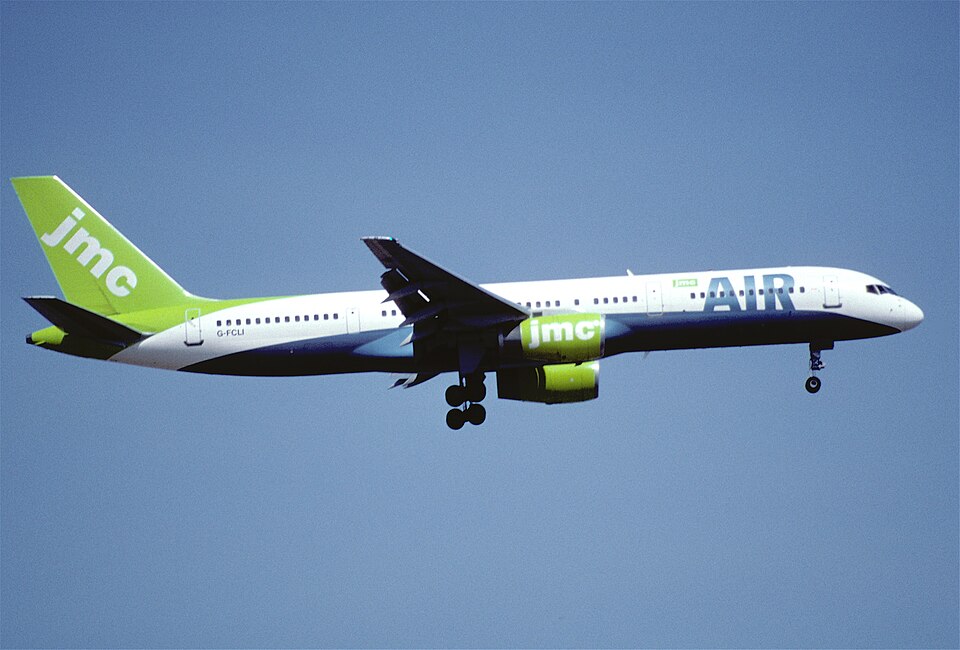
On 4 December 1999 at 2102 UTC, a Boeing 757-28A (registration G-FCLI) departed Runway 24R at Manchester Airport for a flight to Las Palmas, Canary Islands. During landing gear retraction, the Engine Indication and Crew Alerting System (EICAS) displayed 'Gear Disagree' and 'Gear Doors' caution messages, accompanied by an abnormal ambient airflow noise. The flight crew kept the aircraft's speed below 270 knots in accordance with the Quick Reference Handbook. After consulting with company operations and engineering, the crew recycled the landing gear while climbing through FL90 at 250 knots, but the caution messages remained. The commander elected to divert to London Gatwick Airport, where engineering inspection facilities were available. The aircraft made an uneventful overweight landing at Gatwick, approximately 4 tonnes above the normal maximum landing weight. Normal landing gear down and locked indications were obtained during the approach.
Examination
Post-incident examination revealed damage to the composite panelling forming the outboard boundary of the starboard main landing gear bay. The starboard landing-gear truck was fully retracted into the main leg, with the fescalised portion of the inner cylinder not visible. Pressurising the leg had no effect on extension. Jacking the aircraft failed to extend the inner cylinder. A phase 1 high-weight/hard landing structural inspection found no damage. The complete leg was removed and sent to an overhaul agency. Borescope inspection of the inner cylinder showed extensive deformation of the cross-section and major cracking near its upper end. Separating the inner and outer cylinders by jacking resulted in complete failure of the inner cylinder in the region of the cracking. The upper end remained lodged in the outer cylinder and was extracted by drilling, tapping, and pulling. Metallurgical examination found no pre-existing defects in the fracture faces. All seals were intact. Evidence showed forcible contact between the face surrounding the metering pin and the orifice plate.
A similar failure occurred on another Boeing 757-28A within days. That aircraft had a left main landing gear leg collapsed, with similar cracking and deformation. The flight crew reported a slight nosewheel bounce during taxiing and a gear door light remaining on after takeoff. The aircraft touched down right-gear-first, and examination revealed the left gear inner cylinder was fully compressed, causing damage to the wing/body fairing.
Discussion
The manufacturer stated that calculations demonstrated the inner cylinder could not be collapsed by excessive hydraulic or gas pressure during high alighting rates unless accompanied by severe damage to other components. The specialist noted only one previous similar failure, on a Boeing 737, whose cause was not established. The possibility of 'dieseling' (rapid combustion of hydraulic fluid vapour) was considered but thought unlikely since compressed air sources are not common near maintenance areas. Operating patterns of the two aircraft showed no common maintenance location. The available stroke from normal to fully compressed was short, and with the leg fully compressed, the aircraft did not lean noticeably. It is most likely that the damage resulted from compressive crippling when the metering pin surround forcibly contacted the orifice plate. This could occur if the leg lacked sufficient fluid, causing the fluid level to drop below the orifice plate, reducing damping and allowing full compression during a firm landing.