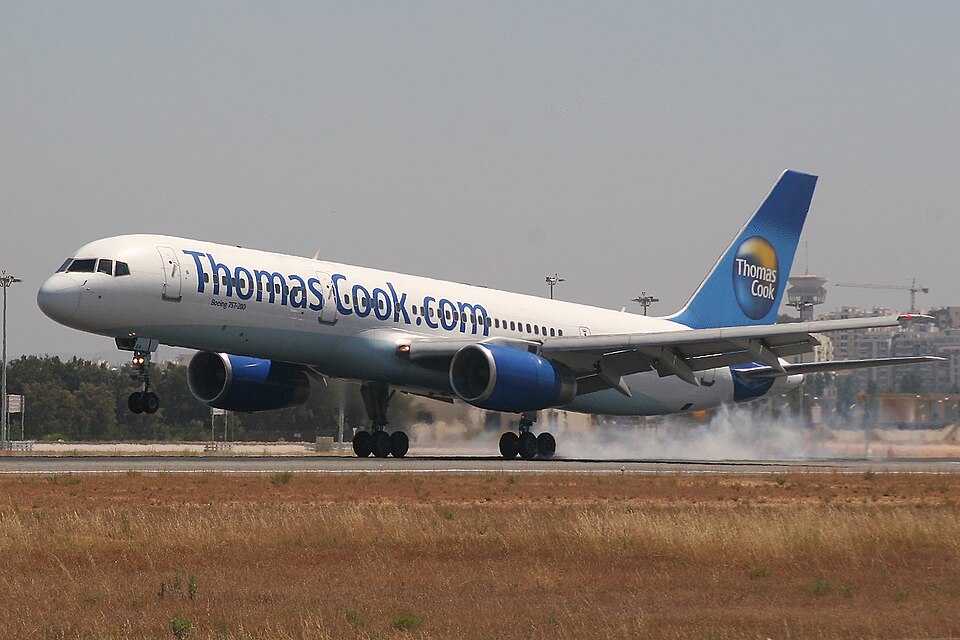
Summary of the Flight
On 12 June 2010 at 0045 UTC, a Boeing 757-28A, registration G-TCBA, was on a commercial passenger flight from Milas-Bodrum Airport, Turkey, to London Gatwick Airport, UK. The aircraft was cruising at Flight Level 360 with 8 crew and 226 passengers on board. Approximately 2 hours and 20 minutes into the flight, shortly after entering French airspace, a FUEL CONFIG warning appeared on the EICAS display. The commander consulted the Quick Reference Handbook and detected a lateral fuel imbalance of 800 kg, right wing heavy. During the corrective drill, a discrepancy of 800 kg was noted between fuel consumed and fuel remaining, indicating a probable fuel leak. Fuel flow indications remained equal for both engines.
The commander contacted Maintrol via high-frequency link. The duty engineer suggested possible water contamination in the fuel. Fuel balancing continued, but the discrepancy increased to 1,200 kg, confirming a fuel leak. The commander considered diverting to Paris Charles de Gaulle Airport, about 40 nm away, but Runway 09 in use would have added track miles. Since the aircraft was nearing top of descent for Gatwick, where Runway 26L was active, the commander elected to continue and made a PAN call to London ATC. The aircraft was cleared for an immediate approach to Runway 26L with no speed or altitude constraints and landed normally.
Approaching the end of the landing roll, the commander shut down the left engine as a fire precaution and parked on Runway 08L to allow Airfield Fire and Rescue Services (AFRS) inspection. The airfield was closed. The AFRS fire chief advised passenger evacuation using only the right-hand slides due to fuel on the runway, taxiway, left engine, and brakes. The commander shut down the right engine, and AFRS hosed away the fuel. Total useable fuel on board at shutdown was approximately 3,800 kg, about 478 kg less than the flight planned arrival fuel of 4,278 kg. The commander estimated that 1,300 kg of fuel had leaked from the left engine.
Investigation and Findings
The aircraft was towed to a remote stand for normal passenger disembarkation. An operator's maintenance engineer opened the left engine cowl, causing a further fuel spill; the engine and cowling were saturated with fuel. The engineer traced the leak to the seal ring between the HP fuel pump and the fuel flow governor (FFG) to HP fuel pump overspill return tube on the left engine. Both engines' seal rings were replaced per the aircraft maintenance manual, and a duplicate inspection was conducted. Ground runs at maximum static EPR showed no leaks, and the aircraft was released to service.
A review of maintenance records found no scheduled or unscheduled maintenance on the fuel supply tube since the left engine was installed after overhaul eight months prior, in August 2009. The engine had accumulated 2,839 flight hours and 812 cycles since installation. The removed seal ring was discarded, contrary to the operator's engineering organisation's procedures requiring retention of parts involved in occurrences. This prevented further investigation of the seal ring's condition.
Background and Similar Incidents
The CAA's MOR database was searched for similar fuel leaks on RB211-535E4 series engines. After the introduction of Service Bulletin (SB) RB.211-73-B047 in April 1996, which revised fuel tube end adapters to a rigid two-bolt flanged joint and seal ring, only one fuel leak at this location was recorded in the MOR database. However, the engine manufacturer supplied information on 23 other events since January 2008 across the worldwide RB211-535E4 fleet, including one precautionary diversion; all others were detected during ground checks.
Investigation by the engine manufacturer determined that the width of the seal ring groove in the fuel tube end adapter was insufficient (2.60 mm) to allow proper seating when the joint was compressed during torque tightening. This could cause the seal ring to become pinched at the groove corners, leading to erosion from vibration and fuel pressure fluctuations, resulting in loss of sealing.
In November 2009, the engine manufacturer introduced SB RB.211-73-G230, increasing the groove width to 4.15 mm. No engines with this SB have experienced fuel leaks at these couplings. The modification is currently recommended for embodiment when engines are disassembled for refurbishment or overhaul, and is optional on-wing when parts require renewal or connections are disturbed during maintenance.
Safety Actions
The engine manufacturer plans a revision to SB RB.211-73-G230 to recommend on-wing replacement during planned maintenance and during unplanned overhaul shop visits, based on human factors analysis indicating acceptable reliability when tubes are replaced during planned on-wing maintenance. Full implementation into the fleet is expected by the end of 2013, with progress monitored.