Summary
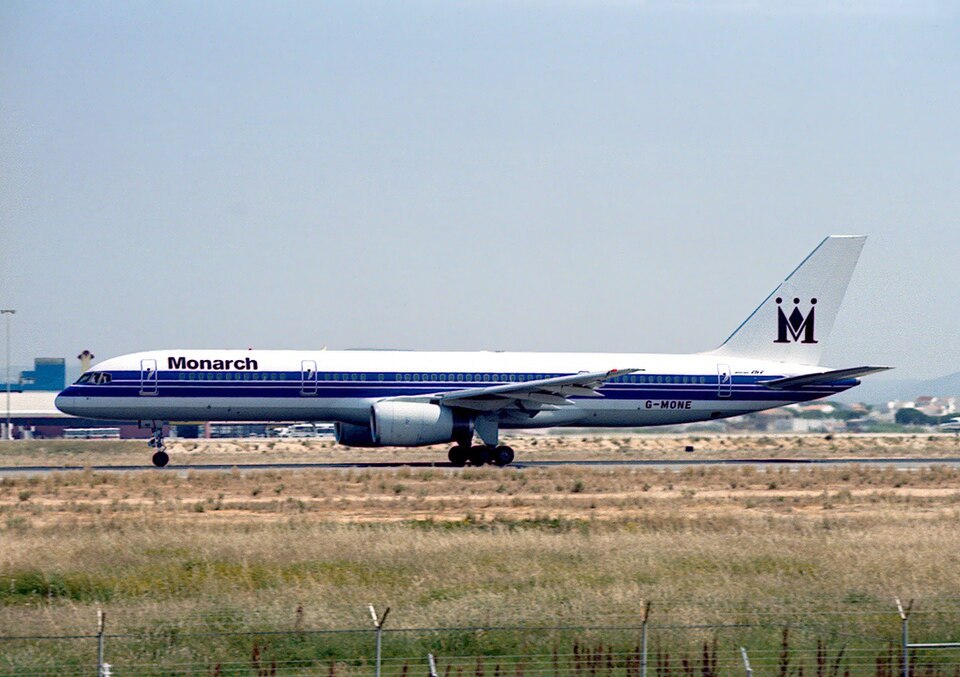
On 22 January 2000 at 1200 UTC, a Boeing 757-2T7, registration G-MONE, operated as a public transport flight, encountered a nose landing gear retract actuator failure during approach to London Gatwick Airport. The crew performed a go-around and subsequent precautionary landing with emergency services in attendance. There were no injuries among the 10 crew and 74 passengers. The aircraft sustained damage to the nose landing gear retract actuator, lock actuator, and associated components.
Event Description
During takeoff from Salzburg (SZG), a loud bang was heard from below the front of the aircraft. The crew presumed a birdstrike as no other indications were present. On approach to Gatwick, selecting landing gear down produced a very loud bang and the aircraft shook. The nose landing gear indicated amber (unlocked). The crew conducted a go-around. Tower observers noted the gear appeared down, while a taxiing aircraft crew reported it appeared down but not locked. A PAN call was transmitted and the QRH drill performed. After a NITS briefing, the passengers were informed. A precautionary landing was carried out with emergency services. The nose landing gear remained down and locked. The aircraft taxied clear and, after ground-locks were inserted, taxied to the stand without further incident.
Examination Findings
Inspection revealed the nose landing gear retract actuator eye-end had failed at the junction of the eye and its threaded section. The nose landing gear lock actuator also failed, and various mechanical components were bent. Metallurgical examination showed the lock actuator failed due to ductile overload, while the retract actuator eye-end suffered a fatigue failure. The fatigue crack exhibited numerous closely spaced striations. The machined face of the shoulder beneath the locking collar had deep marks from a saw or file, which had almost entirely obliterated the original surface. The fatigue crack originated from these pre-existing damage marks and had extended approximately one-third across the cylindrical section. The mating face of the collar showed mirror-image tool marks.
Component History
The aircraft operator reported no record of the actuator being removed since a Service Bulletin (SB) was carried out in 1988 on three Boeing 757 aircraft, including G-MONE. The SB required removal and dismantling at the company's hydraulic bay. Examination of two other affected actuators revealed similar mechanical damage to the shoulder on one, and on both, the eye-ends were not torque tightened to the correct value. The two personnel involved in 1988 left the company in 1989, and the supervisor left in 1990; they are not thought to be still employed in aviation.
Discussion
The fatigue cracking originated from stress raisers created by the mechanical damage. The damage was present at the last reassembly, as the locking collar was new and showed matching tool marks. The damage was likely inflicted during disassembly using a saw or file, probably to free the previously installed lock collar. The collar area is normally coated in sealant, which may have obscured the locking method. The lock actuator failed by ductile overload, likely occurring after takeoff from SZG. The retract actuator failure probably occurred during retraction. During extension, the failed retract actuator allowed the leg to descend unrestrained after up-lock release, causing rapid extension and tensile overload of the lock actuator ram. Despite the lock actuator failure, the two locksprings maintained the down-lock.
Conclusions
The incident was caused by failure of the eye-end of the nose landing gear retract actuator. This failure resulted from a long-term fatigue crack that propagated from an area of mechanical damage inflicted by a saw or file. The damage occurred when the actuator was last dismantled, 11 years before the incident, due to inappropriate workshop practice during dismantling. The actuator was reassembled with the damage still present. The operator's quality system in place at that time failed to detect the use of unsatisfactory workshop procedures.