History of the Flight
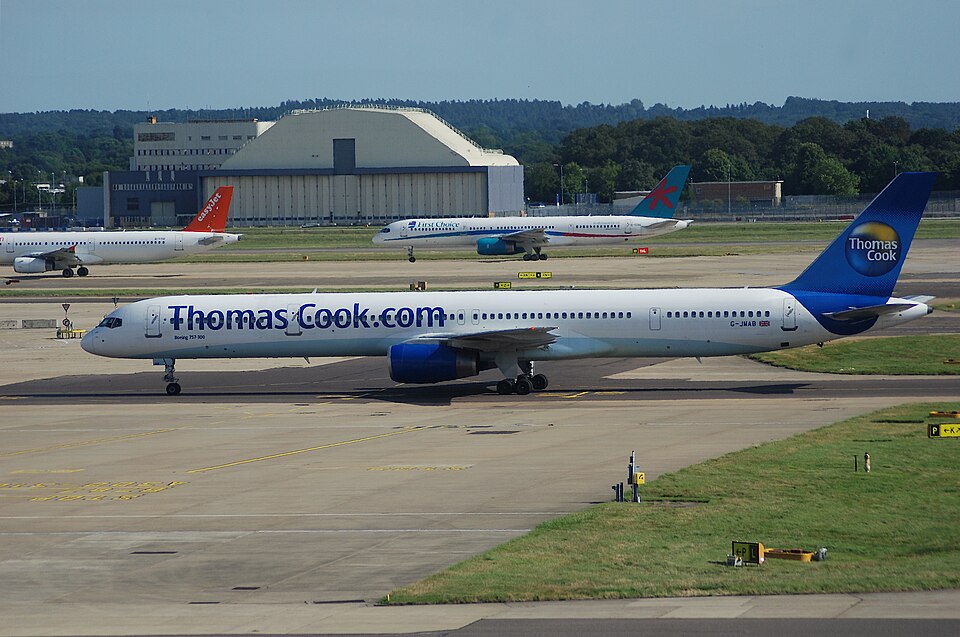
The aircraft, a Boeing 757-3CQ registered G-JMAB, landed at Manchester International Airport at 1935 UTC on 12 December 2007 after an uneventful flight. It was instructed to park on Stand 32. Due to commitments elsewhere, a dispatcher allocated to attend the arriving aircraft was unable to reach the stand before the aircraft. Stand guidance was activated remotely by Apron Control. The commander maneuvered the aircraft from the taxiway centerline to the stand centerline using the azimuth guidance system and commenced gentle braking. Deceleration was more pronounced than expected, and the aircraft stopped approximately 3 feet short of the indicated position. The pilots shut down the engines, and the passengers and crew disembarked without further incident. The left engine intake cowling had impacted the outer airbridge. The Aerodrome Fire and Rescue Service was not called.
Damage to Aircraft
Maintenance personnel assessed the damage to the front upper intake lip of the intake cowl of the left engine as beyond allowable limits and replaced the cowling in accordance with the Aircraft Maintenance Manual. The engine strut, fairings, structure, mounts, and fittings were inspected but found undamaged. After replacement, the aircraft was declared serviceable and returned to normal operations.
Stand Entry Docking Guidance
Stand 32 was equipped with an Aircraft Guidance for Nose-In Stands (AGNIS) system for centerline guidance and a Parallax Aircraft Parking Aid (PAPA) for stopping guidance. Recorded flight data showed that the aircraft approached the stand at a ground speed of 12 knots, decelerating to 3.75 knots immediately before impact. Photographs showed the aircraft stopped approximately 3 feet short of the position indicated by the PAPA.
Airbridge Management
When parked correctly, the airbridge wheels should remain within a circle painted on the apron, providing adequate clearance. G-JMAB was the first aircraft allocated this stand after the airbridge had been subject to maintenance work on the two previous days. It was handed over to the airport operator at 1440 hrs on the day of the occurrence. In the absence of relevant procedures, the airport operator did not check physically that the airbridge was serviceable or correctly parked. The Apron Controller was unable to visually check the stand prior to use. Photographic evidence indicated the airbridge was parked incorrectly during the aircraft's arrival. The airport operator's investigation noted that the handling agent did not check the position of the outer airbridge, though local procedures required it. The operator was also concerned that the AFRS had not been called.
Previous Occurrence
A similar occurrence was reported in the AAIB's March 2003 Bulletin involving an aircraft arriving on Stand 6 at Manchester Airport. After a technical problem, the airbridge could not be parked correctly. From the remote location of Apron Control, the stand allocator was unaware of the obstruction, allocated the stand, and activated the Stand Entry Docking Guidance (SEDG) lighting. The marshaller arrived when the aircraft was already maneuvering. Neither the commander nor the marshaller noticed the incorrectly parked airbridge until the aircraft's left engine cowling struck it. Two Safety Recommendations were made to Manchester Airport addressing control of SEDG systems. The airport accepted them, with budgetary provision made for works. However, the current investigation found that this safety action appears to have been ineffective. Therefore, one further Safety Recommendation was made to address the same issue.
Analysis
The investigation found that no procedure existed for inspecting the proper arrangement of the stand and its equipment prior to its return to service after maintenance. Consequently, an opportunity was lost to check that the airbridge was parked correctly. Illumination of stand guidance is understood by pilots to indicate the stand is ready, but in this case, the guidance was activated by Apron Control from a location where the stand could not be seen.