History of the Incident
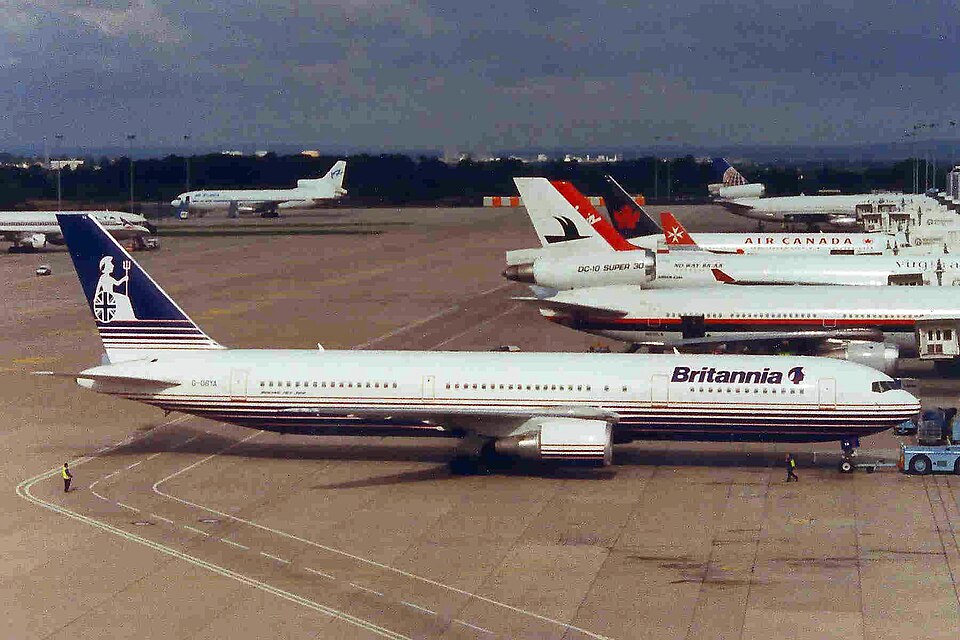
The crew of a Boeing 767-304, registration G-OBYA, reported for duty at Manchester to operate a flight to Abu Dhabi via London Gatwick on 10 October 2000. The aircraft carried 10,000 kg of fuel and 2,230 kg of freight. The first officer acted as pilot flying. The departure, cruise, and descent were normal. The crew reviewed relevant NOTAMs and ATIS information for Gatwick.
During the approach for an ILS to Runway 26L, the commander noticed floodlights associated with work in progress (WIP) near the threshold of Runway 08L. This WIP was not mentioned in the Gatwick NOTAM or ATIS. The commander decided to exit via the second rapid exit turnoff (RET) 'F' to avoid potential disruption.
The aircraft touched down on the runway centerline at a speed of 129 kt, with autobrake level 3 selected. During rollout, the commander determined that autobrake level 3 would not provide sufficient deceleration to use RET 'F' and increased it to level 4. The aircraft slightly overshot the centerline of RET 'F' while decelerating through 40 kt.
At 35 kt, the commander initiated a right turn using nose wheel steering. He could see the RET centerline lights but not the painted markings due to glare from the construction lights reflecting on the damp runway and waterlogged grass. He was unaware of a new RET under construction at a 20° angle just beyond RET 'F', which was not mentioned in NOTAMs.
During the turn, the aircraft suddenly stopped. The commander observed lighter-colored surface to his left and realized some landing gear wheels were off the paved surface. He applied brakes, cancelled reverse thrust, stowed speedbrakes, and raised flaps. The left engine was shut down and the APU started. The right engine remained running briefly while contacting handlers for recovery. Passengers disembarked via mobile steps at door Right 1 into waiting coaches. The aircraft was recovered and towed to the terminal about 4 hours later. The runway reopened at 2242 hrs.
The aircraft came to rest with the left main landing gear in soft grass approximately 10 metres from the edge of RET 'F', while the nose wheel and right main gear remained on hard surface.
Flight Recorder Data
The aircraft's solid-state flight recorders captured data from the landing. The aircraft was configured with Flap 30, gear down, speedbrakes armed, and autobrake level 3. It crossed the threshold at 50 ft radio altitude and touched down 11 seconds later at 129 kt, about 100 metres beyond the touchdown zone. Ground spoilers deployed automatically.
At 123 kt, idle reverse thrust was selected. As the nose gear contacted, reverse thrust increased to 70% N1 on both engines. At 90 kt, autobrake level 4 was selected, increasing deceleration from -0.2G to -0.26G. As speed reduced through 61 kt, a right turn began with heading increasing. Maximum right rudder deflection of 18° was recorded at 30 kt. The system stopped recording airspeed below 30 kt.
Perturbations in roll attitude and normal acceleration indicated the main landing gear left the paved surface when the aircraft heading was 45° right of runway with 63% N1 reverse thrust applied and autobrake level 2 selected. Within four seconds the aircraft stopped. The final position was heading 311°M with roll attitude 2.4° left wing low.
Meteorological Conditions
At 1829 hrs, surface wind was 120°/04 kt (variable 090°-160°), light rain, scattered cloud at 2,600 ft, broken cloud at 3,500 ft, temperature 9°C, dewpoint 6°C, QNH 979 mb.
Post-Incident Actions
The airport operator discussed the issues with the CAA Safety Regulation Group and met with Gatwick-based airlines to address edge lighting for the new RET and existing RETs. Temporary blue 'Metalight' lighting was placed across the entrance to the new RET and either side of RET 'F' where it joined the runway shoulder. Temporary paint markings were applied to indicate the new RET was not in use. Revisions were made to the Gatwick NOTAM covering construction.
The operator conducted an internal investigation, identifying minor CRM issues and several airfield issues: the WIP was not in NOTAM, lack of edge lights on RET, black bitumen spray on grass between RET and runway that resembled tarmac, and the new RET not mentioned in NOTAM or on airfield chart. Recommendations included publishing the report for pilots, guidance on RET speeds and centerline use, and re-examination of black bitumen application, taxiway edge markings, and WIP lighting control.
Conclusion
The commander, seeing the aircraft slightly beyond the RET centerline, believed the surface ahead could bear the aircraft's weight. However, in the prevailing conditions, no surface markings, lights, or edge markers delineated the load-bearing surface. He was aware of WIP only on final approach and assumed exit via RET 'F' would be expeditious. The lighting from the WIP reflected on water, hindering differentiation between load-bearing and non-load-bearing surfaces. Additionally, the grass area between the RET and runway had been sprayed with black bitumen, disguising its true nature.